

Could a lower cap rate actually be the hallmark of a superior investment in the most coveted corners of Northern Michigan? Many investors enter the 2026 market with a singular focus on high yields, yet they often feel a sense of hesitation when faced with the premium entry prices of waterfront estates in Charlevoix or luxury condominiums in Grand Traverse. It's natural to worry about how current mortgage rates, averaging 6.47% for a 30-year fixed, might impact your bottom line or whether a modest return is enough when managing the nuances of a short-term rental. You want the security of a proven asset without sacrificing the lifestyle that drew you to the region in the first place.
This guide will clarify what a good cap rate is for a rental property within our unique regional landscape, helping you balance immediate cash flow with the enduring prestige of property appreciation. We will explore specific benchmarks for Emmet County and its neighbors, the rise of sanctuary travel, and why your personal lifestyle goals are the final, essential piece of the ROI puzzle. Discover how to move forward with the quiet confidence that defines the most successful portfolios in the North.
In this guide to navigating the 2026 investment landscape, you will find a sophisticated analysis of the Northern Michigan rental market, specifically tailored for those seeking both financial growth and a connection to the region's natural beauty. We cover:
- The essential definition of capitalization rate is a tool for evaluating the inherent value of properties in Grand Traverse and Emmett counties, separate from the complexities of financing.
- A detailed breakdown of what is a good cap rate for a rental property in the current market, contrasting the standard 5% to 10% range with the lower-yield, high-appreciation nature of elite luxury estates.
- An exploration of the unique income profiles found in Charlevoix, comparing the prestige of Lake Michigan waterfront homes with the consistent demand for inland lake retreats.
- The critical operational factors, from professional short-term rental management to specialized maintenance, ensure your investment remains a seamless addition to your lifestyle.
- A strategic framework for identifying high-yield opportunities by aligning traditional data-driven analysis with a search by lifestyle approach.
Understanding the Foundation: What is Cap Rate in Real Estate?
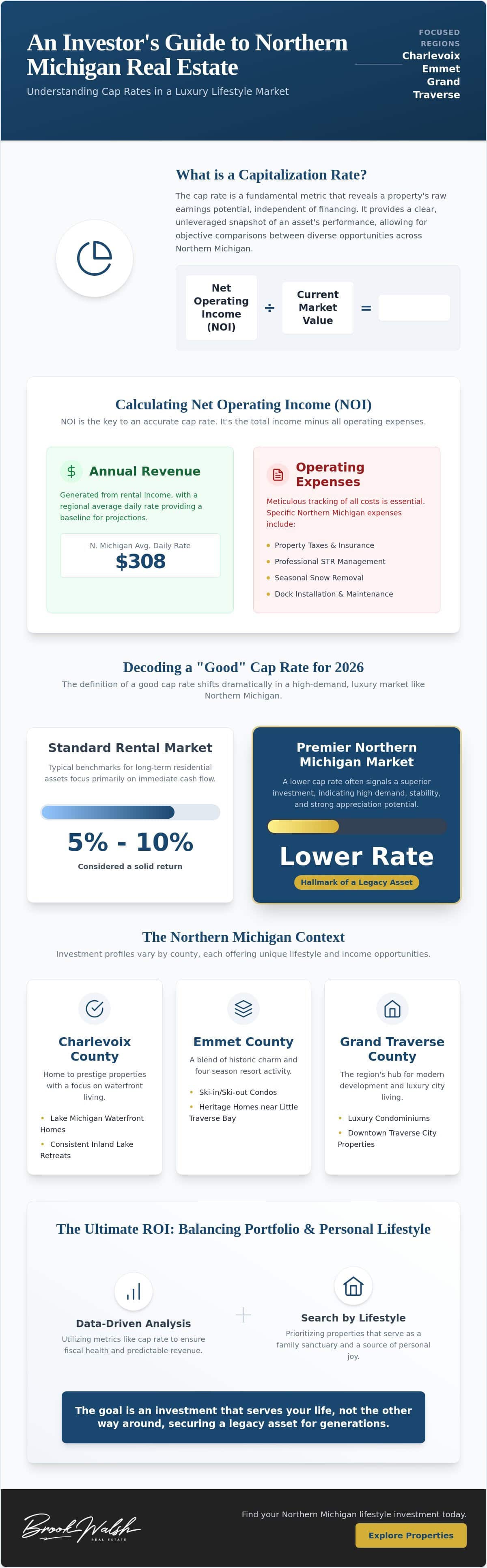
In the pursuit of a refined real estate portfolio, clarity is the ultimate luxury. Understanding what a good cap rate for a rental property begins with stripping away the noise of debt and personal finance to reveal the raw earnings power of a property. The Capitalization rate, or cap rate, serves as a fundamental metric that acts as a snapshot in time, providing a clear window into how a waterfront estate in Charlevoix or a ski-in/ski-out condo in Petoskey performs as a pure asset. This metric is especially vital in the luxury sector, where accurate expense reporting ensures that the prestige of an address is matched by its fiscal health. By focusing on the property’s performance rather than the owner’s specific financing, you can objectively compare a heritage home near Little Traverse Bay with a modern development in downtown Traverse City. This metric serves as the baseline for why discerning investors use this specific ratio to compare disparate opportunities across Northern Michigan.
To better understand this concept and how it applies to your investment strategy, watch this helpful video:
The Mathematical Formula for Success
The core of this calculation is simple yet profound: take the Net Operating Income (NOI) and divide it by the current market value. For a Northern Michigan rental, your NOI includes the annual revenue generated from an average daily rate, which sits near $308 for the region, minus all operating expenses. These expenses must be meticulously tracked, including property taxes, specialized insurance, and essential services like professional short-term rental management. In our specific climate, you must also account for seasonal maintenance such as snow removal and dock installation. In its purest form, the cap rate represents the unleveraged return on investment for a property. It is the most reliable way to evaluate the intrinsic value of a property's income stream before the influence of debt is introduced.
Why Cap Rate Matters for Lifestyle Investments
Determining what a good cap rate for a rental property is requires looking beyond the digits to the geography of the investment. While a 5% to 8% return is often a standard benchmark for long-term assets, high-demand resort markets in Emmet and Grand Traverse counties often command lower cap rates. This lower yield is not a failure of the asset; instead, it's a reflection of the property's extreme stability and historical appreciation potential. Unlike cash-on-cash return, which fluctuates based on your specific loan terms and the current 6.47% interest rate environment, the cap rate allows you to compare disparate opportunities on a level playing field. It helps you decide if a boutique downtown property or a sprawling lakefront retreat offers the right balance of risk and reward for your specific investing in Northern Michigan real estate strategy.
By utilizing a search by lifestyle approach, you can prioritize properties that offer both a sanctuary for your family and a disciplined financial return. In these coveted geographies, the "perfect" number is often the one that secures a legacy asset while maintaining consistent, predictable revenue. This balance ensures that your investment serves your life, rather than the other way around.
Decoding the "Good" Cap Rate: Benchmarks for 2026
Defining what is a good cap rate for a rental property in the current market requires a nuanced understanding of the local geography. While general industry benchmarks for June 2026 suggest a range of 5% to 8% for long-term residential assets, the luxury landscape of Northern Michigan operates on a different set of principles. In premier locations like Bay Harbor or the pristine shores of Lake Charlevoix, investors often encounter cap rates in the 4% to 6% range. This compressed yield isn't a sign of a weak investment. Instead, it signals a high-demand, low-risk environment where property values remain historically resilient. Discerning buyers recognize that in Emmet and Grand Traverse counties, a lower cap rate often correlates with superior long-term appreciation and the intangible value of owning a legacy asset.
Comparing Returns Across Asset Classes
Short-term rentals in high-traffic resort areas often target a higher yield, typically between 6% and 10%, to compensate for the operational complexity of guest turnover and seasonal shifts. However, luxury waterfront estates in our region frequently defy these broader averages. These properties serve as emotional havens where the scarcity of land and the purity of the landscape drive a premium price point that naturally lowers the immediate cap rate. When you're evaluating a ski-in/ski-out condominium or a golf course community home, you're investing in a specific regional lifestyle that transcends simple spreadsheets. Exploring our curated selection of luxury lifestyle homes for sale offers a firsthand look at how these benchmarks translate into tangible, high-value real estate.
The Impact of Macroeconomic Trends in 2026
The economic climate of mid-2026 presents a unique challenge for those balancing cash flow and appreciation. With the 30-year fixed-rate mortgage averaging 6.47%, the spread between rental yields and borrowing costs has narrowed significantly. This shift means that what is a good cap rate for a rental property today must be viewed in relation to risk-free rates, such as Treasury bonds. Factors That Influence Cap Rate include these broader fiscal trends, but also the local stability of the Grand Traverse market. As interest rates stabilize in the mid-6% range, investors are prioritizing quality over sheer volume. A balanced portfolio in Northern Michigan might include a high-yield downtown property alongside a low-cap, high-appreciation waterfront estate to ensure both immediate income and future wealth. Adjusting your expectations to account for this 2026 reality is the first step toward a successful acquisition in our most coveted geographies.
The Northern Michigan Context: Waterfront vs. Resort Properties
The allure of Northern Michigan lies in its diversity, yet this variety demands a sophisticated approach to valuation. In the refined markets of Charlevoix and Emmet counties, the typical math behind what is a good cap rate for a rental property often takes a backseat to the enduring value of a specific geography. While national averages might suggest a higher immediate yield, the scarcity of land along the shores of Lake Michigan creates a different paradigm. Discerning investors recognize that understanding capitalization rates in a luxury context requires factoring in the lifestyle yield. This is the intrinsic value of personal use and the security of a legacy asset. When you are investing in Northern Michigan real estate, you are often choosing between the prestige of the big water and the consistent performance of inland retreats.
Yield Expectations for Waterfront Luxury
Waterfront homes in areas like Bay Harbor and Petoskey are viewed as essential emotional havens that offer unparalleled stability. These properties command a premium average daily rate, with Lake Charlevoix waterfront homes achieving approximately $432 per night. Inland lake properties, such as those on Walloon Lake, offer a distinct income profile compared to Lake Michigan estates, often providing higher occupancy rates due to warmer waters and more accessible recreation. While the purchase price for these estates is significant, the steady growth in equity often outweighs a lower immediate cap rate. Ownership here does come with specific considerations. Shoreline preservation costs and seasonal dockage fees must be factored into your net operating income to maintain accuracy. Despite these unique expenses, the sheer demand for a private piece of the coastline ensures that these assets remain the crown jewels of any regional portfolio.
Short-Term Rental Dynamics in Resort Communities
Property performance near Boyne Mountain or Nubs Nob operates on a different rhythm. It's driven by the dual-season allure of world-class skiing and championship golf. These resort communities often provide a more balanced entry point for those seeking a mix of personal escape and reliable revenue. In Harbor Springs, well-managed homes generate an average of $53,076 in annual revenue. They benefit from a steady stream of sanctuary travelers who prefer private residences over hotels. Resort amenities such as clubhouse access, private trails, and professional concierge services directly enhance the desirability and cap rate of a condominium by justifying higher nightly rates. This synergy between luxury lifestyle and data-driven results makes resort properties a cornerstone of the Grand Traverse and Emmet county markets. Ultimately, determining what is a good cap rate for a rental property in these resort hubs depends on how you value the balance between active income and the ease of a well-managed, high-amenity environment.
Beyond the Number: Factors That Influence Your Investment Return
While the initial calculation provides a vital benchmark, the true performance of a luxury asset is found in the meticulous details of its operation. A property that appears to answer the question of what is a good cap rate for a rental property with a high percentage may falter if its carrying costs are not expertly managed. In the premier markets of Grand Traverse and Emmett counties, the net operating income is a living figure that fluctuates with the seasons. Professional vacation rental management is not merely a service; it's a strategic investment in maintaining high occupancy and protecting the property’s prestige. By entrusting your home to experts who understand the nuances of the local market, you ensure that every guest experience enhances the property's reputation and your bottom line. Beyond management, Michigan’s tax environment offers unique advantages, though investors must stay informed on legislative shifts such as the proposed 6% excise tax on short-term rentals currently under review in House Bill 6026.
The True Cost of Ownership
Owning a high-end residence in Northern Michigan involves specialized expenses that can quickly erode a seemingly attractive cap rate. Property taxes in coveted areas like Charlevoix and Petoskey reflect the premium nature of the land, while insurance for waterfront estates requires a sophisticated understanding of regional risks. Maintenance for luxury homes demands a dedicated reserve fund to preserve bespoke finishes and architectural integrity. You must also account for seasonal utility variations; heating a sprawling estate during a Northern Michigan winter requires a different budgetary approach than maintaining a summer cottage. These costs are the price of entry for a sanctuary that offers both personal escape and financial potential.
Appreciation: The Silent Partner in ROI
In the most exclusive geographies, the cap rate only tells half the story. Discerning investors often prioritize properties in Harbor Springs or Bay Harbor where a modest 4% cap rate is eclipsed by consistent, high-single-digit annual appreciation. A property with a lower immediate yield in a high-appreciation zone often outperforms a 10% cap rate property in a stagnant market over a five-year horizon. This growth is driven by the scarcity of elite waterfront and the growing "sanctuary travel" trend, where travelers seek the safety and purity of private, high-end homes. The emotional and aesthetic value of owning in a premier geography provides a level of security that generic data cannot capture. If you're ready to refine your portfolio with an asset that balances immediate performance with long-term prestige, our team provides a detailed investment property analysis to ensure your acquisition aligns with your highest aspirations.
Strategic Acquisition: Finding High-Yield Opportunities
Identifying an undervalued gem in Grand Traverse or Emmet County requires looking past the surface. While a generic analysis might overlook a property with unoptimized rental schedules, a local expert sees the potential for a significant NOI lift through professional staging and strategic marketing. This is where your understanding of what a good cap rate is for a rental property becomes a competitive advantage. You aren't just looking for a static number; you're looking for the story behind the asset and its capacity for growth in a stabilizing 2026 market. Accurate projections must account for the region's unique seasonality, ensuring that your investment remains robust even as broader economic trends shift.
Our search by lifestyle philosophy is built on the belief that the most resilient investments are those that cater to specific, high-demand experiences. Whether it's the thrill of a ski-in/ski-out retreat or the quietude of a lakeside sanctuary, aligning your acquisition with the way people want to live in Northern Michigan ensures long-term desirability. This approach filters properties not just by square footage, but by their ability to provide the sanctuary travel experience that modern high-net-worth travelers demand. By focusing on these lifestyle anchors, you secure an asset that transcends the volatility of traditional markets.
Leveraging Local Expertise for Better Returns
Local knowledge is your strongest shield against regulatory surprises. With Michigan’s House Bill 6026 proposing a statewide registry and a 6% excise tax, knowing which specific communities in Charlevoix or Emmet are most supportive of short-term rentals is essential. We often secure off-market opportunities for our clients, providing access to exclusive estates before they reach the public eye. I invite you to a personal consultation where we can review data-driven ROI projections and discuss how to navigate the current 6.47% interest rate environment with precision. These insights allow you to move with the quiet confidence of a seasoned regional expert.
Your Next Steps in Northern Michigan Investment
Success in this market begins with a disciplined due diligence phase. Your checklist should include a thorough review of historical ADR data, verification of local permit availability, and a detailed assessment of seasonal maintenance requirements unique to our climate. Integrating professional management from day one ensures your transition into ownership is as smooth as the waters of Little Traverse Bay. To begin your journey toward a refined portfolio, explore our collection of luxury lifestyle homes for sale. This is more than a transaction; it's an invitation to a life of curated elegance and enduring value in the heart of the North.
- Verification of township-specific rental ordinances
- Analysis of historical occupancy rates during shoulder seasons
- Assessment of capital improvement needs for premium positioning
- Review of utility performance and winterization requirements
Elevating Your Investment Strategy in the North
Success in the 2026 real estate market requires a shift from viewing properties as mere spreadsheets to understanding them as essential emotional havens. Determining what is a good cap rate for a rental property is only the beginning of a larger conversation about value and legacy. In the coveted geographies of Charlevoix and Emmet counties, the most rewarding acquisitions are those that balance immediate income with the profound stability of long-term appreciation. By prioritizing the sanctuary travel experience and professional operational standards, you ensure your asset remains a beacon of quality in an evolving landscape. It's this intersection of data and lifestyle that defines a truly successful portfolio.
I invite you to start your journey toward a rewarding Northern Michigan investment with Brook Walsh. Our team provides expert investment property analysis and specializes in the most exclusive luxury waterfront and resort communities. From the initial acquisition to comprehensive vacation rental management services, we are dedicated to ensuring your investment reflects the curated elegance of the regional lifestyle. The shores of Grand Traverse and the slopes of Harbor Springs are waiting for those with the vision to act today. You deserve a guide who appreciates the finer details of life as much as you do.
Frequently Asked Questions
Is a 5% cap rate good for a vacation rental in Petoskey?
Yes, in the luxury segment of Petoskey, a 5% cap rate is considered a strong and stable return. High-end properties in Emmet County often trade at lower cap rates because of their immense appreciation potential and scarcity. While 6% to 10% is a national target for many short-term rentals, the local demand for sanctuary travel makes 5% a respectable baseline for premium assets.
How do I calculate the cap rate for a ski-in/ski-out condo?
You calculate the cap rate by dividing the Net Operating Income (NOI) by the property’s current market value. For a condo near Boyne Mountain, ensure your NOI accounts for specific resort expenses such as association fees and seasonal maintenance. This unleveraged figure provides a clear snapshot of the property's efficiency as an income-producing asset before you consider the impact of financing.
Does the cap rate include mortgage interest payments?
No, the cap rate calculation specifically ignores mortgage interest and financing costs. It's designed to measure the property's performance as if it were purchased entirely with cash. This allows you to compare various opportunities in Grand Traverse or Charlevoix on a level playing field, regardless of the 6.47% average interest rate environment found in mid-2026.
What is the difference between the cap rate and cash-on-cash return?
Cap rate measures the property’s intrinsic return without debt, while cash-on-cash return measures the actual return on the cash you personally invested. If you utilize financing, your cash-on-cash return will vary based on your specific loan terms and down payment. Understanding what is a good cap rate for a rental property is helps you identify the asset's raw potential, while cash-on-cash reflects your individual financial strategy.
How do short-term rental regulations in Michigan affect cap rates?
Regulations like House Bill 6026 can lower cap rates by increasing operating expenses through new taxes and registration fees. If the proposed 6% excise tax is implemented, your Net Operating Income will decrease unless you can adjust nightly rates to compensate. Staying informed on local ordinances in Charlevoix and Emmet counties is vital to maintaining an accurate and profitable financial projection.
Why are cap rates lower for waterfront properties than for inland homes?
Waterfront properties command lower cap rates because they are lower-risk assets with significantly higher appreciation potential. The extreme scarcity of Lake Michigan shoreline in Grand Traverse County drives purchase prices up, which naturally compresses the immediate yield. Investors accept a lower cap rate in exchange for the security and prestige of owning a legacy waterfront estate that holds its value.
Can I improve the cap rate of my existing rental property?
You can improve your cap rate by either increasing your gross rental income or reducing your operating expenses. Implementing professional short-term rental management can often boost your average daily rate through better marketing and dynamic pricing. Simultaneously, refining your maintenance contracts and improving energy efficiency in your Northern Michigan home will protect your NOI and enhance your overall yield.
Should I prioritize cap rate or property appreciation when buying in Charlevoix?
Your priority should align with your specific lifestyle and financial goals. In high-prestige markets like Charlevoix, the long-term equity gain from appreciation often far outweighs the immediate annual yield. While knowing what is a good cap rate for a rental property provides a necessary safety net, the true wealth in Northern Michigan real estate is often found in the enduring value of the location itself.
Enjoy this blog post? Click here to subscribe for updates
Leave A Comment