

The most beautiful Northern Michigan setting isn’t automatically the strongest rental-market fit. The top rental markets for lifestyle investors are places where a property’s appeal, intended use, and ownership responsibilities align with an investor’s goals. A waterfront retreat, ski-in/ski-out condominium, or golf-course home may offer a compelling way to experience the region, but scenery alone can’t establish whether a property suits your investment plan.
If you’re comparing communities across Charlevoix, Emmet, and Grand Traverse counties, start by separating what you know about a property from what you still need to establish. A city and a nearby township can have different rental requirements. Seasonality, maintenance, management, and ownership costs also affect a home’s practical fit. This guide offers a consistent way to compare locations and property types, identify the details to investigate, and connect a lifestyle-focused search with investment analysis and vacation-rental management.

Key Takeaways
- Compare Charlevoix, Boyne City, Boyne Falls, and Lake Charlevoix with options in Emmet and Grand Traverse counties using the same criteria.
- Use the top rental markets for lifestyle investors as a shortlist, then weigh each location against your preferred property type and ownership goals.
- Evaluate waterfront, ski, golf, resort, and downtown properties according to personal-use priorities, operating needs, and property-specific evidence.
- Keep verified information separate from estimates when reviewing rental potential, operating costs, taxes, insurance, and maintenance.
- Connect market research with a focused property search and a plan for vacation-home ownership and rental management.
Table of Contents
- How to compare top rental markets for lifestyle investors in Northern Michigan
- Northern Michigan rental-market candidates across three counties
- Compare waterfront, ski, golf, resort, and downtown rental-property profiles
- How to evaluate a Northern Michigan rental property before investing
- Turn a lifestyle-market shortlist into a considered investment plan
How to compare top rental markets for lifestyle investors in Northern Michigan
A shoreline view, nearby ski access, or a walkable downtown can make a property feel like an ideal Northern Michigan escape. Lifestyle appeal is a useful way to narrow your search, but it isn’t evidence of rental performance. Treat the top rental markets for lifestyle investors as candidates for property-level research, not as a verified ranking of income or returns.
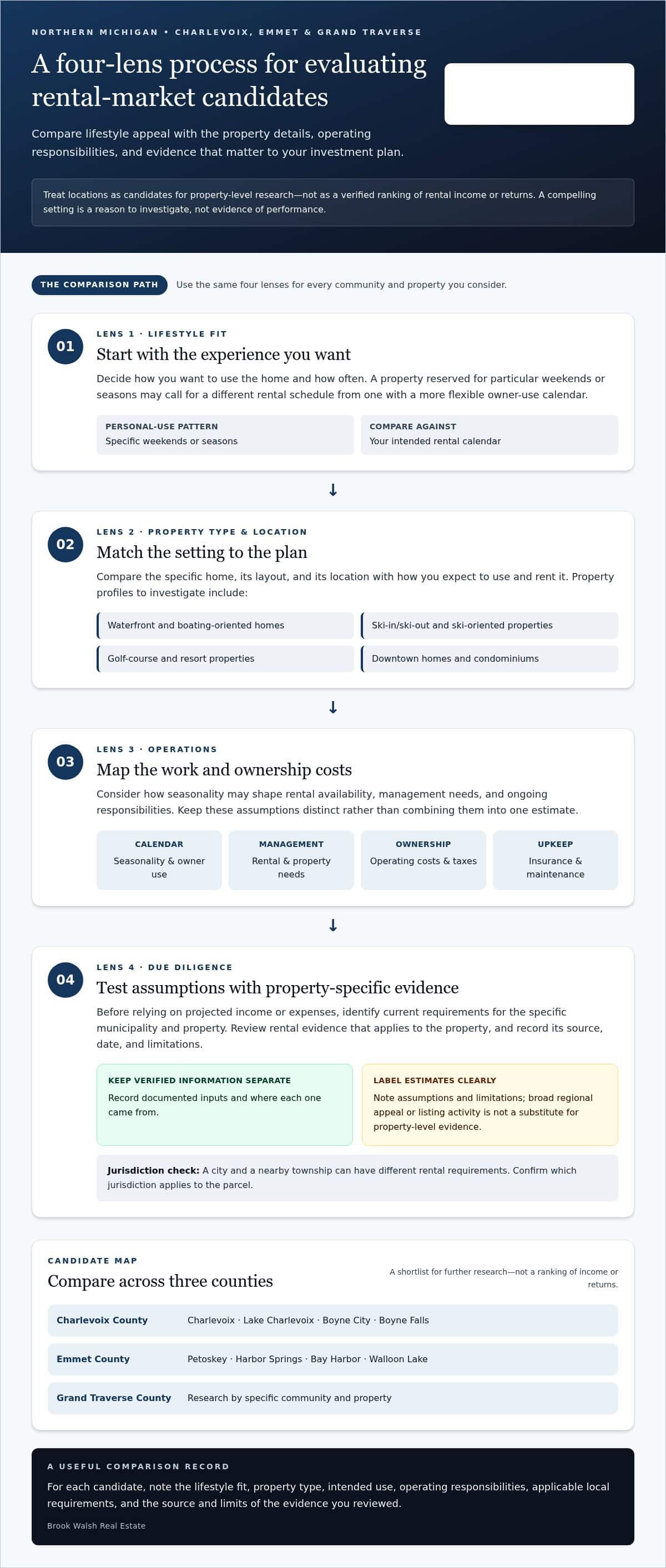
This comparison focuses on Charlevoix, Emmet, and Grand Traverse counties, where buyers can explore waterfront settings, resort communities, and downtown neighborhoods. The Northern Michigan region provides a broad geographic frame, but investment decisions depend on the specific community and property. Compare each candidate through four lenses: lifestyle fit, property type, operations, and due diligence.
What makes a market a lifestyle-investment candidate?
Begin with the experience you want from the property. Waterfront homes may suit buyers drawn to time on the water; ski-in/ski-out condominiums, golf-course homes, resort properties, and downtown residences offer different settings and uses. Then consider how often you expect to use the home yourself. A property reserved for particular weekends or seasons may call for a different rental schedule from one with a more flexible owner-use calendar.
These preferences can help narrow your search, but they don’t establish demand or financial performance. A compelling setting is a reason to investigate a property, not a substitute for evidence about that property. Brook Walsh’s lifestyle property search categories can help organize options by setting and property type before you compare individual opportunities.
Which comparison criteria matter before choosing a location?
Use the same checklist for every candidate. Record how well the property fits your lifestyle priorities, how its location supports your intended use, which seasons matter to you, and what ongoing ownership and management responsibilities it may involve. Consider whether the home’s layout and location work for your rental plan rather than assuming that an appealing community makes every property a good fit.
Next, review current rental evidence that is relevant to the property and note its source, date, and limitations. Listing activity or broad regional appeal can’t replace property-level assumptions. Before relying on projected income or expenses, identify the current requirements that apply to the specific municipality and property. Keep operating, tax, insurance, and maintenance assumptions distinct, since rules and costs can vary by location and home.
A consistent shortlist makes the next step more productive: compare communities and property profiles, then test promising options against documented inputs. Investment analysis helps connect the lifestyle you want with the practical details of ownership.
Northern Michigan rental-market candidates across three counties
Use this shortlist to decide where to investigate, not to declare a winner. Charlevoix, Emmet, and Grand Traverse counties offer varied settings, but a community’s appeal can’t establish a property’s rental performance. For each location, match the lifestyle it supports with the property type you’re considering, then identify the local and property-specific information you need to assess.
Michigan’s outdoor destinations help explain why recreation can be part of a lifestyle search. The Michigan Department of Natural Resources’ guide to natural attractions is a starting point for exploring the region, not evidence of rental demand at a particular address. Use each row below as a prompt for further property-level research.
| County | Community or area | Lifestyle lens | Diligence questions |
|---|---|---|---|
| Charlevoix | Charlevoix | Waterfront and boating-oriented homes | What current demand evidence applies to this property and its seasons? |
| Charlevoix | Lake Charlevoix | Waterfront access and boating lifestyle | Which jurisdiction applies to the parcel, and what operating assumptions fit? |
| Charlevoix | Boyne City | Downtown, waterfront, resort, or golf preferences | Which property type fits the location, and what evidence supports the rental plan? |
| Charlevoix | Boyne Falls | Ski, resort, and golf-oriented ownership | How could seasonal use shape the rental calendar and management plan? |
| Emmet | Petoskey | Downtown, waterfront, and condominium options | What requirements and property-specific demand evidence apply? |
| Emmet | Harbor Springs | Waterfront, resort, and golf settings | Do current rental assumptions reflect the property’s location and seasonal use? |
| Emmet | Bay Harbor | Resort, waterfront, and golf properties | What property and community terms shape use and operations? |
| Emmet | Walloon Lake | Lake-oriented vacation-home settings | Which local rules, rental evidence, and ownership costs apply? |
| Grand Traverse | Research by specific community | Waterfront, downtown, resort, ski, or golf interests | What current local evidence supports adding a location to your shortlist? |
Charlevoix County: waterfront, resort, and ski-oriented possibilities
In Charlevoix and around Lake Charlevoix, start with the waterfront experience you want and the property’s precise location. Boyne City and Boyne Falls call for a different comparison, including downtown access and resort, golf, or ski preferences. These are distinct research paths, not claims about rental performance. For each property, assess current demand evidence, seasonal assumptions, applicable requirements, and operating needs.
Emmet and Grand Traverse counties: compare lifestyle fit locally
Petoskey, Harbor Springs, Bay Harbor, and Walloon Lake each merit a separate look at setting, property type, personal-use priorities, and management needs. East Jordan is another community to include in a Northern Michigan search, with the same property-specific questions applied. In Grand Traverse County, use consistent criteria and let current community-level evidence determine which locations advance. A Northern Michigan lifestyle-based property search can help shape a shortlist around waterfront, ski, golf, resort, downtown, or condominium preferences before you evaluate individual opportunities.
Compare waterfront, ski, golf, resort, and downtown rental-property profiles
A property’s setting shapes the experience it offers and the questions an owner needs to answer. A Lake Michigan home, ski-oriented condominium, and downtown residence may each appeal to lifestyle buyers, but their rental plans, personal-use priorities, and operating responsibilities can differ.
Lifestyle fit is a screening tool, not a rental forecast. For investors considering the top rental markets for lifestyle investors, the useful comparison is how location, property type, intended use, and operations work together, not simply which setting feels most compelling.
| Profile | Lifestyle appeal | Owner-use priority | Management considerations |
|---|---|---|---|
| Waterfront | Lake Michigan, Lake Charlevoix, or another water-oriented setting | Water access, views, and time by the shore | Investigate upkeep, insurance, access, and applicable rental requirements |
| Ski | Proximity to a ski-oriented experience | Convenient winter recreation and personal stays | Review seasonal use, property readiness, and operating arrangements |
| Golf | A golf-centered setting and community | Personal rounds and time near the course | Understand community rules, maintenance responsibilities, and rental terms |
| Resort | A setting designed around a vacation experience | Shared amenities or a resort atmosphere | Clarify association rules, management arrangements, and rental permissions |
| Downtown | Walkable access to local shops and gathering places | Convenience and connection to community life | Review property-specific requirements, access, and turnover needs |
| Condominium | A shared-property format that may suit some buyers | Ease of personal use and shared-property living | Review association documents, rental rules, and responsibility boundaries |
| Luxury | Distinctive design, finishes, or setting | A refined personal retreat | Assess upkeep expectations and property-specific operating costs |
Waterfront and resort properties: weigh experience against operations
Waterfront living might mean a Lake Michigan shoreline, a home near Lake Charlevoix, or another Northern Michigan waterfront setting. The details matter. Evaluate the property’s access, maintenance needs, insurance assumptions, and local rental requirements rather than treating “waterfront” as a complete investment profile. Waterfront lifestyle homes offer one way to frame a search around this preference.
Resort properties also call for a close review of shared spaces, association rules, and management arrangements. Understand how these terms affect owner use and rental plans before comparing a resort property with a standalone home.
Ski, golf, downtown, and condominium properties: compare use cases
Ski and golf settings center on different experiences, but neither setting alone establishes rental demand. Consider when you expect to use the home, how those dates fit with your rental plan, and what the property requires between stays. Downtown homes may put more emphasis on walkability; condominiums may come with shared rules and defined responsibility boundaries. Review the relevant association documents, local requirements, and operating arrangements for the specific property. Luxury is a preference that can overlap with any of these profiles, not a performance forecast.
How to evaluate a Northern Michigan rental property before investing
A disciplined review turns an appealing listing into a decision grounded in location, intended use, and ownership demands. For a property in Charlevoix, Emmet, or Grand Traverse County, assess lifestyle fit and operating assumptions together. Keep documented facts separate from estimates, and don’t treat a market-wide figure as a forecast for one home.
- Define your ownership goals. Decide how the property should serve you: as a personal retreat with occasional rentals, or as a vacation home organized around a rental schedule. Write down the seasons and dates you hope to reserve for personal use.
- Match the property to those priorities. Assess whether the home’s setting, layout, and type support the experience you want. A waterfront home, condominium, or ski-oriented property can involve different use patterns and responsibilities.
- Build a property-level assumption sheet. Record the proposed acquisition terms and financing assumptions, then list taxes, insurance, maintenance, utilities, and management as operating inputs. Use current documentation where available, label estimates clearly, and note each source and date.
- Test the rental plan with evidence. Use current, attributable information relevant to the property’s location and rental approach. Separate verified inputs from projections, and don’t present an estimate as a known result. If an important assumption lacks reliable support, mark it unresolved instead of filling the gap with a broad regional average.
- Review rules and ownership obligations. Identify the local jurisdiction and verify current rental requirements for the property. Review relevant association documents and property terms, then consider the work involved in ongoing upkeep and guest operations.
Build a realistic property-level investment picture
The goal isn’t to produce a polished projection from uncertain inputs. It’s to understand which assumptions drive the plan and what evidence supports them. Compare your personal-use calendar with the rental schedule you’re evaluating. Then consider whether the remaining ownership workload fits your availability, distance from the home, and expectations for managing a vacation property.
Include the relevant costs in your review: acquisition, financing, taxes, insurance, maintenance, utilities, and management. Amounts depend on the property and your circumstances, so use sourced assumptions rather than invented figures. Keep verified information distinct from estimates that need further review.
Investigate local rules, management, and ownership responsibilities
Requirements can vary between local jurisdictions, and association rules may affect a property independently of its broader location. Review the governing documents and operating arrangements for the home you’re considering. Then decide whether professional vacation-rental management fits your availability, distance, and service expectations. Brook Walsh’s Northern Michigan real estate investment analysis connects a lifestyle-focused search with property-level evaluation.
Turn a lifestyle-market shortlist into a considered investment plan
A shortlist is most useful when it reflects your priorities, not just a collection of attractive places. Group candidates by county, then compare the setting, property type, intended personal use, and ownership responsibilities. A waterfront retreat in Charlevoix County, a condominium in Emmet County, and a downtown home in Grand Traverse County may each merit consideration for different reasons. The goal is to identify opportunities for property-level analysis, not to assume a lifestyle match guarantees rental performance.
- Choose the setting. Decide whether waterfront, ski, golf, resort, downtown, or another lifestyle category best reflects how you want to experience Northern Michigan.
- Define your use. Record when you expect to use the home personally and how that affects the rental schedule you have in mind.
- Narrow the property type. Compare homes, condominiums, and other relevant options against your use priorities and ownership capacity.
- Identify open diligence. For each candidate, list the current local requirements and property-specific income and expense assumptions that still need supporting evidence.
Connect investment analysis with a lifestyle-focused property search
Once your criteria are clear, a focused property search can turn market research into a practical set of options. Brook Walsh’s search categories include Waterfront, Ski, Golf, Resort, Luxury, Downtown, Condominium, and Land Lover. You can also filter listings by bedrooms, bathrooms, and price range. These tools organize options around your preferences; they don’t establish rental suitability. Northern Michigan real estate investing can connect your comparison framework with investment property analysis without treating advisory as a promise of returns.
Plan for vacation-home ownership beyond the purchase
Ownership continues after closing. Consider how you’ll handle the property’s ongoing needs, coordinate personal use, and manage guest stays if rentals are part of your plan. Northern Michigan Escapes is Brook Walsh’s family-owned vacation-rental and property-management agency for owners considering professional management. Weigh management against your availability, distance, and expectations, without assuming it will produce a particular occupancy level or financial outcome.
With a considered shortlist, a clear sense of personal use, and documented assumptions, you can move from broad market comparisons to a property search tailored to your goals. Explore Northern Michigan property opportunities and start shaping a property search around the lifestyle you want.
Explore Northern Michigan property opportunities
Shape your next Northern Michigan property search
The top rental markets for lifestyle investors aren’t defined by a single view, property style, or projection. Focus your search on how you want to use a home, then evaluate each opportunity with current, property-specific information. That balance supports a meaningful Northern Michigan retreat and a careful investment decision.
As you refine your priorities, consider which county and setting feel most aligned, what ownership responsibilities fit your plans, and which questions still need answers. A considered search can begin with a thoughtful shortlist and a willingness to evaluate each property on its own merits.
Explore Northern Michigan properties by lifestyle, and take the next step toward finding a property that fits your goals and your connection to the region.
Frequently Asked Questions
Which Northern Michigan county should I consider for a lifestyle rental investment?
Choosing among the top rental markets for lifestyle investors depends on the property and your goals, not just a county name. Charlevoix, Emmet, and Grand Traverse counties each offer different settings. Begin with communities such as Charlevoix, Boyne City, Boyne Falls, Petoskey, Harbor Springs, or East Jordan, then compare intended use, property type, current rental evidence, operating assumptions, and local requirements. Treat each location as a starting point for research, not a performance ranking.
Can a waterfront vacation home make a good rental investment?
It may fit your investment plan, but waterfront appeal alone can’t establish performance. For a Lake Charlevoix or Lake Michigan property, assess purchase and operating assumptions, upkeep and insurance inputs, how often you plan to stay, and the rental schedule that remains. Consider guest access and property care as part of the management plan, and evaluate applicable requirements for that home. Base your decision on current property-specific evidence, not scenery alone.
How do I estimate rental income for a Northern Michigan property?
Build an estimate from current rental evidence relevant to the specific property, and document its source, date, and assumptions. Where suitable information is available, compare properties with similar locations and features. Account for seasonal differences rather than applying one nightly figure throughout the year. Compare projected income with financing, taxes, insurance, maintenance, utilities, management, and personal-use plans. An estimate is a planning tool, not a guarantee.
What should I verify about short-term rental rules before buying?
Verify current requirements for the property’s exact jurisdiction before purchase. Don’t assume a rule in Petoskey applies to a nearby community, or that requirements are uniform across Charlevoix, Emmet, and Grand Traverse counties. Review applicable association or property documents as well, since they may affect how the home can be used. This address-specific review is a due-diligence step, not a reason to dismiss an entire market.
Is a vacation-rental manager useful if I do not live near my property?
A manager may be useful if distance or a busy schedule makes guest-facing and property-management responsibilities difficult to handle personally. The right arrangement depends on your availability, location, property plans, and service needs. Northern Michigan Escapes is Brook Walsh’s family-owned property-management and vacation-rental agency. Include management in your ownership plan, but don’t assume it will produce a particular occupancy level or financial result.
Should I prioritize personal use or rental income when choosing a vacation home?
Decide how personal stays fit your goals before comparing homes. If you want regular time at a Petoskey-area retreat during a particular season, consider how those dates shape the rental calendar you’re evaluating. If rental income is a stronger priority, focus on supported operating assumptions and management needs. Assess both aims for each property; lifestyle appeal alone can’t ensure one home will satisfy every investment objective.
Posted by Brook Walsh onEnjoy this blog post? Click here to subscribe for updates
Leave A Comment