

Imagine watching 30% of your investment equity vanish the moment you sign a closing statement. For many investors in Grand Traverse and Charlevoix counties, this isn't just a fear; it's the reality of unrecaptured depreciation and capital gains. You've worked hard to curate a portfolio of waterfront retreats or ski-in/ski-out condos, and the thought of losing that momentum to taxes is frustrating. This is where understanding what is a 1031 exchange for investment property is becomes your most powerful financial tool. It's a sophisticated strategy that allows you to defer those liabilities indefinitely, ensuring your capital stays where it belongs: working for you in the pristine landscapes of Northern Michigan.
We know that the strict 45-day identification window and the confusion over like-kind requirements can feel daunting. Yet, mastering these rules is the essential path to transitioning from a standard rental into a high-yield legacy property in Emmett County. This guide explores how you can navigate rigid IRS deadlines, utilize a mandatory Qualified Intermediary, and leverage the robust 2026 market trends to build lasting wealth. From the shores of Lake Michigan to the fairways of our premier golf communities, you'll discover how to refine your portfolio and protect your family's future.

Key Takeaways
- Learn how to defer federal and state capital gains taxes indefinitely by understanding what a 1031 exchange is for investment property.
- Master the rigid 45-day identification and 180-day closing deadlines to protect your equity during a property transition.
- Identify which Northern Michigan assets, from commercial buildings to vacation rentals, qualify under the IRS like-kind definition.
- Discover how to consolidate or diversify your holdings into premium resort properties and luxury waterfront estates across the region.
- Gain clarity on the mandatory role of a Qualified Intermediary to avoid constructive receipt and ensure a tax-deferred outcome.
Table of Contents
- Defining the 1031 Exchange for the Sophisticated Investor
- The Critical Timelines and Regulatory Framework
- Qualifying Property: Like-Kind and the Vacation Rental Nuance
- Strategic Wealth Building in Northern Michigan Real Estate
- Navigating Your Exchange with Expert Precision
Defining the 1031 Exchange for the Sophisticated Investor
Owning a piece of the Northern Michigan shoreline is often the culmination of a lifelong ambition. Whether it's a sprawling estate overlooking Little Traverse Bay or a modern retreat in downtown Traverse City, these assets represent more than just financial value; they are the backdrop for a specific, elevated way of life. However, when the time comes to evolve your portfolio, the tax implications of a traditional sale can be staggering. This is why discerning owners prioritize understanding what is a 1031 exchange for investment property. It represents a strategic pivot from simply owning real estate to masterfully managing a legacy.
The mechanism is rooted in the Internal Revenue Code section 1031, a provision that has allowed investors to defer capital gains taxes for over a century. By exchanging one investment property for another of like-kind, you effectively hit the pause button on your tax liabilities. This includes the federal capital gains tax, which can reach 20% for high earners in 2026, and the 3.8% Net Investment Income Tax. In the context of Northern Michigan's high-value market, this strategy ensures that your hard-earned equity isn't diluted by the friction of a taxable event.
To better understand this concept, watch this helpful video:
The Power of Tax Deferral in Luxury Real Estate
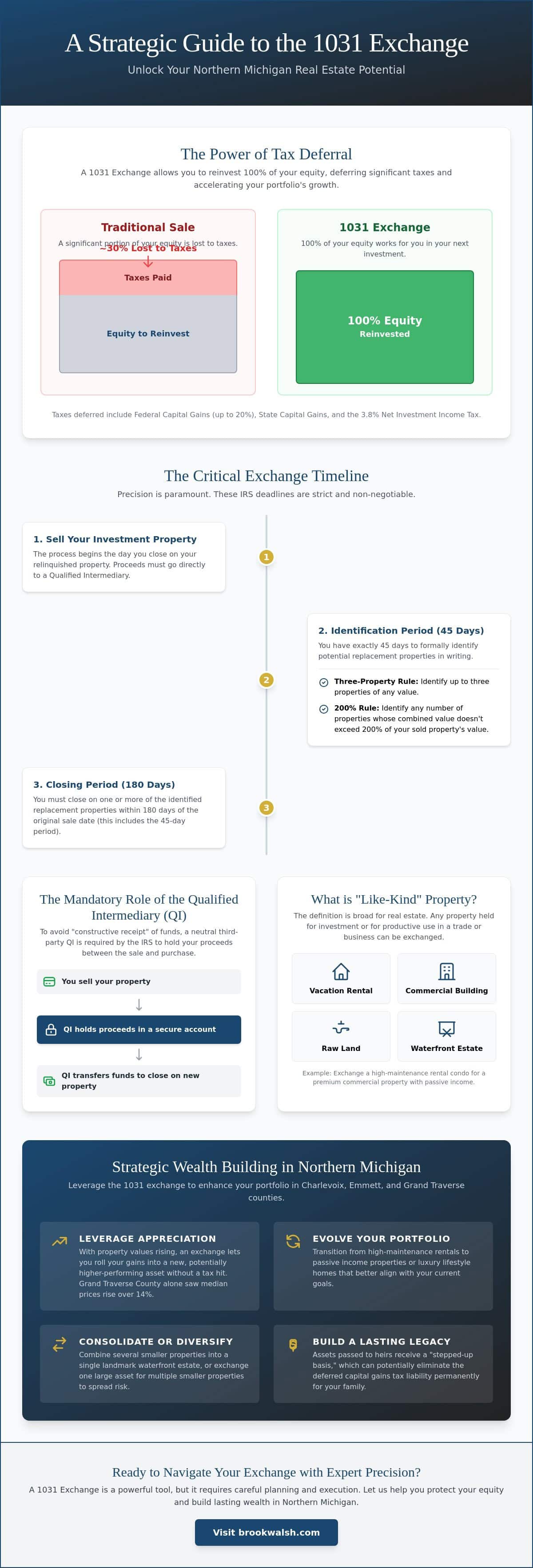
The true brilliance of an exchange lies in the compounding power of your capital. When you sell and pay taxes, you're left with a diminished pool of funds to reinvest. By contrast, an exchange allows 100% of your equity to migrate into a new, potentially higher-yielding asset. It's the difference between a "sell and pay" trajectory that stunts growth and an "exchange and grow" philosophy that accelerates it. A 1031 exchange is a wealth-preservation engine that transforms current equity into future opportunity.
Who Should Consider a 1031 Exchange in 2026?
With median sale prices in Grand Traverse County rising over 14% year-over-year as of early 2026, many local owners are sitting on significant appreciation. If you own a property in Charlevoix or Emmett County that no longer aligns with your lifestyle goals, an exchange is your best path forward. This tool is ideal for those looking to transition from high-maintenance short-term rentals into passive luxury lifestyle homes or commercial assets. It's also a cornerstone of investing in Northern Michigan real estate for those who wish to provide a stepped-up basis for their heirs, effectively eliminating the deferred tax upon their passing.
The Critical Timelines and Regulatory Framework
Precision is the hallmark of a successful transition in the luxury market. When exploring what is a 1031 exchange for investment property, you'll quickly realize that timing isn't merely a detail; it's the entire foundation of your tax-deferral strategy. The IRS mandates that you never take constructive receipt of the sale proceeds. Instead, a Qualified Intermediary (QI) acts as the essential third-party accommodator, holding your funds in a secure account until the purchase of your replacement property is finalized. If you bypass this step or handle the funds yourself, the exchange fails instantly, triggering the very capital gains taxes you aimed to avoid. For those seeking a strategic guide to 1031 exchanges, understanding the interplay between the QI and these rigid deadlines is paramount.
The 45-Day Identification Period
The first hurdle is the identification period. You have exactly 45 days from the date you close on your relinquished property to formally identify potential replacements. This is a firm deadline with no extensions, even if the 45th day falls on a weekend or holiday. Most investors utilize the Three-Property Rule, which allows you to identify up to three properties regardless of their total market value. Alternatively, the 200 Percent Rule permits you to identify any number of properties, provided their combined value doesn't exceed twice the value of the property you sold. In high-demand areas like Petoskey or Harbor Springs, where premier waterfront homes move quickly, having a shortlist of targets before you even list your current asset is a vital component of investing in Northern Michigan real estate successfully.
The 180-Day Completion Rule
The final horizon is the 180-day completion rule. You must close on your replacement property within 180 days of the initial sale or by the due date of your tax return for that year, whichever comes first. It's crucial to remember that these 180 days run concurrently with the 45-day identification period; they don't start after it. This six-month window might seem generous, but the complexities of luxury transactions in Grand Traverse or Charlevoix counties require diligent management. From detailed inspections of resort properties to navigating the nuances of commercial sales, every day counts. Early preparation is your best defense against unforeseen delays. If you're considering a transition, starting with a professional investment property analysis can help you align your timeline with current market inventory and ensure a seamless close.
Qualifying Property: Like-Kind and the Vacation Rental Nuance
A frequent point of confusion for investors is the term like-kind. Many mistakenly believe this requires swapping a condominium for another condominium or land for land. In reality, the IRS provides a generous interpretation of the term for real property. You can exchange a commercial building in downtown Traverse City for a portfolio of ski-in/ski-out condominiums in Emmett County, or trade raw acreage for a luxury waterfront estate. The primary requirement is that the property must be held for productive use in a trade or business or for investment. This definition excludes your primary residence and properties held primarily for sale, such as fix-and-flip projects that the IRS views as inventory rather than long-term investments.
Understanding what a 1031 exchange for investment property is
requires a nuanced look at the intent behind the ownership. While the flexibility is broad, the property must not be for personal use. This creates a unique challenge in Northern Michigan, where the line between a personal summer retreat and an investment asset often blurs. To navigate this, investors must adhere to specific guidelines that distinguish a lifestyle choice from a business asset. Failing to meet these standards can disqualify the entire exchange, making the role of a professional advisor essential during the selection process.
The Safe Harbor for Vacation Rentals
For those owning luxury cottages or lakeside retreats, Revenue Procedure 2008-16 provides a safe harbor that clarifies how a vacation home can qualify for an exchange. To meet these standards, you must have owned the property for at least 24 months before the exchange. During each of those two years, you're required to rent the property at a fair market rate for at least 14 days. Most importantly, your personal use cannot exceed 14 days or 10% of the days the property is actually rented. Utilizing professional short-term rental management is a practical way to ensure these occupancy and fair-market-rate requirements are meticulously documented, safeguarding your 1031 compliance.
Trading Up: From Vacant Land to Luxury Waterfront
One of the most effective wealth-building strategies in Grand Traverse County involves exchanging appreciated vacant land for income-producing assets. You might find that a development lot in Boyne City has gained significant value, allowing you to transition into waterfront lifestyle homes for sale without a tax penalty. To achieve full tax deferral, the replacement property must be of equal or greater value than the one you sold. Any cash or debt reduction you receive in the transaction is considered boot and is subject to taxation. By carefully selecting replacement properties that exceed your current equity, you can consolidate your holdings into high-yield resort assets while preserving every dollar of your investment capital.
Strategic Wealth Building in Northern Michigan Real Estate
Wealth is rarely static; it requires constant refinement to match your evolving lifestyle and financial objectives. While the technical rules of the IRS provide the framework, the true art of the transition lies in how you deploy your equity across the region's most coveted geographies. Understanding what a 1031 exchange for investment property is allows you to execute these pivots without the friction of immediate taxation. This is particularly relevant in the 2026 market, where Grand Traverse County has seen median price gains of 14.53% year-over-year. By leveraging these gains, you can move away from high-maintenance assets and into luxury lifestyle homes that offer both aesthetic pleasure and superior long-term value.
A cornerstone of sophisticated estate planning is the "Swap Until You Drop" strategy. This approach involves a series of successive exchanges throughout your lifetime, allowing your portfolio to grow unencumbered by tax liabilities. Because the deferred taxes are effectively eliminated when heirs receive a stepped-up basis upon the owner's passing, this tool becomes a powerful vehicle for building a multi-generational legacy. In a region where cash buyers represent 47% of transactions in areas like Leelanau County, having 100% of your equity available for your next acquisition provides a significant competitive edge in securing premier inventory.
Consolidating into Premier Waterfront Estates
Many investors reach a point where managing multiple smaller rental units in Charlevoix or Emmett County becomes more burdensome than beneficial. A 1031 exchange facilitates the consolidation of these disparate holdings into a single, high-value legacy property on Lake Charlevoix or the shores of Lake Michigan. This shift reduces administrative complexity and focuses your capital on the most resilient segment of the market. There is a profound sense of serenity that comes from anchoring your capital in a singular, breathtaking estate where the value is as enduring as the shoreline itself.
Diversifying into Resort and Golf Communities
Conversely, you may choose to use an exchange to diversify your holdings and mitigate geographic or seasonal risk. You might exchange a single large waterfront property for a combination of golf lifestyle homes and ski-in/ski-out condominiums. This strategy allows you to capture different segments of Northern Michigan's tourism economy, balancing the summer demand of the Great Lakes with the winter draw of our premier ski resorts. If you are ready to explore how these strategies apply to your specific holdings, our team provides a detailed investment property analysis to guide your next move.
Navigating Your Exchange with Expert Precision
Successfully executing a tax-deferred transition requires more than just a basic understanding of what a 1031 exchange is for investment property. It demands a symphony of professional coordination. You need a team that operates with the same precision you apply to your own business ventures. This group typically includes a Qualified Intermediary to secure the funds, a CPA to ensure regulatory alignment, and a broker who understands the specific micro-climates of the Northern Michigan market. In a landscape where Charlevoix has shown the most improvement across key metrics as of early 2026, having local eyes on the ground is your greatest advantage. We ensure every detail is managed so you can focus on the aesthetic and emotional value of your next acquisition.
The Brook Walsh Approach to Investment Consulting
We believe that a property is more than a line item on a balance sheet; it's a sanctuary. Our approach blends rigorous, data-driven investment property analysis with a deep appreciation for the region’s unique character. By utilizing a lifestyle-driven search, we identify replacement properties that don't just meet IRS requirements but also fulfill your personal vision of Northern Michigan living. This often involves accessing exclusive off-market listings in Harbor Springs or Petoskey, where the most coveted assets never reach the public eye. Whether you're seeking the quiet prestige of a Harbor Springs estate, the vibrant energy of downtown Traverse City, or the secluded luxury of a Charlevoix waterfront, we prioritize finding the right fit for your portfolio's long-term health.
Common Pitfalls to Avoid in a 1031 Exchange
Even the most seasoned investors can stumble over technicalities that trigger an immediate tax bill. One frequent trap is failing to account for mortgage debt. If your replacement property has a lower mortgage than the one you sold, the IRS considers that difference to be mortgage boot, which is subject to taxation. Another danger is the simple passage of time. With the 45-day identification window being non-negotiable, waiting until after your sale closes to begin your search is a high-risk gamble. In a market where inventory for premier resort assets can be limited, early identification is the only way to ensure a seamless transition into your next haven. We're here to guide you through these complexities, providing the steady hand needed to preserve your wealth for generations to come.
Securing Your Northern Michigan Legacy
Navigating the transition from an appreciated asset to a premier legacy property requires both technical precision and a deep connection to the regional landscape. You've seen how the strategic deferral of capital gains allows you to keep your equity intact, providing the leverage to consolidate holdings in Charlevoix or diversify into the resort communities of Emmett County. Understanding what a 1031 exchange for investment property is the first step toward a more sophisticated approach to wealth preservation. By adhering to strict IRS timelines and utilizing the vacation rental safe harbor, you transform a simple real estate transaction into a powerful engine for growth.
As a premier waterfront specialist, we offer the expert investment consulting and lifestyle-driven property search needed to identify your next essential haven. Whether you're targeting a high-yield condo or a secluded lakeside estate, our team ensures your transition is handled with quiet confidence. Explore Northern Michigan investment opportunities and start your 1031 exchange journey today. The shores of Grand Traverse and the fairways of our golf communities are waiting; it's time to build the portfolio your future deserves.
Frequently Asked Questions
Can I use a 1031 exchange for a vacation home in Northern Michigan?
You can certainly use this strategy for a vacation property if you adhere to the specific safe harbor guidelines established by the IRS. The property must be rented at a fair market rate for at least 14 days annually, and your own personal enjoyment of the home cannot exceed 14 days or 10% of the rented days. This ensures the asset is viewed as a legitimate investment rather than a personal residence. Owners in Emmett County often find that professional management helps maintain the meticulous records required to prove this intent.
What happens if I miss the 45-day identification deadline?
Missing this firm deadline results in a failed exchange, which triggers immediate tax liabilities on your capital gains and depreciation recapture. The IRS does not grant extensions for this 45-day window, regardless of whether the final day falls on a weekend or a holiday. Because the stakes are so high, we recommend having your replacement properties in Grand Traverse or Charlevoix counties identified well before your initial sale closes. This proactive approach protects your equity from unnecessary erosion.
Is it possible to do a 1031 exchange on a property I fix and flip?
No, properties purchased with the primary intent of a quick resale don't qualify for tax-deferred treatment. The IRS classifies fix-and-flip projects as inventory held for sale rather than assets held for productive use in a trade or investment. To benefit from the deferral, you must demonstrate a long-term investment intent, typically by holding the property for at least one to two years before initiating an exchange. This distinction is vital for maintaining the integrity of your tax strategy.
How many properties can I identify in a 1031 exchange?
Most investors utilize the Three-Property Rule, which allows you to identify up to three potential replacements regardless of their total market value. If you require more options, you can follow the 200 Percent Rule, identifying any number of properties as long as their combined fair market value doesn't exceed double the value of the property you sold. Understanding what is a 1031 exchange for investment property involves choosing the rule that best fits your portfolio's growth strategy and the specific inventory available.
Does the replacement property have to be in the same state as the sold property?
You aren't restricted by state lines, as federal law allows you to exchange real property located anywhere within the United States. Since Michigan conforms to these federal regulations, you can sell an investment asset in another region and reinvest the proceeds into a premier waterfront estate in Charlevoix. This flexibility is essential for investors looking to relocate their capital into the high-demand markets of Northern Michigan without losing a significant portion of their wealth to state or federal taxes.
What is "boot" in a 1031 exchange, and how is it taxed?
Boot refers to any non-like-kind property you receive during the transaction, such as excess cash or a reduction in your mortgage debt. While the exchange itself is tax-deferred, the value of the boot is considered a taxable gain and is subject to capital gains tax. To avoid this, you must reinvest all net proceeds and ensure the debt on your new property is equal to or greater than the debt on the property you relinquished. Precision in these calculations is paramount for a total deferral.
Can I move into my 1031 exchange property later and make it my primary residence?
It's possible to convert an investment property into a primary residence, but you must first establish a clear history of investment use. Most advisors suggest a minimum holding period of two years as a rental before you consider moving in. When you eventually sell that home, the tax treatment becomes more complex because you'll have to account for both the deferred gains and the period of personal use. It's a sophisticated long-term play that requires careful coordination with your tax professional.
How do I report a 1031 exchange to the IRS?
You must report the transaction using IRS Form 8824, Like-Kind Exchanges, which is filed alongside your federal income tax return for the year the exchange occurred. This form requires detailed information regarding the properties involved, the dates of identification and closing, and the role of your Qualified Intermediary. Correctly filing this form is the final step in confirming that you've correctly navigated what is a 1031 exchange for investment property. It serves as the official record that your taxes have been legally and successfully deferred.
Posted by Brook Walsh onEnjoy this blog post? Click here to subscribe for updates
Leave A Comment