

While many investors braced for the erosion of accelerated tax benefits, the permanent restoration of 100% bonus depreciation has transformed this year into a landmark opportunity for high-end property portfolios. You've likely felt the weight of shifting IRS classifications and the looming complexity of maintaining a compliant, high-value investment. Understanding the specific tax deductions for vacation rental owners in 2026 is no longer just about seasonal bookkeeping; it's a sophisticated play in wealth preservation.
We recognize that managing a luxury waterfront home or a premier ski-in/ski-out condominium involves more than just aesthetic curation. It requires a precise, expert hand to navigate the nuances of the One Big Beautiful Bill Act and the permanent 20% Qualified Business Income deduction. This guide will show you how to master the sophisticated tax strategies and essential 2026 deductions that transform your luxury vacation properties into high-performance assets. We'll explore the critical material participation tests and cost segregation benefits that ensure your regional lifestyle investment remains a private, profitable sanctuary.

Key Takeaways
- Understand how the 2026 fiscal year shifts the paradigm of real estate taxation, positioning vacation rentals as premier tax shelters for high-income earners.
- Learn the precise criteria for the short-term rental loophole, including the essential 7-day average stay rule required to unlock non-passive classification.
- Discover how cost segregation and front-loaded depreciation can maximize tax deductions for vacation rental owners in 2026, especially for high-value waterfront and resort properties.
- Identify the full spectrum of deductible operating expenses and learn why professional short-term rental management fees provide a seamless path to lowering your liability.
- Explore the synergy between specialized investment property analysis and management to ensure your portfolio remains a high-performance, wealth-preservation asset.
Table of Contents
- Navigating the 2026 Tax Landscape for Vacation Rental Owners
- The Short-Term Rental Loophole and Participation Requirements
- Strategic Depreciation and Cost Segregation for High-Value Properties
- Operational Deductions and Management Fee Efficiency
- Elevating Your Portfolio Through Expert Investment Consulting
Navigating the 2026 Tax Landscape for Vacation Rental Owners
The passage of the One Big Beautiful Bill Act on July 4, 2025, fundamentally altered the trajectory for property investors. As we move into 2026, the tax environment has shifted from uncertainty to permanent opportunity. For those who hold luxury waterfront homes or mountain retreats, the tax deductions for vacation rental owners in 2026 represent a sophisticated mechanism for wealth preservation rather than just a collection of write-offs. It's about transforming a high-end escape into a high-performance business engine that shields your broader portfolio from unnecessary liability.
Understanding Navigating the 2026 Tax Landscape for Vacation Rental Owners requires a departure from traditional passive investment thinking. The IRS continues to scrutinize the distinction between a personal indulgence and a legitimate enterprise. To secure the most aggressive benefits, you must demonstrate a clear profit motive and a business-first approach to your portfolio. This distinction is the gateway to treating your property as a premier tax shelter, allowing you to offset active income with strategic losses.
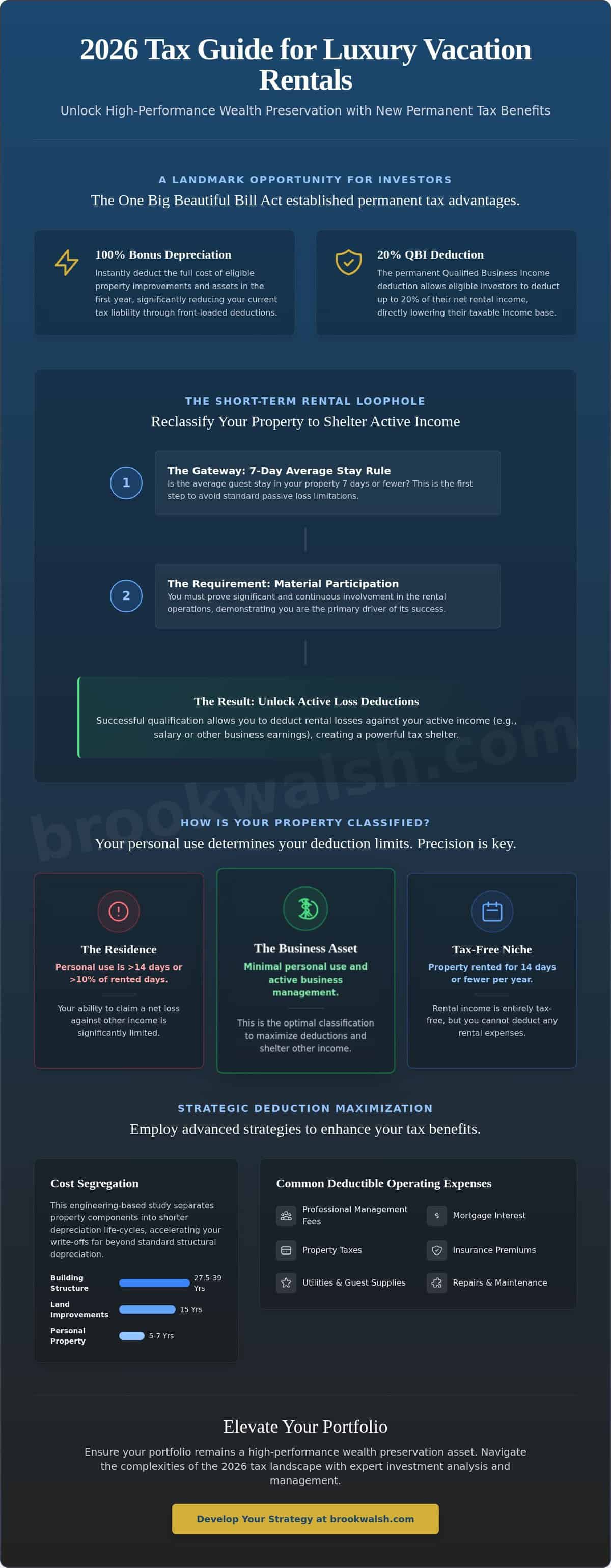
To visualize how these unique breaks apply to your portfolio, consider this expert overview:
The 2026 Regulatory Environment
Proactive planning is the hallmark of the discerning investor. With the OBBBA making many provisions permanent, such as the 100% bonus depreciation rate, the 2026 fiscal year offers a stable foundation for long-term strategy. You shouldn't wait for April to react to your earnings. Instead, early 2026 is the time to refine your investment property analysis to ensure every acquisition aligns with current federal tax brackets, which now range from 10% to 37%. Maintaining a business-first mindset for your luxury holdings ensures that every aesthetic upgrade also serves a documented commercial purpose.
Defining Your Property Classification
The line between a personal haven and a tax-advantaged asset is drawn by the 14-day or 10-percent rule. If your personal use exceeds the greater of 14 days or 10% of the total days rented, the IRS classifies the property as a residence. This limits your ability to claim a net loss. Conversely, if you rent the property for 14 days or fewer, that income is tax-free, though you cannot deduct rental expenses. Precision in tracking usage is vital. Every day spent on maintenance versus personal leisure must be documented with contemporaneous logs to withstand scrutiny and maximize the available tax deductions for vacation rental owners in 2026. This meticulous record-keeping transforms a simple ledger into a robust shield for your wealth.
The Short-Term Rental Loophole and Participation Requirements
The short-term rental loophole remains the most potent tool for high-income earners seeking to reclassify passive losses as active offsets. By meeting specific criteria, you can use property-related expenses to shield your primary income from taxation. The technical foundation for this strategy lies in The Short-Term Rental Loophole and Participation Requirements, which dictate how the IRS views your involvement. It's not enough to simply own a ski-in/ski-out condominium; you must prove you are the primary driver of its success.
The 7-day average stay rule serves as the gateway. If the average guest stay is seven days or fewer, the activity isn't considered a rental activity under standard passive loss rules. This reclassification is essential for anyone looking to maximize tax deductions for vacation rental owners in 2026. Once you've cleared this hurdle, the focus shifts entirely to material participation. This transition from passive investor to active business owner is what allows for the immediate deduction of significant expenses against your salary or business income.
Mastering Material Participation
Material participation is the heartbeat of active tax planning. The IRS offers seven tests, but two are the most common for luxury owners. The 500-hour test is the gold standard, requiring you to spend substantial time on operations throughout the year. Alternatively, the 100-hour test is often more attainable for busy professionals. Under this rule, you must spend at least 100 hours on the activity, and no other individual, including a property manager or cleaner, can spend more time than you. If a manager handles every detail, the IRS may reclassify your income as passive, stripping away your ability to offset active earnings. Rigorous documentation of your hours is your best defense against an audit.
The 7-Day Rule in Practice
Calculating your average stay requires precision. You divide the total number of days rented by the number of separate guest stays. For example, a property rented for 210 days across 35 stays averages exactly six days. Long-term stays in the off-season can jeopardize this average. If a single guest stays for 30 days, you must balance that with several two-day weekend bookings to keep the overall average below the seven-day threshold. For 2026 investors, the short-term rental loophole is defined as the strategic alignment of guest stay duration and owner involvement to unlock active loss treatment. To ensure your next acquisition meets these rigorous standards, consider a professional investment property analysis to project your participation requirements accurately.
Strategic Depreciation and Cost Segregation for High-Value Properties
Standard straight-line depreciation over 27.5 years is a blunt instrument that often fails to reflect the financial reality of a luxury lifestyle home. While the structure itself depreciates slowly, the high-end finishes, bespoke cabinetry, and elaborate landscaping of a waterfront estate lose value or require updates on a much faster timeline. Strategic investors don't settle for the slow crawl of residential depreciation. Instead, they use cost segregation to reclassify portions of their property into 5-year, 7-year, or 15-year recovery periods, significantly accelerating their cash flow.
The restoration of the 100% bonus depreciation rate under the One Big Beautiful Bill Act is the most significant development for your 2026 ROI. This provision allows you to deduct the entire cost of qualifying assets, such as furniture, appliances, and land improvements, in the very first year they're placed in service. For a property valued over $300,000, a professional cost segregation study can yield a 5-10x return on the cost of the study itself. These strategies are the cornerstone of tax deductions for vacation rental owners in 2026, providing a massive upfront tax shield that can be used to offset other active income when paired with the short-term rental loophole discussed earlier.
Implementing these advanced techniques requires strict adherence to IRS guidelines on vacation rental deductions. The IRS expects a clear division between personal and rental use, and cost segregation only amplifies the need for precise record-keeping. By accelerating these deductions, you're essentially claiming tomorrow's tax breaks today, creating a powerful engine for immediate wealth reinvestment.
The Anatomy of a Cost Segregation Study
For properties valued at one million dollars or more, an engineering-based cost segregation study is essential. These studies go beyond simple accounting to identify specific land improvements like docks, private roads, and professional landscaping, which are typically 15-year assets. They also isolate personal property like high-end lighting fixtures and security systems as 5-year or 7-year assets. While this front-loads your deductions, it's vital to consider the long-term impact on your property's basis, as these choices will influence your tax position during a future resale.
Managing Depreciation Recapture
Accelerated depreciation is a loan from the government that eventually comes due through depreciation recapture when you sell the asset. However, 2026 investors can navigate this by utilizing 1031 exchanges to defer those taxes indefinitely. By rolling the proceeds of a sale into a new investment property analysis, you can maintain your tax shield while upgrading your portfolio. Our consulting approach ensures your tax strategy remains aligned with the entire lifecycle of your property, from the initial acquisition to a sophisticated exit.
Operational Deductions and Management Fee Efficiency
Maintaining the pristine allure of a golf course community home or a lakeside estate involves a complex web of operational requirements. While previous sections detailed the structural tax shields, the day-to-day management of your asset offers a consistent stream of tax deductions for vacation rental owners in 2026. Professional management fees are perhaps the most transparent of these. These fees don't just secure a seamless guest experience; they're fully deductible, effectively reducing the net cost of expert oversight while protecting your property's market value. It's a strategic trade-off where professional excellence pays for itself through tax efficiency and asset preservation.
Your travel to oversee maintenance or perform property inspections is also a legitimate business expense. As long as the primary purpose of the trip is business-related, you can deduct airfare, lodging, and a portion of meals. Similarly, the curated touches that define a luxury stay, from high-end linens to bespoke welcome packages, are essential guest experience enhancements that qualify as deductible operating costs. These details ensure that your property remains a coveted geography for discerning travelers. A robust operational strategy includes several key line items that reduce your taxable income. Consider the following checklist for your 2026 filings:
- Professional short-term rental management fees and commissions
- Property insurance premiums and specialized liability coverage
- Utility costs, including high-speed internet and premium streaming services
- Cleaning and turnover services between guest stays
- Marketing expenses and professional listing photography
Professional Services and Consulting
Sophisticated vacation rental investment strategies require expert analysis to remain viable. Fees paid for legal counsel, specialized accounting, and professional investment property analysis are all essential business costs. Even the expenses associated with professional photography and high-end digital marketing are fully deductible. These are direct requirements for generating rental income in a competitive luxury market. By leveraging these services, you're not just spending; you're investing in the visibility and performance of your wealth preservation asset.
Maintenance, Repairs, and Improvements
The de minimis safe harbor election allows you to immediately deduct smaller purchases, such as high-end kitchen appliances or patio furniture, rather than depreciating them over several years. In 2026, distinguishing between a deductible repair, like fixing a leaking dock, and a capitalized improvement, like building a new one, remains critical for your cash flow. Specialized care for waterfront assets, including professional pool maintenance and artistic landscaping, ensures the property remains an emotional haven for guests while serving as a robust tax deduction for vacation rental owners in 2026. This meticulous care preserves the aesthetic value that initially drew you to the region.
If you're looking to maximize the performance of your portfolio, we invite you to explore our comprehensive investment property analysis services to align your operational costs with your long-term wealth goals.
Elevating Your Portfolio Through Expert Investment Consulting
Luxury real estate is an intricate dance between aesthetic appreciation and financial precision. While mastering the technical nuances of tax deductions for vacation rental owners in 2026 is vital, these strategies only reach their full potential when applied to the right assets. A unified approach to brokerage and management ensures that every property you acquire isn't just a beautiful retreat, but a calculated component of your wealth preservation strategy. This synergy allows for a seamless transition from the initial search to active income generation, where data-driven ROI projections inform every decision.
Selecting a property based on its tax efficiency requires more than a standard market overview. It demands a deep understanding of how specific regional identifiers and property types interact with the current regulatory environment. By bridging the gap between lifestyle aspirations and financial performance, we help you identify opportunities that others might overlook. Auditing your current portfolio for 2026 tax efficiency is the first step toward ensuring your investments remain high-performance havens that shield your capital effectively.
The Brook Walsh Advantage
The distinction of our approach lies in the integration of lifestyle-driven property searches with sophisticated investment analysis. We invite you to explore lifestyle-driven property searches that prioritize the emotional and aesthetic value of a location while grounding the search in fiscal reality. Having a single-source advisor for both acquisition and short-term rental management eliminates the friction often found between purchase and operation. This holistic view ensures that the participation requirements and operational deductions discussed in previous sections are built into the business plan from day one. It's about providing a clear roadmap for 2026 compliance without sacrificing the curated elegance of your investment.
Securing Your 2026 Financial Future
As you look toward your next acquisition, developing a personalized tax-advantaged roadmap is essential. This involves analyzing the permanent restoration of 100% bonus depreciation against your specific income bracket to time your purchases for maximum impact. We encourage you to view a curated luxury property portfolio to see how architectural details and location prestige can align with your long-term financial goals. Your 2026 financial future isn't just about what you save; it's about the quality of the environment you choose to inhabit and the legacy you build through real estate.
Expert consultation and professional short-term rental management are the final pieces of the puzzle. By aligning with a partner who understands the profound connection between a person and their environment, you ensure that your portfolio reflects your values and your ambitions. Let's refine your strategy and secure the tax deductions for vacation rental owners in 2026 that your investment deserves. We're here to guide you toward a future where luxury and wealth preservation exist in perfect harmony.
Securing Your Legacy in the 2026 Luxury Market
The 2026 tax landscape offers a rare alignment of permanent benefits and high-performance opportunities for the discerning investor. By mastering the 7-day rule and utilizing engineering-based cost segregation, you've seen how a lifestyle asset can transform into a sophisticated wealth preservation tool. These tax deductions for vacation rental owners in 2026 are the keys to shielding your active income while enjoying the curated elegance of a waterfront or resort estate. It's about precision in documentation and confidence in your participation strategy.
Success in this prestigious market requires more than just a beautiful structure; it demands a partner who understands the granular data behind every transaction. We provide expert investment consulting for high-yield vacation rentals and comprehensive management for luxury waterfront homes. Our data-driven ROI analysis for lifestyle properties ensures your portfolio remains resilient against shifting regulations while maintaining its emotional and aesthetic value. You've built your wealth through vision and discipline, and your real estate portfolio should reflect that same standard of excellence.
Elevate your investment strategy with Brook Walsh Real Estate. Your journey toward a more secure, tax-advantaged future begins with a single, intentional step. We look forward to guiding you through every detail of this coveted regional experience and ensuring your investment remains a private, profitable sanctuary for years to come.
Frequently Asked Questions
Can I deduct the interest on my vacation rental mortgage in 2026?
Yes, you can deduct mortgage interest on your vacation rental as a legitimate business expense in 2026. If the property is used exclusively for rental purposes, the full interest amount is deductible against your rental income. For properties with mixed personal and rental use, the IRS requires a pro-rated calculation based on the total days the property is occupied. This ensures your financial obligations support the commercial viability of your investment.
What is the short-term rental tax loophole for 2026?
The short-term rental loophole in 2026 allows owners to reclassify rental losses from passive to non-passive, provided the average guest stay is seven days or fewer. By meeting material participation tests, such as the 100-hour or 500-hour thresholds, you can use these losses to offset other active income like salaries. This strategy is a cornerstone of tax deductions for vacation rental owners in 2026, creating a powerful shield for your broader wealth portfolio.
How many days can I personally stay in my rental without losing tax benefits?
You can stay in your rental for up to 14 days or 10% of the total days it is rented, whichever is greater, without losing your business classification. Exceeding this limit causes the IRS to treat the property as a personal residence, which restricts your ability to claim a net loss. Meticulous tracking of your stay is essential to maintain the prestige of your investment as a legitimate wealth preservation asset and a high-performance sanctuary.
Are property management fees fully tax-deductible for vacation rentals?
Professional property management fees are fully tax-deductible for vacation rentals in 2026. These costs are considered essential operating expenses required to generate rental income and maintain the high standards of a luxury estate. Deducting these fees reduces your taxable income while ensuring your property benefits from expert oversight and a seamless guest experience. It is a straightforward way to align professional excellence with fiscal efficiency and long-term asset preservation.
Can I deduct my travel costs to visit my rental property?
You can deduct travel costs to visit your rental property if the primary purpose of the trip is business-related. This includes airfare, mileage, and lodging for trips focused on maintenance, repairs, or property inspections. You must maintain a detailed log documenting the business activities performed during the visit. If the trip is part business and part pleasure, the IRS requires you to allocate expenses accordingly to ensure compliance with current regulations.
What is the difference between a repair and an improvement for IRS purposes?
The IRS distinguishes between repairs, which are immediately deductible, and improvements, which must be capitalized and depreciated. A repair restores a property to its previous condition, such as fixing a broken window or a leaky pipe. An improvement adds value or prolongs the property's life, such as a kitchen remodel or a new roof. Understanding this distinction is vital for optimizing your first-year tax deductions for vacation rental owners in 2026 and maximizing cash flow.
Do I need a cost segregation study for my vacation home?
While not legally required, a cost segregation study is highly recommended for high-value vacation homes to maximize first-year deductions. With the 2026 bonus depreciation rate restored to 100%, you can immediately write off the full cost of qualifying personal property and land improvements. For properties valued over $300,000, the ROI of such a study often results in a 5 to 10x return on the initial cost through immediate, significant tax savings.
How does the QBI deduction apply to vacation rental owners in 2026?
The Qualified Business Income (QBI) deduction allows eligible owners to deduct up to 20% of their net rental income in 2026. This provision was made permanent by the One Big Beautiful Bill Act, offering significant savings for pass-through entities. For 2026, the full deduction applies if your taxable income is below $191,950 for single filers or $383,900 for married couples filing jointly. Above these levels, specific wage and property-based limitations begin to phase in.
Posted by Brook Walsh onEnjoy this blog post? Click here to subscribe for updates
Leave A Comment