
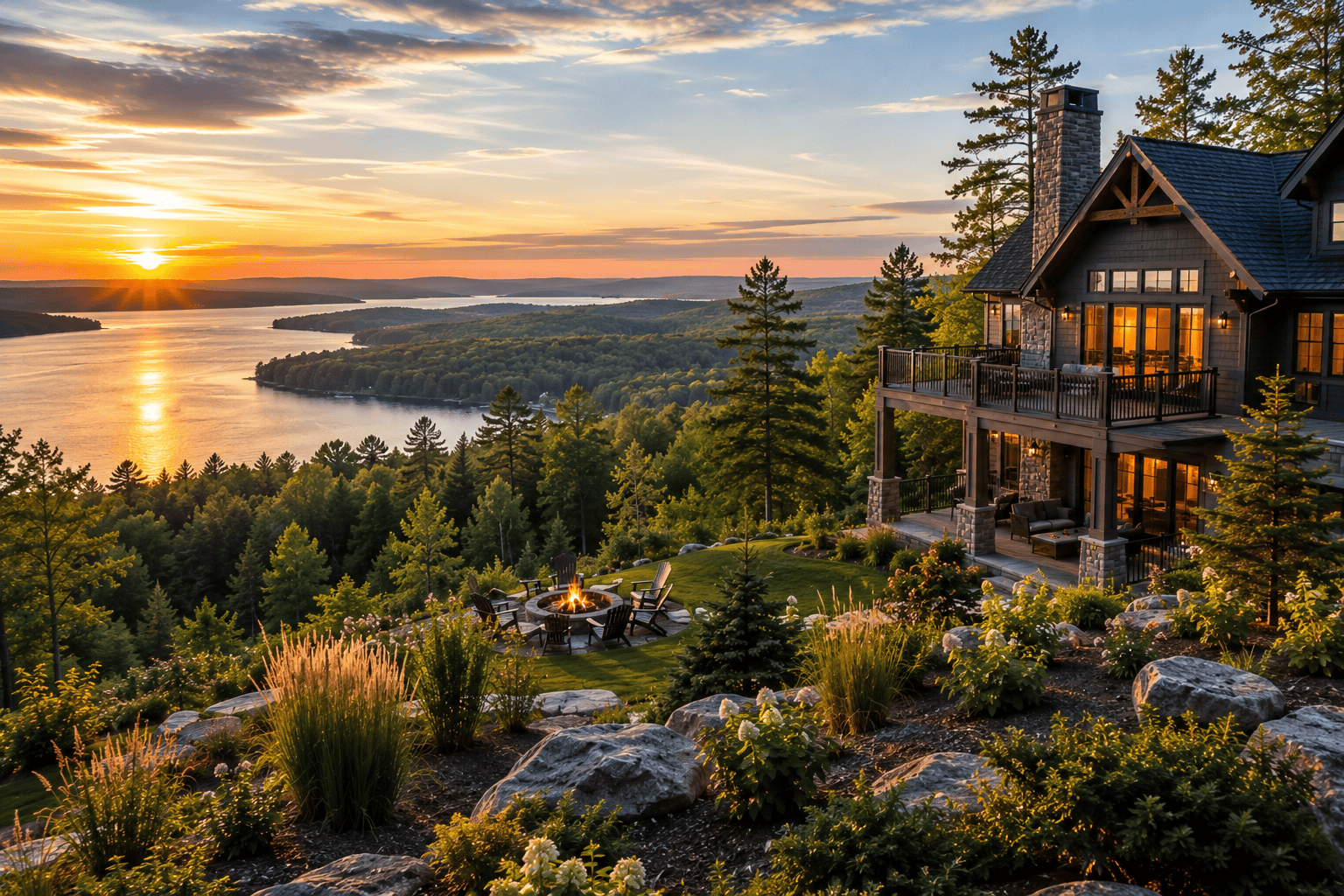
The most profitable northern Michigan real estate investment you'll make in 2026 won't be the one with the lowest price per square foot. It will be the one that speaks directly to a specific, deeply felt way of life, whether that's waking up to the crystalline waters of Lake Charlevoix, carving fresh powder at Boyne Highlands, or teeing off at a world-class course in Grand Traverse County.
You already sense that this region is different. The demand here isn't driven by proximity to office parks or school ratings alone. It's driven by aspiration, by the pull of a landscape so genuinely extraordinary that people return season after season, year after year, and eventually decide they never want to leave. That instinct is correct, and it's the foundation of a remarkably resilient market.
What's harder to navigate is the complexity beneath the surface: the evolving short-term rental ordinances across Charlevoix, Emmet, and Grand Traverse counties, the rhythm of seasonal occupancy, and the challenge of finding property management that protects a luxury asset as carefully as you would. This guide cuts through that complexity, offering a strategic framework for identifying high-yield lifestyle properties and building a portfolio that delivers both personal legacy and predictable income.
Key Takeaways
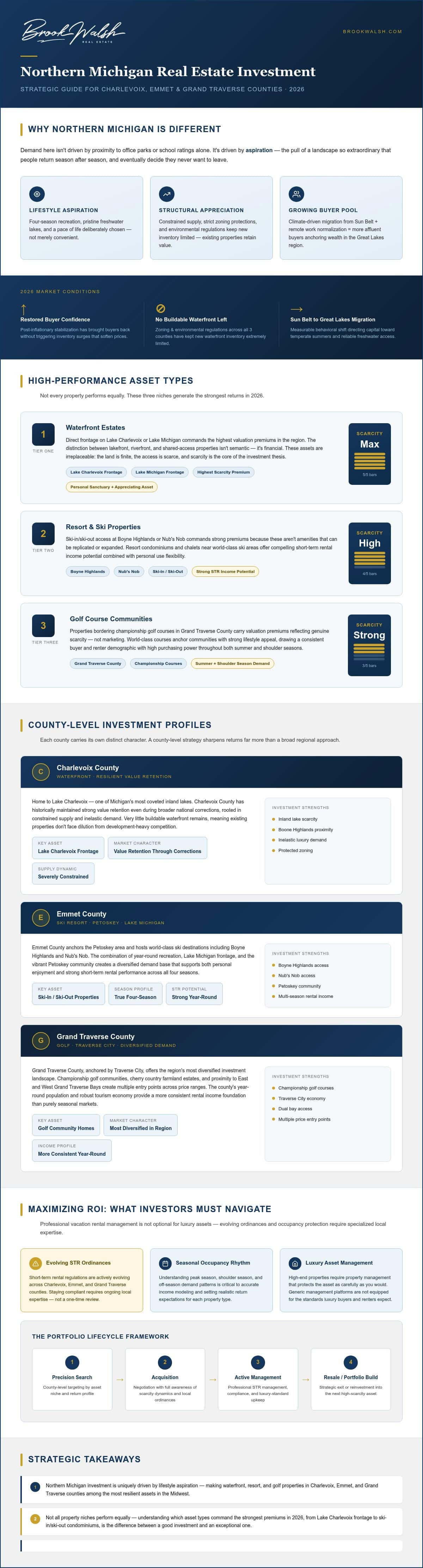
- Northern Michigan real estate investment is uniquely driven by lifestyle aspiration rather than conventional market forces, making waterfront, resort, and golf properties in Charlevoix, Emmet, and Grand Traverse counties among the most resilient assets in the Midwest.
- Not all property niches perform equally — understanding which asset types command the strongest premiums in 2026, from Lake Charlevoix frontage to ski-in/ski-out condominiums, is the difference between a good investment and an exceptional one.
- Each of the three primary investment counties carries its own distinct character and opportunity profile, and a county-level strategy will sharpen your returns far more than a broad regional approach.
- Professional vacation rental management is not optional for luxury assets — navigating evolving short-term rental ordinances and protecting occupancy rates requires specialized local expertise.
- A lifecycle approach to ownership, from precision property search to active management and eventual resale, is the strategic framework that separates portfolio builders from one-time buyers in this market.
Table of Contents
- The Northern Michigan investment landscape in 2026
- High-performance assets: Waterfront, resort, and golf homes
- County-level opportunities: Emmet, Charlevoix, and Grand Traverse
- Maximizing ROI through professional vacation rental management
- Building your Northern Michigan portfolio with Brook Walsh
The Northern Michigan investment landscape in 2026
Something fundamental has shifted in how serious investors approach second-home markets. The post-pandemic recalibration of priorities, accelerated by the normalization of remote work and a growing awareness of climate-driven migration patterns, has redirected significant capital away from overheated coastal corridors and toward places that offer what no urban market can replicate: genuine natural beauty, four-season recreation, and a pace of life that feels deliberately chosen rather than merely convenient.
Northern Michigan sits at the precise intersection of all these forces. Charlevoix, Emmet, and Grand Traverse counties aren't benefiting from a passing trend. They're absorbing a structural shift in where affluent buyers want to anchor their lives and their wealth. For those evaluating northern Michigan real estate investment in 2026, the question is no longer whether this region merits serious attention. It's how to position yourself within it with precision.
The evolution of luxury lifestyle real estate
The definition of luxury has moved decisively. Privacy, natural access, and the ability to step directly into a world-class recreational experience now outweigh square footage and proximity to commercial centers. A property bordering a championship golf course in Grand Traverse County or offering direct frontage on Lake Charlevoix carries a valuation premium that reflects genuine scarcity, not simply marketing. Ski-in/ski-out access at Boyne Highlands or Nub's Nob commands a similar premium, because these aren't amenities that can be replicated or expanded. The land is finite. The access is irreplaceable. That irreplaceability is the core of the investment thesis.
Demand for high-end waterfront estates across the region has remained particularly resilient, driven by buyers who view these properties simultaneously as personal sanctuaries and appreciating assets. You can explore available options across lifestyle categories at waterfront lifestyle homes for sale to understand the current inventory landscape.
Stability and appreciation in the 2026 market
What distinguishes this region from more speculative markets is the consistency of its appreciation story. Charlevoix and Emmet counties have historically maintained strong value retention even during broader national corrections, a pattern rooted in two structural realities: constrained supply and inelastic demand. There is simply very little buildable waterfront left. Zoning protections and environmental regulations across all three counties have kept new inventory limited, which means existing properties don't face the dilution that affects more development-heavy markets.
The 2026 environment adds another layer of support. Post-inflationary market stabilization has restored buyer confidence without triggering the inventory surge that would soften prices. Climate-conscious migration, particularly from the Sun Belt, is directing buyers toward the Great Lakes region's temperate summers and reliable freshwater access. This isn't speculation. It's a measurable behavioral shift that northern Michigan real estate investment professionals are tracking closely as it reshapes demand across all three counties.
Scarcity, lifestyle alignment, and a buyer pool that is growing rather than contracting: these are the conditions that produce durable long-term returns.
High-performance assets: Waterfront, resort, and golf homes
Not every property in northern Michigan performs equally, and understanding which asset types generate the strongest returns in 2026 is where strategic northern Michigan real estate investment begins to separate itself from opportunistic buying. The region's most compelling opportunities cluster around three distinct niches: waterfront estates, resort and ski properties, and golf course communities. Each carries its own return profile, its own demand drivers, and its own scarcity logic.
The waterfront premium on Lake Michigan and beyond
The distinction between lakefront, riverfront, and shared-access properties isn't semantic. It's financial. Direct frontage on Lake Charlevoix or Lake Michigan commands a fundamentally different buyer pool than a property with deeded access to a shared beach association. The difference shows up not just in list price but in velocity, in negotiating leverage, and in long-term appreciation. Shared-access properties can offer an accessible entry point, but they don't carry the irreplaceable scarcity premium that moves serious buyers.
Lake Charlevoix frontage in particular occupies a category of its own: crystalline water clarity, protected coves, and proximity to the village of Charlevoix combine to make these parcels among the most coveted and least available assets in the entire Great Lakes corridor, with resale values that have historically outpaced the broader regional market even during periods of softened demand. Waterfront lifestyle homes represent the gold standard of the northern Michigan portfolio, and current inventory reflects just how rarely genuine frontage properties change hands.
Riverfront and interior lake properties deserve consideration in their own right, particularly for buyers seeking lower acquisition costs with strong short-term rental income potential. However, the ceiling on appreciation is lower, and buyer competition at resale is measurably thinner.
Resort and golf assets: Beyond the seasonal peak
Ski-in/ski-out condominiums near Boyne Highlands and Nub's Nob address one of the most common concerns in seasonal rental markets: occupancy concentration. These properties attract a compressed but high-yield winter rental window, and increasingly, a spring and fall shoulder season that extends revenue well beyond peak powder months. Proximity to the lifts isn't a convenience feature. It's the asset itself.
Resort lifestyle homes excel in short-term rental markets because they deliver an experience that can't be replicated by a standard residential property. Guests aren't renting a house; they're renting access to a specific world. That distinction justifies premium nightly rates and drives repeat bookings.
Golf course communities, particularly in Bay Harbor and the Grand Traverse region, offer something equally valuable: year-round desirability. Golf lifestyle homes attract buyers and renters who prioritize the social architecture of a well-managed community as much as the course itself. Private docks, ski lift access, and clubhouse privileges all function as resale multipliers, features that compress time on market and support asking price integrity in ways that standard amenities simply don't.
Across all three niches, the common thread is access to something finite. That's the investment thesis, and it holds.
County-level opportunities: Emmet, Charlevoix, and Grand Traverse
A regional overview only takes you so far. The real precision in northern Michigan real estate investment comes from understanding each county on its own terms: its distinct buyer psychology, its supply constraints, and the specific pockets where capital is most intelligently deployed in 2026. Emmet, Charlevoix, and Grand Traverse counties share a regional identity, but they don't share the same opportunity profile.
Emmet County: Luxury and legacy
Petoskey and Bay Harbor anchor Emmet County's investment case with a combination of established prestige and genuine scarcity. Bay Harbor in particular functions as one of the most self-contained luxury communities in the entire Great Lakes region, a planned enclave where marina access, golf, and architectural standards combine to create a buyer profile that skews heavily toward ultra-high-net-worth individuals seeking generational assets rather than short-term yield plays. Resale velocity here is low not because demand is weak, but because owners rarely sell.
Harbor Springs reinforces this dynamic. Its historic streetscape, protected harbor, and deeply loyal seasonal community have kept speculative development at bay for decades. Properties here don't trade on cap rate logic. They trade on legacy, on the recognition that certain addresses in northern Michigan carry a cultural weight that simply can't be manufactured elsewhere.
For investors who want Emmet County exposure at a more accessible entry point, downtown Petoskey offers a compelling case. Condominium lifestyle homes near the Gaslight District capture walkable access to independent dining, boutique retail, and Little Traverse Bay, attributes that resonate strongly with the short-term rental guest seeking a curated, place-specific experience rather than a generic vacation property.
Charlevoix and Grand Traverse: Growth and diversification
Charlevoix County's investment story in 2026 extends well beyond the village of Charlevoix itself. Boyne City has matured into a genuine year-round destination, with a revitalized downtown, direct Lake Charlevoix access, and a buyer demographic that increasingly values authenticity over amenity excess. East Jordan and Boyne Falls represent the county's undervalued pockets: lower acquisition costs, improving infrastructure, and proximity to Boyne Mountain that positions them well as shoulder-season rental markets continue to develop.
Grand Traverse County operates at a different scale entirely. Traverse City's urban-resort hybrid character, shaped by a thriving culinary scene, a regional airport with direct national connections, and a wine country corridor that draws visitors across all four seasons, creates investment conditions that are genuinely distinct from the rest of the region. The opportunity here isn't purely residential. Downtown lifestyle homes and mixed-use residential assets appeal to a buyer who wants the northern Michigan experience without sacrificing urban convenience.
Across all three counties, the strategic principle holds: specificity wins. Understanding which sub-markets carry genuine scarcity versus which are simply benefiting from regional momentum is the discipline that separates durable northern Michigan real estate investment from exposure to mean reversion.
Maximizing ROI through professional vacation rental management
Acquiring the right property is only half the equation. What happens after closing determines whether a luxury asset in Charlevoix, Emmet, or Grand Traverse County performs as an investment or simply appreciates quietly while leaving significant income on the table. The synergy between acquisition strategy and professional management is where most investors either capture or surrender their returns, and it's a dimension that deserves the same analytical rigor you applied to the purchase itself.
Understanding 2026 STR ordinances
Short-term rental regulation across northern Michigan has matured considerably, and the landscape varies meaningfully from one township to the next. Charlevoix County municipalities have moved toward permit-based systems that cap the number of active rentals in certain residential zones, while Emmet County townships have adopted varying approaches to density limits and operational requirements. These aren't uniform rules. A property in one Harbor Springs township may carry a grandfathered operating status that a neighboring parcel does not, and that distinction can represent a substantial difference in income potential and resale value.
Identifying properties with favorable or grandfathered zoning status requires local expertise that goes well beyond a title search. Consulting with a specialist in investing in northern Michigan real estate before committing to a purchase ensures that your compliance position is understood from day one, not discovered after the fact. The regulatory environment will continue to evolve; building that advisory relationship early is the most effective risk mitigation available.
The financial benefit of professional management
Dynamic pricing is where professional management earns its fee most visibly. Algorithmic rate tools calibrated to northern Michigan's specific demand patterns, adjusted weekly against local event calendars, competing inventory, and seasonal booking windows, consistently outperform static pricing by a meaningful margin. A ski-adjacent property near Boyne Highlands priced correctly across the shoulder seasons of October and April captures revenue that an owner managing remotely will almost certainly leave uncollected.
Beyond pricing, the operational architecture of professional management protects the physical asset itself. Coordinated maintenance schedules, vetted vendor relationships, and rigorous guest screening preserve the condition of a luxury property in ways that self-management rarely sustains at scale. Guest experience quality drives repeat bookings and five-star reviews, which directly support occupancy rates across the full calendar year.
Professional management increases net operating income not simply by filling more nights, but by commanding higher nightly rates, reducing costly vacancy gaps, and preventing the deferred maintenance that quietly erodes asset value over time.
For a Northern Michigan real estate investment to perform at its ceiling, the management layer must be treated as a strategic decision, not an afterthought. The right partner understands the specific character of each county, the expectations of a luxury guest, and the regulatory environment that shapes what's operationally possible.
Building your Northern Michigan portfolio with Brook Walsh
Every strategic framework in this guide converges on a single practical question: who is guiding your decisions on the ground? The difference between a well-positioned Northern Michigan real estate investment and one that underperforms its potential almost always traces back to the quality of local expertise behind it. Brook Walsh brings a lifecycle approach to ownership that begins well before a purchase agreement is signed and extends through active management and eventual resale, treating each property not as a transaction but as a long-term asset requiring continuous, informed stewardship.
Expert consulting and market analysis
The most compelling opportunities in Charlevoix, Emmet, and Grand Traverse counties rarely wait for public listing. Relationships with estate attorneys, longtime owners, and community insiders create access to properties before they reach the open market, which means less competition, more negotiating latitude, and better entry pricing. That off-market intelligence is paired with specialized knowledge of waterfront and resort niches that standard residential analysis simply doesn't capture: understanding which Lake Charlevoix coves carry the strongest rental demand, which Emmet County townships hold grandfathered short-term rental status, and which golf community amenity packages translate most directly into resale premiums.
Personalized portfolio strategy sessions for 2026 are structured around your specific objectives, whether that's maximizing short-term rental income, building a generational asset, or identifying undervalued sub-markets in Boyne City or East Jordan before broader capital catches on. Investment property analysis and data-driven ROI projections are central to that process, giving you a clear financial picture before any commitment is made.
The search by lifestyle platform reflects a fundamentally different philosophy than a standard property search. Rather than filtering by bedrooms and price bands, it allows you to identify properties by the specific way of life they enable: waterfront mornings, ski-in access, fairway views, walkable village living. That alignment between lifestyle intention and asset selection is where precision northern Michigan real estate investment actually begins.
Securing your legacy in the North
Ownership here carries a weight that purely financial metrics don't fully capture. The emotional return of a property on Little Traverse Bay or a ski-adjacent chalet near Boyne Highlands is real, and it compounds alongside the financial one. Buyers who entered the Charlevoix and Emmet markets in prior cycles have consistently found that the region rewards patience and conviction. The constrained supply, the growing buyer pool, and the structural shifts in how affluent families prioritize place all point toward 2026 as a moment of genuine strategic opportunity, before further appreciation narrows the entry window.
The invitation is direct: explore luxury lifestyle homes currently available across the region, and bring your questions to a team that knows this market at the level of individual parcels, not just county-wide trends. Your northern Michigan legacy is worth building with that kind of precision behind it.
Your 2026 Northern Michigan investment starts here
The case for northern Michigan real estate investment in 2026 rests on foundations that don't shift with market sentiment: finite waterfront, irreplaceable resort access, and a buyer pool that's growing larger, not smaller. Charlevoix, Emmet, and Grand Traverse counties each offer distinct entry points, and the investors who will look back on this moment with satisfaction are the ones who moved with precision rather than hesitation.
What separates a portfolio that performs from one that simply sits is the quality of guidance behind every decision, from identifying the right sub-market to navigating short-term rental regulations to protecting a luxury asset through professional management. That lifecycle expertise is exactly what Brook Walsh brings to every client relationship.
You don't have to navigate this market by feel. Begin your lifestyle-driven property search with Brook Walsh and work with a team that understands these counties at the level of individual parcels, not just regional trends. The right property is out there, and the right moment to pursue it is now.
Frequently Asked Questions About Northern Michigan Real Estate Investment
Is Northern Michigan a good place to invest in real estate in 2026?
Yes, and the fundamentals behind that answer are structural rather than speculative. Constrained waterfront supply, strengthening demand from climate-conscious buyers relocating from the Sun Belt, and the normalization of remote work have all converged to support durable appreciation across Charlevoix, Emmet, and Grand Traverse counties. This isn't a market riding a trend. It's a market benefiting from a lasting shift in how affluent buyers prioritize place.
Northern Michigan real estate investment also benefits from a buyer pool that's expanding rather than contracting, with new entrants drawn by direct flight access into Traverse City and a four-season recreational calendar that keeps demand from concentrating entirely in summer months.
What are the short-term rental laws in Charlevoix and Emmet counties?
Both counties have moved toward permit-based regulatory frameworks, but the rules vary considerably at the township level rather than the county level. Certain Harbor Springs townships in Emmet County carry grandfathered operating statuses that neighboring parcels don't, and some Charlevoix County municipalities have introduced density caps in residential zones. These distinctions can meaningfully affect a property's income potential and resale value.
Because ordinances continue to evolve and enforcement varies by municipality, verifying a specific property's compliance position before purchase is essential. Working with a local specialist who tracks these regulations closely is the most reliable way to avoid surprises after closing.
Which Northern Michigan towns offer the best rental yields?
Traverse City consistently performs well due to its year-round draw: a regional airport with national connections, a culinary and wine tourism corridor, and a cultural calendar that sustains occupancy well outside summer. In Emmet County, properties near Petoskey's Gaslight District capture strong shoulder-season demand from guests seeking a walkable, place-specific experience. Boyne City in Charlevoix County has emerged as a reliable performer as its downtown revitalization matures.
Ski-adjacent properties near Boyne Highlands and Nub's Nob deserve particular attention for winter rental yields, especially those that can also attract fall foliage and spring visitors. The towns with the strongest returns tend to be those offering multi-season appeal rather than a single peak window.
Should I buy a waterfront home or a ski condo for the best ROI?
The honest answer is that they serve different investment objectives. Waterfront properties, particularly those with direct Lake Charlevoix or Lake Michigan frontage, tend to deliver stronger long-term appreciation and carry a scarcity premium that holds even during softer demand periods. Ski-in/ski-out condominiums near Boyne Highlands typically generate more concentrated short-term rental income, with high nightly rates during peak winter weeks and improving shoulder-season occupancy as the region's year-round appeal grows.
If your primary goal is capital appreciation and legacy value, waterfront frontage is the more defensible asset. If short-term rental income is the priority, a well-located ski condo can deliver a compelling yield profile. Many sophisticated investors hold both as complementary positions within a broader northern Michigan portfolio.
How does professional property management affect my investment returns?
Professional management affects returns in two directions simultaneously: it increases revenue through dynamic pricing calibrated to local demand patterns, and it protects asset value through coordinated maintenance and rigorous guest screening. Static pricing set by remote owners consistently underperforms algorithmic rate tools that adjust against local event calendars, competing inventory, and seasonal booking windows.
Beyond pricing, the operational discipline of professional management reduces costly vacancy gaps and prevents the deferred maintenance that quietly erodes a luxury property's condition over time. For an asset in the Charlevoix, Emmet, or Grand Traverse market, where guest expectations are high and repeat bookings drive occupancy, the management layer isn't an overhead cost. It's a revenue strategy.
What is the outlook for the Petoskey real estate market in 2026?
Petoskey occupies a compelling position within Emmet County's broader investment story. Its proximity to Little Traverse Bay, the established prestige of the Bay Harbor community nearby, and a walkable downtown with independent dining and boutique retail create a buyer profile that values authenticity and place-specific character. Inventory remains constrained, which has historically supported price stability even when broader national markets soften.
For investors seeking Emmet County exposure at a more accessible entry point than Bay Harbor or Harbor Springs, downtown Petoskey condominiums offer a practical path in. Short-term rental demand here is supported by visitors drawn to the Gaslight District and the broader Harbor Springs and Boyne Highlands corridor, making it a credible income-generating asset alongside its appreciation potential.
Can I use my investment property for personal vacations as well?
Yes, and this is one of the most distinctive aspects of northern Michigan real estate investment compared to purely commercial asset classes. Owners can reserve personal-use windows while still generating rental income across the remaining calendar. The key is structuring that personal use thoughtfully, particularly in relation to IRS guidelines that govern how a property is classified for tax purposes based on the ratio of personal to rental days.
A local advisor familiar with both the rental management calendar and the tax implications can help you design a use schedule that preserves your personal enjoyment without inadvertently compromising the property's income classification or its availability during peak rental periods.
What are the tax implications of owning a second home in Michigan?
Michigan does not impose a separate state transfer tax beyond its standard real estate transfer tax, and property taxes on second homes are assessed at the same millage rates as primary residences, though the principal residence exemption doesn't apply, which affects your effective tax rate. If the property generates rental income, federal tax treatment depends on how many days it's rented versus personally used, which determines whether it's classified as a rental property or a personal residence for deduction purposes.
Michigan also applies a flat income tax rate to net rental income reported on your state return. Because the interplay between personal use, rental income, and depreciation deductions is genuinely complex, consulting a tax professional who has experience with Michigan vacation rental properties before you close is strongly advisable. The rules are navigable; they simply reward preparation.
Posted by Brook Walsh onEnjoy this blog post? Click here to subscribe for updates
Leave A Comment