

Your luxury waterfront home in Charlevoix isn't just a sanctuary of glass and cedar; it's a sophisticated tax engine designed to shield your wealth from the very moment you acquire it. You likely recognize that entering the premium market in Grand Traverse or Emmett County requires a significant commitment, and it's natural to feel a sense of hesitation when faced with complex IRS codes or the fear of a 25% recapture tax down the road.
This guide offers depreciation on rental property explained through the lens of the Northern Michigan lifestyle, showing you how to turn these accounting rules into a clear advantage for your portfolio. We'll explore the 27.5-year recovery period, the impact of the 100% bonus depreciation under the One Big Beautiful Bill Act, and how to project your ROI with absolute confidence. By the end of this article, you'll have a clear framework to protect your investments and maximize your long-term wealth in our region's most coveted communities.

Key Takeaways
- Understand how a non-cash tax deduction serves as a silent partner in protecting your luxury assets across Grand Traverse and Emmett counties.
- Master the mechanics of the 27.5-year straight-line schedule with depreciation on rental property explained to ensure your investment clock starts at the perfect moment.
- Learn the art of separating land from building value to navigate the high-valuation landscape of Lake Charlevoix waterfront properties.
- Follow a precise step-by-step framework to calculate your depreciable basis and project a more accurate long-term ROI for your portfolio.
- Discover how tax efficiency allows you to scale your investments into more exclusive golf course community homes and ski-in/ski-out condominiums.
The Strategic Power of Depreciation for Northern Michigan Investors
Owning a piece of the Northern Michigan shoreline is often viewed through the lens of aesthetic beauty and lifestyle enrichment. However, beneath the surface of these elegant structures lies a powerful financial mechanism. Savvy investors use it to their advantage. Depreciation acts as a non-cash tax deduction, allowing you to account for the gradual wear and tear of a building over time. While your property in Grand Traverse County may be physically pristine, the IRS views it as an asset that exhausts its value over a standard 27.5-year lifespan. Whether you are acquiring a ski-in/ski-out condominium in Emmett County or a sprawling waterfront estate on Lake Michigan, this accounting practice acknowledges that even the most well-maintained estates eventually require structural updates or system replacements.
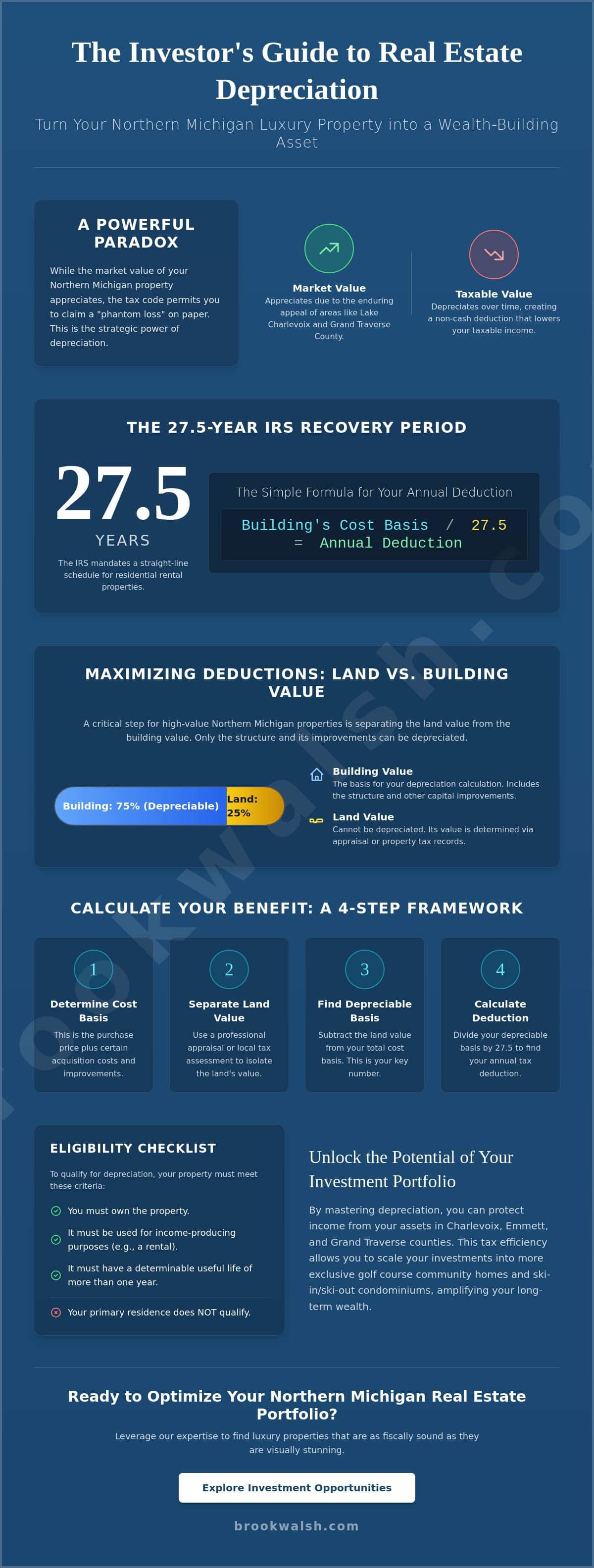
This creates a fascinating paradox for the sophisticated investor. While the market value of your home likely appreciates due to the enduring appeal of the region, the tax code permits you to claim a loss on paper. These phantom losses are essential for reducing your taxable rental income without impacting your actual cash flow. It's a strategy that transforms a high-value physical asset into a tax-sheltered wealth engine, allowing you to retain more capital for future acquisitions or property enhancements. This concept is central to depreciation on rental property, as it bridges the gap between accounting reality and market performance. It allows you to build a portfolio that is as fiscally sound as it is visually stunning.
To better understand this concept, watch this helpful video:
Why Depreciation Matters in Luxury Real Estate
In markets like Petoskey or Harbor Springs, high entry costs for luxury waterfront homes amplify the impact of depreciation. A high-value asset generates a larger annual deduction, which is particularly useful for offsetting premium management costs when investing in Northern Michigan real estate. This ensures your ROI remains robust while maintaining the highest standards of quality for your resort lifestyle homes. By leveraging these deductions, you effectively protect the income generated by your most exclusive properties.
Eligibility Requirements for the Deduction
Not every property qualifies for this unique treatment. To benefit from depreciation on rental property explained here, you must own the asset and use it for income production. The property must have a determinable useful life exceeding one year. While your primary residence in Charlevoix offers personal rewards, it doesn't qualify for these benefits. This distinction drives many discerning buyers to structure acquisitions as short-term rentals to capture these fiscal advantages while enjoying the region's natural character.
The Mechanics: How Rental Property Depreciation Works
The transition from owner to investor involves a fundamental shift in perspective. You no longer view your Grand Traverse estate solely as a private retreat; it becomes a structured financial asset. The depreciation clock begins the moment your property is placed in service. This specific term describes the point when the home is ready and available for its intended income-producing use. For a waterfront home on Lake Charlevoix, this means the day the property is listed and prepared for guests, regardless of when the first reservation is actually booked.
Understanding these mechanics requires a focus on the physical structure itself. In any discussion regarding depreciation on rental property, the primary rule is that land does not depreciate. It remains a permanent fixture of the Northern Michigan landscape, supposedly eternal in its value. Only the building, along with certain improvements, qualifies for the annual deduction. This necessitates a meticulous separation of the purchase price, typically based on a professional appraisal or property tax records, to establish the depreciable basis of the structure.
The 27.5-Year IRS Recovery Period
The IRS mandates a straight-line schedule of 27.5 years for residential rental assets. The math is elegant in its simplicity. You divide the cost basis of the building by 27.5 to determine your annual non-cash deduction. This timeline reflects the government's estimate of the functional lifespan of a residential structure. If you choose to sell your property before this period concludes, you may face depreciation recapture. This is currently taxed at a federal rate of 25%, making long-term planning essential for those investing in Northern Michigan real estate.
Improvements vs. Repairs: A Critical Distinction
Distinguishing between capital improvements and routine repairs is a cornerstone of tax efficiency. According to IRS Publication 527, a repair keeps your property in good operating condition without adding significant value. Examples include minor plumbing fixes or painting a room in your Emmett County cottage; these are deducted in the year they occur. Conversely, capital improvements like a new cedar shake roof or a complete kitchen renovation add long-term value. These costs are not deducted all at once. They are added to the property's basis and depreciated over their own specific recovery periods.
Under the One Big Beautiful Bill Act, certain qualified improvements or personal property acquired after January 19, 2025, may qualify for 100% bonus depreciation. This allows for an immediate deduction of the full cost in the first year, providing a significant cash flow advantage. Ensuring your portfolio is optimized for these distinctions requires a discerning eye. If you are refining your strategy, a detailed investment property analysis can provide the clarity needed to maximize your fiscal benefits while preserving the regional character of your holdings.
Maximizing Deductions: Land vs. Building Value in Luxury Markets
The enduring allure of Northern Michigan lies in its untamed shoreline and ancient glacial topography. While these landscapes offer a sense of permanence, the structures we build upon them are viewed differently by the tax code. A fundamental rule within the framework of depreciation on rental property explained is that land never depreciates. It's considered an asset that is never used up or exhausted. For an investor, this means the portion of your purchase price attributed to the ground itself cannot be deducted. Only the improvements, the architectural havens we call home, qualify for the annual tax benefit.
Establishing an accurate cost basis is the first step toward tax efficiency. You must determine the ratio between the value of the land and the value of the building. Many investors look to property tax assessments to find this percentage, though these figures don't always reflect the true market nuances of a luxury estate. When seeking to have depreciation on rental property explained for high-net-worth scenarios, the precision of this split becomes your most valuable tool. According to IRS Publication 527, you must use a reasonable method to divide the cost. If you undervalue the land, you risk an audit; if you overvalue it, you leave significant tax savings on the table.
Valuation Challenges in Charlevoix and Emmet Counties
In coveted areas like Lake Charlevoix or the bluff-side estates of Harbor Springs, land values often represent a disproportionate share of the total acquisition cost. It's not uncommon for a premier waterfront lot in Emmett County to command a price nearly equal to the structure sitting upon it. This high land-to-building ratio can limit your annual depreciation deduction compared to inland properties. A professional appraisal is often vital here. It provides a defensible, data-driven foundation for your cost basis, ensuring your tax strategy remains as resilient as your investment.
The Role of Cost Segregation
To maximize immediate benefits, sophisticated owners often turn to cost segregation. This strategy allows you to identify and reclassify specific property components, such as bespoke cabinetry, high-end appliances, or elaborate landscaping, into shorter depreciation cycles. Instead of the standard 27.5-year schedule, these assets can be depreciated over 5, 7, or 15 years. This front-loads your deductions, significantly increasing cash flow during the early years of your investment. When investing in Northern Michigan real estate, this approach transforms a long-term tax play into an immediate financial advantage, providing the liquidity needed to further expand your regional portfolio.
Calculating Your Benefit: A Step-by-Step Framework
Transforming the abstract concept of tax law into a concrete financial advantage requires a meticulous approach to your property's fiscal architecture. To truly have depreciation on rental property explained, one must move beyond theory and into the granular details of the calculation itself. This process ensures that every dollar spent on your Northern Michigan acquisition works toward your long-term wealth preservation. Whether you are adding a Grand Traverse estate or an Emmett County retreat to your portfolio, following a standardized framework is essential for accuracy and IRS compliance.
- Step 1: Determine the total acquisition cost. This includes the purchase price plus non-deductible closing costs such as legal fees, recording fees, and title insurance.
- Step 2: Subtract the value of the land. As established previously, you must isolate the building basis to find the depreciable amount.
- Step 3: Apply the IRS mid-month convention. For the first year, the IRS assumes you placed the property in service in the middle of the month, regardless of the actual closing date.
- Step 4: Calculate the annual deduction. For every full year thereafter, you divide the building basis by 27.5.
- Step 5: Factor in capital improvements. Any major upgrades made during your ownership are added to the basis and depreciated on their own schedules.
A Practical Example for a Northern Michigan Condo
Consider a hypothetical $1,000,000 ski-in/ski-out condominium in Boyne Falls. If a professional appraisal determines the land value is $175,000, your depreciable building basis becomes $825,000. Dividing this by the 27.5-year recovery period results in an annual deduction of $30,000. By applying a $30,000 annual deduction, an investor can effectively transform a taxable profit into a paper loss, preserving vital cash flow for other regional opportunities. This paper loss offsets other passive income, significantly lowering your overall tax liability while the property itself continues to serve as a premier resort lifestyle asset. If you are ready to see how these numbers apply to specific listings, you can begin your search for condominium lifestyle homes for sale to find your next high-performing asset.
Reporting Requirements and IRS Form 4562
Documenting these benefits requires precision during the annual tax season. You will primarily use IRS Form 4562 to report your depreciation and amortization for each property in your portfolio. It's vital to maintain detailed records of all acquisition documents and receipts for capital improvements to defend your cost basis if questioned. While this guide provides a framework for depreciation on rental property explained, the nuances of Michigan real estate laws and individual tax situations often necessitate professional consultation. A tax advisor familiar with the luxury resort market can help ensure you are capturing every available incentive, from standard deductions to the 100% bonus depreciation currently available for qualified personal property.
Optimizing Your Northern Michigan Real Estate Portfolio
Tax efficiency is the bridge between owning a single property and building a lasting regional legacy. By mastering the principles of depreciation on rental property explained throughout this guide, you unlock capital that would otherwise be lost to the IRS. This liquidity is essential for those investing in Northern Michigan real estate, providing the means to acquire additional luxury waterfront homes or ski-in/ski-out condominiums. Within the sophisticated markets of Grand Traverse and Charlevoix, the ability to reinvest your tax savings allows you to scale your portfolio with quiet confidence and precision.
Brook Walsh Real Estate serves as your discerning local expert, providing the data-driven investment property analysis required to identify high-yield opportunities that align with your lifestyle goals. We don't just look at the physical structure; we evaluate the long-term wealth potential of every estate. This holistic approach ensures that your investments are as fiscally sound as they are visually stunning. Whether you are targeting a golf course community home in Emmett County or a downtown retreat, our regional expertise provides the steady hand needed to navigate these complex financial waters.
The Exit Strategy: Depreciation Recapture Explained
You must understand the eventual tax implications when you decide to transition your holdings. Depreciation recapture is the process by which the IRS seeks to tax the benefits you claimed during your ownership period. When a rental property is sold, the total amount of depreciation claimed is taxed at a federal rate of 25%. While this may seem like a hurdle, it shouldn't deter the savvy investor. The key is to view this as a deferred obligation rather than an immediate loss. Many discerning owners utilize a 1031 exchange to defer both capital gains and recapture taxes indefinitely. This allows you to trade up into larger, more exclusive luxury lifestyle homes, effectively rolling your wealth forward into more prestigious assets.
Curating Your Legacy in Northern Michigan
A property in Northern Michigan is more than a line item on a balance sheet; it's a sanctuary for your family and a testament to your success. We invite you to explore our curated selection of waterfront lifestyle homes for sale to find a property that serves as both a financial engine and an emotional haven. By combining professional tax strategies with our deep-rooted knowledge of the local market, you can build a portfolio that thrives across generations. Success here is found in the balance of data-driven analysis and a profound appreciation for the region's natural character. Contact Brook Walsh Real Estate today to begin refining your investment strategy and secure your place within these coveted geographies.
Securing Your Northern Michigan Legacy
The path to enduring wealth in the luxury markets of Charlevoix, Emmett, and Grand Traverse counties requires more than just an appreciation for natural beauty; it demands a rigorous commitment to fiscal precision. Having depreciation on rental property explained is merely the first step in a broader strategy to shield your assets and enhance your long-term returns. By applying these sophisticated tax principles, you ensure that every waterfront sanctuary or golf course retreat serves your family legacy for generations. Success in this unique geography depends on a partner who balances data-driven ROI projections with a deep-rooted passion for our local character.
Brook Walsh Real Estate provides the steady hand needed to navigate these complex financial waters while securing your next emotional haven. It's time to refine your strategy and elevate your investment potential. You deserve a guide who values the profound connection between a person and their environment as much as the granular details of a professional transaction. Explore high-yield investment opportunities in Northern Michigan with Brook Walsh Real Estate and discover how our expertise can redefine your financial future. Your journey toward a more resilient and rewarding portfolio begins with a single, informed decision.
Frequently Asked Questions
How many years can I depreciate a residential rental property?
The IRS allows you to depreciate residential rental properties over a period of 27.5 years. This recovery period is the standard timeline for residential assets under the Modified Accelerated Cost Recovery System (MACRS). Whether you own a ski-in/ski-out condominium in Boyne Falls or a waterfront estate in Grand Traverse County, the structure's cost is divided equally across this duration to determine your annual deduction.
Can I claim depreciation on a vacation home I also use personally?
You can claim depreciation on a vacation home, but the deduction must be prorated based on the percentage of time the property is used for rental purposes. If your Charlevoix retreat is used personally for part of the year, you only depreciate the portion of the cost basis allocated to the days it was available as a short-term rental. This ensures your tax strategy remains compliant with personal use limitations while protecting your investment's cash flow.
What happens to depreciation if I sell my rental property?
When you sell your property, the IRS triggers depreciation recapture, which taxes the total depreciation you claimed over the years at a federal rate of 25%. This process adjusts your gain to account for the tax benefits you received during your ownership. Sophisticated investors in Emmett County often utilize a 1031 exchange to defer this recapture tax, allowing them to reinvest the full proceeds into a new luxury asset or a more expansive regional estate.
Do I have to take depreciation, or is it optional?
Depreciation is technically not optional because the IRS calculates your tax liability based on the depreciation that was allowed or allowable. Even if you choose not to claim the deduction on your annual return, you'll still be subject to recapture tax on that amount when you sell. Having depreciation on rental property explained correctly means understanding that you should always claim it to avoid paying for a benefit you never actually utilized during your ownership.
Can I depreciate the cost of land in Northern Michigan?
You cannot depreciate the cost of land, as the IRS considers land to be an asset that never wears out or becomes exhausted. While the pristine acreage surrounding your Harbor Springs estate is inherently valuable, only the physical structure and certain improvements qualify for the deduction. This makes an accurate appraisal essential for isolating the building's value from the underlying shoreline or forest to maximize your legitimate tax savings.
How does depreciation affect my property’s cost basis?
Depreciation reduces your property's adjusted cost basis by the amount of the deduction taken each year. If you buy a property for a certain amount and claim significant depreciation over several years, your basis for calculating future gains or losses decreases accordingly. This lower basis eventually results in a larger taxable gain upon sale, which is why many investors plan for a 1031 exchange to protect their accumulated wealth.
What is the difference between straight-line and accelerated depreciation?
Straight-line depreciation spreads the deduction evenly over 27.5 years, while accelerated methods front-load the benefits into the earlier years of ownership. While residential structures typically use the straight-line method, you can use accelerated methods for personal property or land improvements through cost segregation. This approach is particularly effective for those seeking depreciation on rental property, explained through the lens of immediate cash flow maximization for their resort lifestyle holdings.
Can I start depreciating a property as soon as I buy it?
You cannot start depreciating a property until it is placed in service, which means it's ready and available for rent. If you acquire a luxury home in Grand Traverse and spend several months on aesthetic renovations before listing it, the depreciation clock doesn't start until those updates are complete. The property must be available to guests or tenants to qualify for the first year's prorated deduction under the mid-month convention.
Posted by Brook Walsh onEnjoy this blog post? Click here to subscribe for updates
Leave A Comment