

What if the Northern Michigan property that feels like a perfect escape doesn’t perform as you expect? Avoiding the pitfalls of real estate investing starts with looking beyond a beautiful shoreline, a resort setting, or an appealing income projection. Before you commit, test the assumptions behind the purchase and separate lifestyle appeal from the investment case.
It’s natural to be drawn to a property that offers personal enjoyment and financial potential. But projected rental income, resale expectations, property condition, and the realities of ownership each need a careful review. From Boyne City and Boyne Falls to Charlevoix, Petoskey, Harbor Springs, and East Jordan, the details can vary by property and community.
This guide offers a practical framework for assessing risk, testing income and resale assumptions, and reviewing property-specific and local considerations. It also helps you distinguish the home you want to enjoy from the investment you expect to make. A considered decision can account for both without treating one as proof of the other.

Key Takeaways
- Separate a property’s lifestyle appeal from its investment potential before deciding whether it fits your goals.
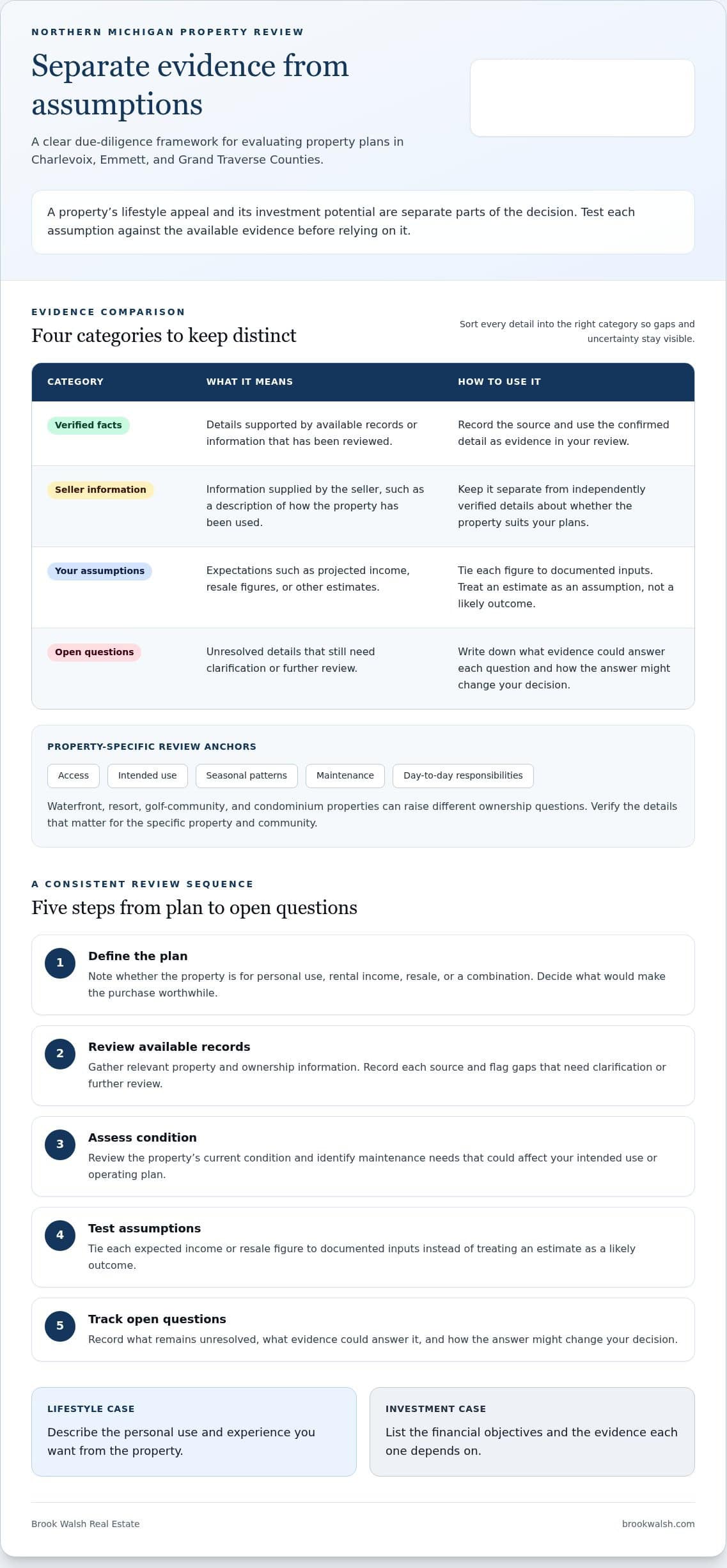
- Use a consistent due-diligence process to distinguish verified facts from seller information, assumptions, and open questions.
- Compare waterfront, resort, golf, and condominium properties by intended use and operating demands, not projected returns alone.
- Set criteria for when to proceed, pause, or walk away. Test attractive income assumptions before relying on them.
- Build an ownership plan alongside your purchase analysis, connecting financial assumptions with your intended use in Northern Michigan.
Table of Contents
- Why real estate investments go wrong before the purchase
- Build a due-diligence process around the property, not the pitch
- Compare Northern Michigan property opportunities without chasing projected returns
- Set decision rules for risk, operations, and changing circumstances
- Make a considered Northern Michigan investment decision with local guidance
Why real estate investments go wrong before the purchase
Northern Michigan’s appeal is easy to understand: a waterfront view, a quiet resort setting, or a home near golf can make a distinctive retreat. But the qualities that make a property attractive for personal use don’t automatically make it a sound investment. Risk often enters before an offer, when a compelling vision is paired with income or resale assumptions that haven’t been tested.
An investment pitfall is a preventable gap between what a buyer assumes and what the available evidence supports. That gap might involve projected income, the property’s condition, whether the location fits its intended use, the work required to operate it, or the eventual resale plan. The broad overview of real estate investing also emphasizes why market analysis and financial risks belong in the decision from the start.
A disciplined review doesn’t mean ignoring the personal value of a Northern Michigan retreat. It means giving enjoyment and investment performance separate places in your decision. Brook Walsh Real Estate’s Northern Michigan investment analysis helps connect financial assumptions with a property’s intended lifestyle use, so you can weigh both without confusing one for the other.
When enthusiasm outruns investment discipline
It’s easy to picture summer mornings by the water or evenings near a resort, then imagine furnishing the home before resolving practical questions. Does the property support your intended use? What condition concerns need review? How much time or oversight would ownership require? When you’re emotionally attached, unanswered questions can seem less urgent, even if their answers could change the decision.
Write down both priorities. Describe the lifestyle you want, then separately list your investment objectives and the evidence each one depends on. A property can be personally meaningful but fall short of your financial criteria. It might also meet your investment aims without being the right personal escape. A written framework keeps both possibilities in view.
Why a Northern Michigan property needs local context
Boyne City, Boyne Falls, Charlevoix, Petoskey, Harbor Springs, and East Jordan each offer a distinct setting. Property types within those communities can also raise different ownership questions. A waterfront home, condominium, golf-community residence, or resort property may require close attention to access, intended use, seasonal patterns, maintenance, and day-to-day responsibilities.
Before relying on a market trend or assuming a rental plan will work, identify what needs to be verified for the specific property. Review available property records and condition information. Investigate relevant land-use and rental considerations for the community and assess whether access and operating requirements align with your plan. Rules and market conditions can vary by location, so verify claims using current, authoritative information. Local context turns an appealing impression into a decision grounded in the property itself.
Build a due-diligence process around the property, not the pitch
A compelling listing or income projection is a starting point, not evidence that a property fits your plan. Use the same review sequence for a waterfront home, resort property, golf-community residence, or condominium, then tailor your questions to its intended use and responsibilities. Investment assumptions are only as dependable as the evidence behind them.
- Define the plan. Note whether the property is for personal use, rental income, resale, or a combination. Decide what would make the purchase worthwhile.
- Review available records. Gather relevant property and ownership information. Record each source and flag gaps that need clarification or further review.
- Assess condition. Review the property’s current condition and identify maintenance needs that could affect your intended use or operating plan.
- Test assumptions. Tie each expected income or resale figure to documented inputs instead of treating an estimate as a likely outcome.
- Track open questions. Record what remains unresolved, what evidence could answer it, and how the answer might change your decision.
Keep four categories distinct: verified facts, information supplied by the seller, your own assumptions, and details requiring further review. For example, a seller’s description of how a property has been used isn’t the same as independently verified information about its suitability for your plans. This distinction shows where confidence is supported and where uncertainty remains.
What to examine before treating a property as an investment
Start with intended use, condition, ownership responsibilities, and relevant available records. Then create property-specific questions about access, utilities, maintenance, and use. A waterfront property may call for different questions than a condominium or golf-community home, so don’t assume that one property’s arrangements apply to another. Verify the details that matter for the property and community, and note each unresolved item alongside its potential effect on your plan.
How to test a property’s financial assumptions
Build your projection from its components: expected income, vacancy assumptions, operating expenses, maintenance, and management needs. For a rental, include relevant costs such as utilities, cleaning, marketing, and ongoing upkeep in your expense review. Label the source for each input, separating documented information from estimates. Then compare conservative, expected, and weaker scenarios. Adjust assumptions you can’t substantiate rather than quietly treating them as facts. If the weaker scenario changes whether the property meets your objectives, pay close attention before proceeding.
Projections are planning tools, not guaranteed outcomes. Actual results depend on the property, its use, and how it’s operated. Brook Walsh Real Estate’s Northern Michigan investment analysis can help connect financial assumptions with a property’s intended lifestyle use.
Compare Northern Michigan property opportunities without chasing projected returns
A useful comparison doesn’t ask which property type promises the highest return. It asks which one fits your intended use, available time, and willingness to manage its responsibilities. A waterfront home, resort property, golf-community residence, or condominium may each suit a different ownership plan. Across Charlevoix, Emmet, and Grand Traverse counties, assess each opportunity on its own merits instead of assuming one property type or community performs better.
Match the property type to the ownership plan
For personal use, consider the setting, access, and time you expect to spend at the property. A rental plan adds operating responsibilities, while resale planning calls for a clear view of the assumptions behind your expected exit. Waterfront or resort appeal alone can’t establish investment performance. Use lifestyle-based property searches to clarify what matters to you, and explore waterfront lifestyle homes as one way to assess that fit.
| Property type | Intended use | Operating demands to examine | Key assumptions | Unresolved questions |
|---|---|---|---|---|
| Waterfront | Personal retreat, rental use, or both | Maintenance, access, and oversight | Income, upkeep, and resale expectations | Are property condition and intended use understood? |
| Resort | Personal stays or guest use | Management needs and use arrangements | Demand, operating expenses, and exit plan | Do local conditions support the intended plan? |
| Golf community | Lifestyle purchase or investment use | Property care and ongoing ownership responsibilities | Use patterns, costs, and resale assumptions | Which details depend on this specific property? |
| Condominium | Personal use, rental use, or a combination | Management responsibilities and applicable shared arrangements | Income, expenses, upkeep, and resale expectations | What records clarify responsibilities and permitted use? |
Compare scenarios using consistent assumptions
Use the same categories for every candidate: expected income, vacancy, expenses, upkeep, management, and exit assumptions. If you include a cost or responsibility for one property, include the comparable category for the others. This makes differences easier to interpret without pretending distinct properties are identical.
Test sensitivity by changing one input at a time. Consider how your decision could change if income is lower than expected or upkeep requires more attention. Treat this as a comparison exercise, not a forecast. Research local demand and applicable land-use or rental considerations in the specific community, whether you’re considering a property in Charlevoix County, Emmet County, or Grand Traverse County. Comparing fit and evidence instead of appealing projections is a practical way of avoiding the pitfalls of real estate investing.
Set decision rules for risk, operations, and changing circumstances
A clear decision framework is most useful before a property feels irresistible or a perceived deadline creates pressure. Set criteria for when to buy, pause, or walk away, then apply them consistently. Attractive projected income can’t replace verified assumptions. If key inputs remain uncertain, decide what evidence would resolve them and whether the purchase still fits without optimistic projections.
Sort risks into two groups: those you can plan for and those that need more information. Your pros-and-cons notes might look like this:
- More controllable: assigning an owner or manager to coordinate maintenance, planning for operating expenses, and setting aside time for regular property reviews.
- Needs further review: unresolved questions about the property’s condition or use, changes in local requirements, or shifts in demand and resale conditions.
This distinction turns concerns into next steps. For a controllable risk, define who will handle it and what resources the plan requires. For an uncertainty, identify the information you need and how a less favorable answer could affect your decision.
Create a practical ownership and contingency plan
Before committing, decide who will oversee the property, coordinate maintenance, and respond to operating needs. Consider what could change, including the property’s use, expenses, condition, or market circumstances, without assuming a particular outcome. Set review points that fit your ownership plan, such as after an operating period or when a major expense arises. Define what evidence would prompt you to revise the plan, lower your expectations, or reconsider holding the property.
Keep the plan usable. A simple record of the issue, its likely effect, the evidence needed, and the person responsible can make an unexpected repair or operating change easier to assess. It also gives you a reference point when the original purchase assumptions no longer match the facts.
Keep personal use and rental operations realistic
If you plan to use a property personally and rent it at other times, decide how those priorities will coexist. Personal stays can reduce the time available for guest bookings, so include your intended use when evaluating availability and income assumptions. A vacation-rental operating plan should also account for marketing, maintenance, guest management, and the oversight needed to keep the property functioning as intended.
Revisit those assumptions as you gain experience. If actual use, upkeep, or management needs differ from the plan, update your expectations instead of relying on the original projection. Brook Walsh Real Estate’s Northern Michigan investment analysis can help connect a property’s financial assumptions with its lifestyle fit. Consider both as you shape an ownership plan.
Make a considered Northern Michigan investment decision with local guidance
A thoughtful purchase decision follows a clear sequence: define the property’s purpose, verify important details, compare assumptions, plan for operations, and set criteria for reviewing the investment over time. This process keeps the financial case distinct from the pleasure of owning a Northern Michigan retreat, while still allowing both to inform your choice.
Local context matters. A waterfront property in Charlevoix County, a condominium near a resort in Emmet County, and a golf-community home in Grand Traverse County may raise different questions about intended use, operating responsibilities, and projected income or resale. Treat each opportunity as its own case rather than applying one broad conclusion to the region.
Where local investment analysis fits
Investment analysis is most useful when it considers property fit, intended use, projected returns, and ownership responsibilities together. Review a projection alongside the assumptions behind it and the practical work involved in ownership. This can help clarify whether a home is primarily a personal retreat, an income-oriented asset, or a combination that involves trade-offs.
Brook Walsh Real Estate supports Northern Michigan buyers and investors through property brokerage, investment analysis, and vacation-rental management. Its local perspective can help frame questions specific to communities across Charlevoix, Emmet, and Grand Traverse counties without treating their markets or opportunities as interchangeable. For early research, Northern Michigan investment information offers a starting point for considering how lifestyle goals relate to financial assumptions.
Choose a next step that matches your investment stage
If you’re still exploring, clarify the kind of ownership experience you want and the role you expect the property to play. If you’re evaluating a specific opportunity, bring your documented assumptions into the decision. Separate verified information from estimates, list unresolved questions, and consider how the operating plan supports your intended use. Brook Walsh’s investment property analysis and ROI projections can help assess those assumptions in the context of the property and its lifestyle fit. For a vacation rental, the operating picture also includes marketing, maintenance, and guest management.
A considered approach to avoiding the pitfalls of real estate investing doesn’t require certainty about every future outcome. It requires a clear view of what you know, what you’re assuming, and what could change your decision. That clarity can help you move forward or pause when the evidence calls for a closer look.
Explore Northern Michigan real estate and start shaping an investment plan around your goals and the life you want the property to support.
Explore Northern Michigan real estate
Move forward with a clearer investment perspective
The right Northern Michigan property should make sense in both your financial analysis and the ownership experience you envision. As you consider opportunities in Charlevoix, Emmet, and Grand Traverse counties, investment analysis can help you weigh financial assumptions alongside lifestyle fit. Vacation-rental management can also support the operating plan behind a rental property.
A considered next step doesn’t have to mean rushing toward a purchase. It might mean refining your priorities, exploring properties, or bringing a specific opportunity into sharper focus. That steady approach is central to avoiding the pitfalls of real estate investing: make choices that reflect the evidence, the responsibilities, and the experience you want.
Explore Northern Michigan real estate and take the next step toward a purposeful, well-considered property plan.
Frequently Asked Questions
Is real estate investing a low-risk way to build wealth?
No. Property ownership can build value over time, but it also involves financial and operational risks. Vacancy, an unexpected repair, a change in demand, or a resale price below your expectations can affect the investment. Before committing, consider whether you could manage a less favorable scenario without relying on optimistic projections. Avoiding the pitfalls of real estate investing means weighing potential benefits against the property’s specific risks and your financial position.
Can a vacation home still make sense if I plan to use it personally?
Yes, if personal value is part of the plan rather than hidden inside the income projection. For example, decide how often you expect to use a home near Petoskey or Charlevoix, then assess whether the remaining availability supports your rental objectives. Consider whether you’d still value owning it if rental income were lower than expected. Your answer can help distinguish a lifestyle purchase with rental income from an investment that depends on frequent bookings.
How much cash should I keep available for an investment property?
There’s no single cash reserve that fits every property. Estimate the funds you may need for ownership costs, planned maintenance, urgent repairs, periods without rental income, and management or guest needs if it’s a vacation rental. Base your reserve on property information and your own operating assumptions, not a generic rule of thumb. Keep purchase funds separate from the cash you expect to rely on after taking ownership.
What happens if a vacation rental receives fewer bookings than expected?
Lower bookings can reduce income while expenses and upkeep continue. Consider this possibility before buying by assessing whether you could manage the property if rental revenue fell short of your projection. You may also need to revisit pricing assumptions, marketing, intended personal use, or the operating plan. In Northern Michigan, assess the specific property and community rather than assuming booking patterns in Boyne City or Harbor Springs will match those elsewhere.
Do I need to account for property management when assessing an investment?
Yes. Rental ownership involves more than receiving bookings. It can include marketing, guest communication, coordinating maintenance, and overseeing the property between stays. Decide who will handle those tasks and how the arrangement fits your time and budget assumptions. If you expect to manage the property yourself, consider how distance from places such as Boyne Falls or East Jordan could affect oversight. Brook Walsh Real Estate provides vacation-rental management covering marketing, maintenance, and guest management.
How can I compare investment properties in different Northern Michigan counties?
Use the same evaluation categories for each property, then investigate community-specific details instead of treating a county as uniform. Compare options in Charlevoix, Emmet, and Grand Traverse counties by intended use, property condition, access, operating responsibilities, income assumptions, and resale considerations. You can also compare homes in Boyne City, Charlevoix, Petoskey, Harbor Springs, Boyne Falls, and East Jordan, while separately verifying local factors that could affect your plan.
Posted by Brook Walsh onEnjoy this blog post? Click here to subscribe for updates
Leave A Comment