

What if a Northern Michigan property’s projected cash-on-cash return looks less reassuring after you account for all the cash invested and the months when rental demand slows? If you’re asking what is a cash-on-cash return in real estate, it’s a measure that compares a property’s annual pre-tax cash flow with the cash you put into it. It offers a useful snapshot, but it isn’t a verdict on an investment.
For buyers weighing a vacation rental or another investment property in Charlevoix, Emmet, or Grand Traverse County, the calculation depends on more than the down payment. Closing and startup costs, operating expenses, financing, and realistic seasonal income assumptions can all shape the result. In this guide, you’ll learn which figures belong in the formula, how to interpret the percentage, and how cash-on-cash return differs from cap rate and total return. You’ll also see where the metric falls short and how a property-specific analysis can help you decide whether an investment fits your goals.

Key Takeaways
- Understand what is a cash-on-cash return in real estate is and why it measures cash flow against the capital invested, rather than overall investment quality.
- Identify which income, expenses, debt payments, and upfront costs can influence the calculation.
- Compare cash-on-cash return with cap rate and total return to see how financing changes the picture.
- Evaluate a Northern Michigan property using assumptions suited to its location and likely rental seasonality in Charlevoix, Emmet, or Grand Traverse County.
- Use the result alongside broader property analysis to weigh projected rental performance against the value of personal use.
Table of Contents
- What Is a Cash-on-Cash Return in Real Estate, and What Does It Measure?
- How to Calculate Cash-on-Cash Return for a Rental Property
- How to Interpret Cash-on-Cash Return Alongside Other Measures
- Assessing Cash-on-Cash Return for Northern Michigan Properties
- Use Cash-on-Cash Return to Make a More Informed Property Decision
What Is a Cash-on-Cash Return in Real Estate, and What Does It Measure?
What is a cash-on-cash return in real estate? It’s annual pre-tax cash flow divided by the total cash invested in a property. Expressed as a percentage, it shows how much annual cash flow the property produces relative to the capital the investor contributed.
Think of it as a snapshot of cash performance, not a measure of everything a property may be worth. It doesn’t capture changes in market value, potential appreciation, or proceeds from a future sale. For buyers considering investment opportunities in Northern Michigan, that distinction helps separate projected income from the appeal of a waterfront retreat, a resort-area condominium, or a property with personal meaning.
For a visual introduction to the calculation and the idea behind it, watch this brief explainer:
What does cash-on-cash return tell a property investor?
The percentage answers a practical question: how much annual cash flow is generated for each dollar of contributed capital? For example, if an investment hypothetically produces $12,000 in annual pre-tax cash flow on $200,000 of cash invested, its cash-on-cash return is 6% for that period.
Investors can use this snapshot to compare opportunities, provided they apply consistent assumptions to each property. A higher projected percentage can indicate more cash flow relative to invested capital, but it doesn’t automatically make one property the better choice. It can’t account for every financial priority or lifestyle consideration.
What does this real estate metric leave out?
Cash-on-cash return focuses on annual cash flow. It doesn’t independently account for future appreciation or the proceeds an owner might receive when selling. Those outcomes depend on factors beyond the annual operating picture and shouldn’t be treated as assured gains.
The result is only as useful as the assumptions behind it. Change expected income, expenses, financing, or the amount of cash invested, and the result changes too. For a Northern Michigan vacation rental, a projection based on steady demand throughout the year may look very different from one that accounts for seasonal variation. Neither projection guarantees actual performance.
There’s no universally good, safe, or achievable percentage that can decide whether a property is right for you. A cash-flow snapshot can inform a comparison, but it can’t establish overall suitability on its own. Consider projected income alongside costs, your investment objectives, and the personal-use value you place on time in Charlevoix, Emmet, or Grand Traverse County.
How to Calculate Cash-on-Cash Return for a Rental Property
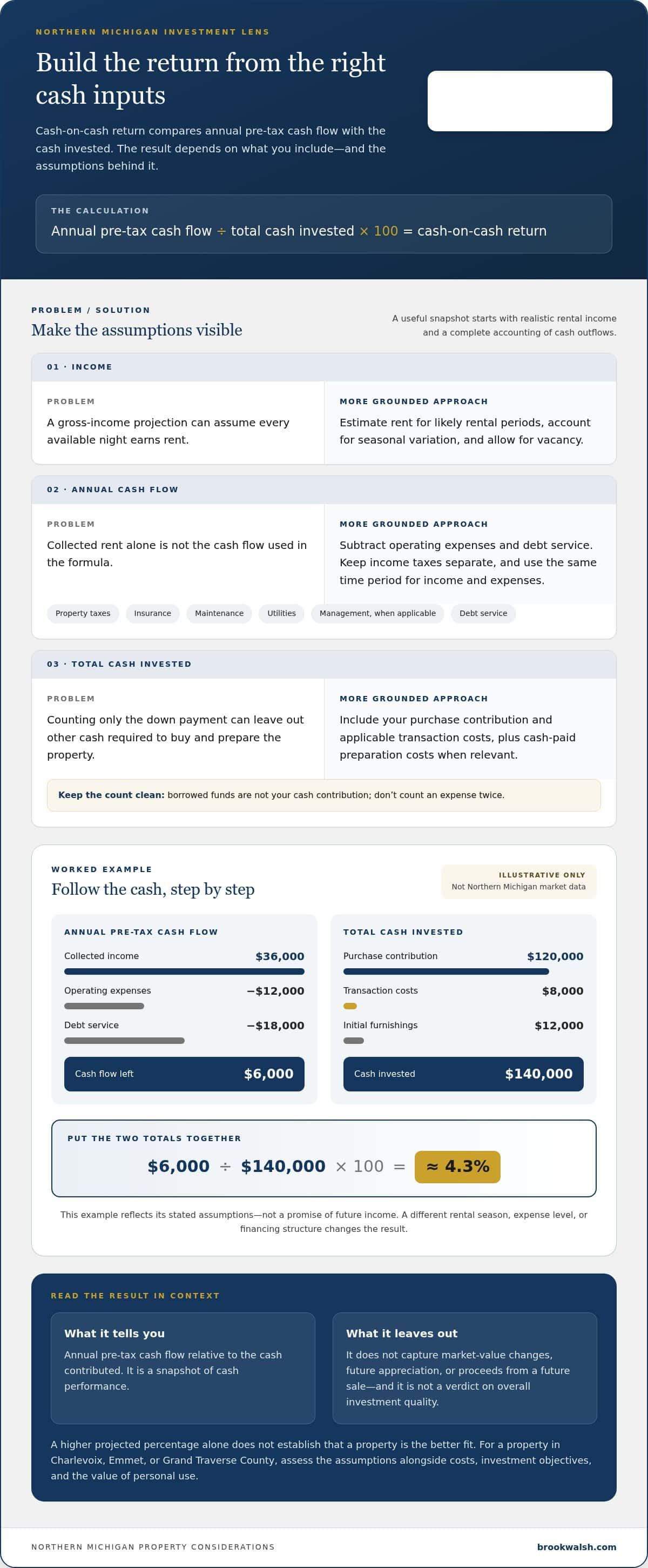
To calculate the return, compare the property’s annual pre-tax cash flow with the cash you personally invested. The formula is:
Cash-on-cash return = (annual pre-tax cash flow ÷ total cash invested) × 100
Annual pre-tax cash flow is the income left after operating expenses and debt service. Total cash invested is your upfront cash contribution and related outlays. The Corporate Finance Institute’s definition of cash-on-cash return also highlights the relationship between property cash flow and investor cash, an important distinction when financing is involved.
Which figures belong in annual cash flow?
Start with a realistic estimate of rent collected, not an idealized gross-income projection. For a Northern Michigan vacation property, account for the possibility that demand and bookings vary by season. Estimate income for the periods the property is likely to be rented, and allow for vacancy rather than assuming every available night produces revenue.
Then subtract operating expenses, such as property taxes, insurance, maintenance, utilities, and management costs when applicable, along with debt service. Keep income taxes separate because this calculation measures pre-tax cash flow. Use the same time period for income and expenses, typically one year, so the comparison is consistent.
What counts as total cash invested?
Include the cash you contribute toward the purchase and applicable transaction-related outlays. Depending on the property, your initial investment may also include cash-paid repairs, furnishings, or other work needed to prepare it for rental use. Don’t count borrowed funds as your own cash contribution, and don’t count an expense twice if it already appears elsewhere in your calculation.
Illustrative example, not Northern Michigan market data: Suppose a rental generates $36,000 in collected income for the year. After $12,000 in operating expenses and $18,000 in debt service, annual pre-tax cash flow is $6,000. If the investor contributed $120,000 toward the purchase, paid $8,000 in transaction costs, and spent $12,000 on initial furnishings, total cash invested is $140,000. The calculation is $6,000 ÷ $140,000 × 100, or approximately 4.3%.
This result reflects the assumptions used, not a promise of future income. A different rental season, expense level, or financing structure would change the outcome. For a property in Charlevoix, Emmet, or Grand Traverse County, a property-specific investment analysis can help organize those inputs. Brook Walsh Real Estate provides Northern Michigan investment property analysis to help frame the calculation alongside broader property considerations.
How to Interpret Cash-on-Cash Return Alongside Other Measures
A return percentage is most useful when you know what it measures and what it leaves out. Cash-on-cash return focuses on annual cash flow relative to investor cash, while cap rate and total return offer different perspectives. If you’re asking what is a cash-on-cash return in real estate is, interpreting it alongside these measures is part of the answer: no single percentage tells the whole investment story.
| Measure | What it helps assess | How financing is treated |
|---|---|---|
| Cash-on-cash return | Annual pre-tax cash flow relative to the investor’s cash contributed | Debt service and cash invested affect the result |
| Cap rate | Property operating income relative to its value or purchase price | Mortgage financing is excluded |
| Total return | A broader view that may combine income with changes in property value | Depends on the calculation method and what components are included |
Cash-on-cash return versus cap rate
Cash-on-cash return reflects the investor’s financing choices: debt service reduces cash flow, and the amount of cash contributed forms the denominator. Cap rate, by contrast, compares a property’s net operating income with its value before mortgage payments enter the calculation. It can help isolate operating performance from financing, but neither measure replaces a careful review of the property.
This distinction matters when comparing Northern Michigan opportunities. Two properties with similar operating income may show different cash-on-cash returns if their purchase financing or upfront cash contributions differ. Their cap rates may be more alike if the income and property-value inputs are calculated consistently. Each metric answers a different question, so use them as complementary lenses rather than competing verdicts.
Why a strong-looking percentage can still mislead
Projected results rely on assumptions. Optimistic rent, high occupancy, understated operating expenses, or financing terms that don’t reflect the buyer’s actual scenario can project appear stronger than it may prove to be. For vacation properties in Charlevoix, Emmet, or Grand Traverse County, rental demand may vary by season, so annual assumptions should reflect the property’s likely use rather than presume uniform bookings.
Projected performance isn’t the same as actual results over an ownership period. Income and expenses can change, and a property’s condition may raise considerations that a return percentage cannot express. A Northern Michigan home might also hold personal value as a place to gather or get away, separate from its projected rental income.
One percentage alone cannot establish investment quality. Compare properties using consistent periods and assumptions for income, operating costs, vacancy, and financing. Then consider property condition, your objectives, and your tolerance for uncertainty. Brook Walsh Real Estate’s data-driven Northern Michigan investment analysis can put these measures in context as you assess whether the numbers and the property align with your plans.
Assessing Cash-on-Cash Return for Northern Michigan Properties
A useful projection starts with the individual property, not a countywide assumption. In Charlevoix, Emmet, and Grand Traverse counties, location, property type, likely rental use, and the evidence available about demand all shape the income estimate. Buyers considering properties in Charlevoix, Petoskey, Harbor Springs, Boyne City, Boyne Falls, or East Jordan should assess each home on its own terms. A waterfront home and a condominium in a resort setting may attract different guests and booking patterns.
For a grounded estimate, gather the property’s known operating details and state the assumptions behind any forecast. Separate documented information, such as actual rental history when available, from estimates about future bookings or expenses. A modeled scenario helps test possibilities, but it isn’t verified local rental data and shouldn’t be presented as a prediction.
How seasonality can shape a rental projection
Where evidence supports seasonal variation, estimate income across distinct periods rather than applying one unsupported annual average. Consider which parts of the year are likely to draw guests, which may have fewer bookings, and how owner use could reduce rentable availability. Expenses such as utilities, maintenance, and management may continue during gaps between stays, so include them rather than assuming costs disappear when a property is vacant.
Compare more than one scenario when useful: a conservative case with fewer bookings, a case based on documented history, and a stronger case only when supported by credible evidence. Label each clearly. This makes uncertainty visible and shows how sensitive the projected return is to booking assumptions, without implying that any scenario guarantees a particular outcome.
Compare property types without assuming identical performance
Waterfront homes, resort properties, and other potential rentals each call for assumptions suited to their features and intended use. Consider how access, layout, guest capacity, owner-use plans, and the likely rental season affect availability and operating needs. These are factors to evaluate property by property, not reasons to assume that one category will always produce stronger returns.
Northern Michigan waterfront homes may offer a distinctive setting, but waterfront appeal alone doesn’t establish rental income or investment performance. The details of a particular home and a realistic operating plan still matter. What is a cash-on-cash return in real estate worth assessing locally? A figure built from assumptions that reflect the property and its likely use.
For a more complete view, connect projected cash flow to the property’s costs, condition, intended use, and your investment objectives. Brook Walsh Real Estate provides Northern Michigan investment guidance and property-specific analysis to help frame those considerations. Review investment property analysis for Northern Michigan to see how projected returns fit into a broader evaluation.
Use Cash-on-Cash Return to Make a More Informed Property Decision
A calculated return is a starting point, not a purchase decision. Before relying on a projection for a Northern Michigan property, verify the inputs, test the assumptions, compare relevant measures, and assess whether the property fits your goals. This process puts the numbers in context, whether you’re considering a vacation home in Charlevoix, Emmet, or Grand Traverse County or a property primarily intended to generate rental income.
What to review before relying on a projection
Revisit the estimated rental income and the expenses that support it. Make sure your projection reflects the property’s likely rental use, operating costs, financing assumptions, and property-specific capital needs, such as initial work or furnishings where applicable. Keep documented information distinct from estimates so it’s clear which inputs are established and which remain uncertain.
Then test how the result changes when a key assumption shifts. What happens if bookings are lower than projected, an expense is higher, or the financing structure changes? This sensitivity check won’t predict the future, but it can show whether the projection depends heavily on one optimistic input. Before relying on a particular short-term rental use, verify current requirements with the relevant municipality.
- Verify the income, expense, financing, and property-cost inputs.
- Test how plausible changes affect the projected result.
- Compare the projection with other measures, including cap rate and total return.
- Assess whether the investment suits your financial objectives and intended use.
Keep personal-use value separate from projected rental performance. A home may offer a welcome retreat near Northern Michigan’s shoreline or other attractions, but that enjoyment isn’t rental income. If you expect to use the property yourself, account for how those stays affect the time available to rent. You can then consider both benefits clearly without treating one as proof of the other.
When local investment guidance can add perspective
Local context can ground assumptions in the details of a specific property and area. A projection for one home shouldn’t be treated as a template for another, even nearby. Brook Walsh Real Estate provides data-driven investment consulting and ROI projections that bring income and expense assumptions together with broader property considerations. The analysis is a planning tool, not a promise of a particular return.
Asking what is a cash-on-cash return in real estate is useful when it leads to better questions about the property, the assumptions, and your goals. If you’re weighing an investment in Northern Michigan, explore Northern Michigan property investment opportunities as a measured next step toward a fuller evaluation.
Shape Your Next Northern Michigan Investment Decision
A property decision is also a choice about how you want the home to serve you over time. In Charlevoix, Emmet, and Grand Traverse counties, that may mean prioritizing rental potential, preserving time for personal use, or balancing the two. Knowing what is a cash-on-cash return in real estate can help frame that choice, but your goals should guide how you interpret the numbers.
Brook Walsh Real Estate brings data-driven investment analysis and ROI projections to property-specific decisions, along with vacation rental management and brokerage services in Northern Michigan. The aim is a clearer view of how an opportunity aligns with your plans, not a promise of a particular outcome.
Ready to evaluate a Northern Michigan investment? Explore Brook Walsh Real Estate’s property investment guidance and take the next step toward a property that reflects your investment priorities and the Northern Michigan experience you value.
Frequently Asked Questions
What counts as cash invested in a real estate cash-on-cash calculation?
Cash invested generally means the money you contribute at acquisition, plus applicable transaction costs and initial property outlays. A down payment, closing expenses, and cash-paid work or furnishings may apply, depending on the deal. For what is a cash-on-cash return in real estate analysis, keep these cash outflows separate from the property’s estimated or appraised value. Use a consistent method and record each cost once rather than duplicating it in multiple categories.
Can cash-on-cash return be negative?
Yes. A negative result can occur if a property’s annual pre-tax cash flow falls below zero after applicable operating expenses and debt service. It indicates a modeled cash shortfall for the period, not the property’s complete long-term outcome. Before drawing conclusions, review the inputs, including rental income, expenses, and financing, and consider how the property fits your broader investment objectives. A negative figure alone doesn’t determine whether the investment is suitable.
What happens to cash-on-cash return if I invest more money after buying a property?
An additional cash contribution increases the total cash invested used in a later calculation. If the money funds an improvement that changes rental income or operating expenses, update those figures as well. Keep a record of when each contribution was made and what it funded. This lets you compare periods consistently instead of changing the original calculation and losing sight of how the investment’s performance has evolved.
Can I calculate cash-on-cash return for a property that I use personally?
You can calculate it if the property generates measurable rental cash flow, but it may offer little insight for a home used only by you. A personally enjoyed waterfront retreat near Charlevoix or Boyne City has lifestyle value the metric doesn’t quantify. If you rent the home for part of the year, distinguish rental periods from personal stays and use assumptions that reflect the days actually available to guests.
How often should a real estate investor recalculate cash-on-cash return?
Recalculate when actual rental income, operating expenses, financing, or additional invested cash materially changes. For example, compare a new period’s results with the original projection and note whether a difference came from bookings, a changed expense, or another input. There’s no single schedule that suits every property. Updating the calculation keeps the analysis tied to current information, but it doesn’t predict what the next period will bring.
Does cash-on-cash return include the money I might make when I sell a property?
No. The standard measure focuses on annual pre-tax cash flow relative to cash invested; it doesn’t independently include appreciation or future resale proceeds. A sale outcome is uncertain, so evaluate it separately within a broader investment analysis. If you model a possible sale, state the assumptions and method clearly, and keep that scenario distinct from annual operating cash flow. This makes it easier to see which part of the projection comes from rental operations.
Posted by Brook Walsh onEnjoy this blog post? Click here to subscribe for updates
Leave A Comment