
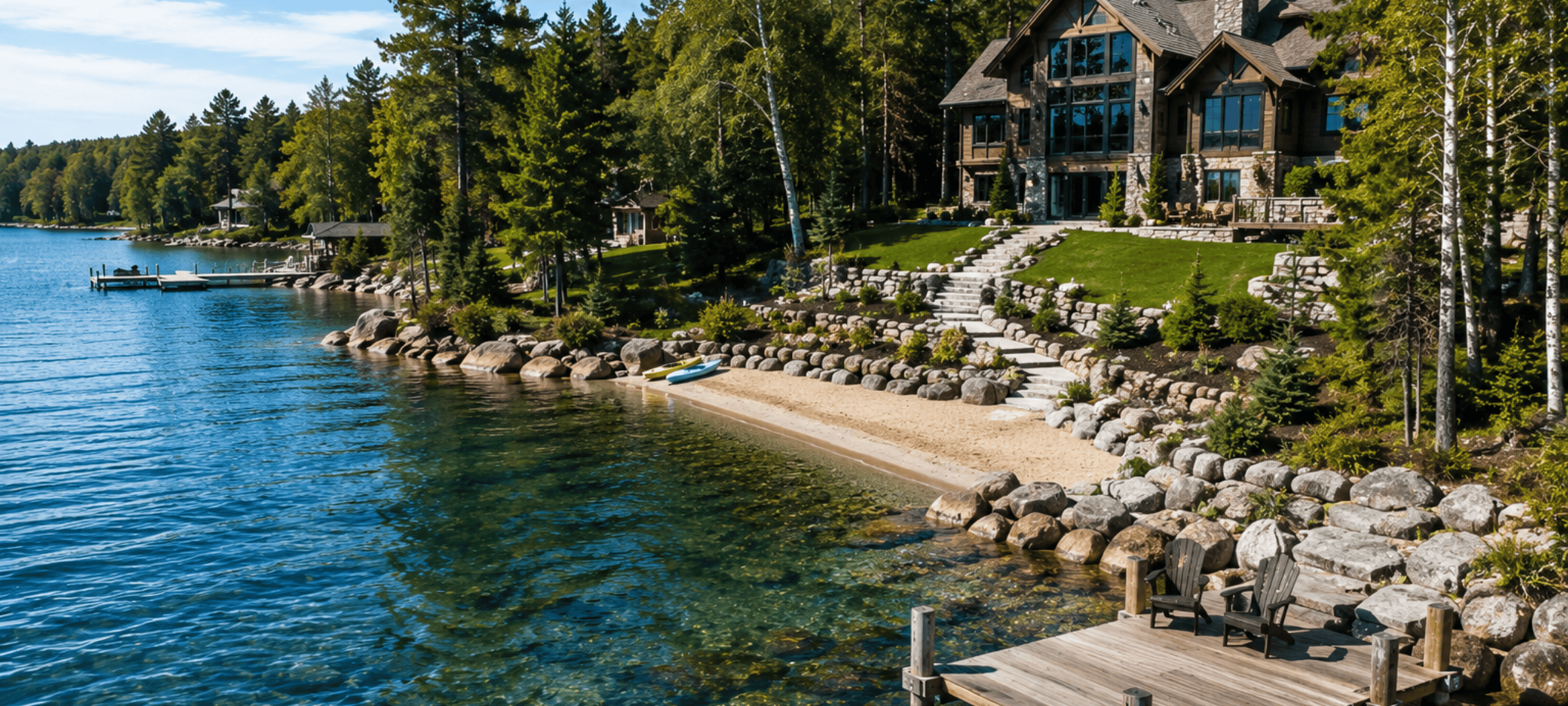
What if the most valuable aspect of your Northern Michigan estate isn't the land you walk on, but the invisible lines extending into the crystal-clear depths of Lake Michigan? Owning a premier home in Charlevoix, Emmet, or Grand Traverse County is a profound achievement, yet the joy of a private shoreline often comes with a quiet anxiety about where your authority ends and public access begins. You've likely felt a flicker of uncertainty when considering a new permanent dock or wondering if a neighbor's boat hoist encroaches on your personal sanctuary. Understanding riparian rights for waterfront property is the essential key to transforming that hesitation into the quiet confidence that defines true luxury living.
This comprehensive guide illuminates the complexities of water rights to ensure your Northern Michigan shoreline investment remains a protected sanctuary for generations. We'll explore the precise legal boundaries of your estate, the current 2026 permitting landscape for shoreline improvements, and the fundamental principles that safeguard your exclusive regional experience. From the nuances of the Ordinary High Water Mark to the latest environmental regulations, you'll gain total clarity on your rights at the water's edge. This is your path to a deeper, more secure connection with the landscape you call home.
Key Takeaways
- Distinguish between riparian and littoral frameworks to identify the specific legal protections governing your shoreline in the prestigious communities of Emmet, Charlevoix, or Grand Traverse.
- Discover the specific privileges within your bundle of rights, including guaranteed water access and the preservation of your estate's panoramic views.
- Understand the intersection of state regulations and local ordinances to ensure every shoreline improvement meets the standards of the Michigan Department of Environment, Great Lakes, and Energy.
- Master the essentials of understanding riparian rights for waterfront property to safeguard your investment and establish a lasting legacy on the Northern Michigan coast.
- Learn how specialized due diligence identifies properties with superior riparian potential, ensuring your shoreline remains a private, high-value sanctuary.
Defining Riparian Rights for the Discerning Waterfront Buyer
In the quiet corners of Charlevoix and Emmet counties, the shoreline isn't merely a boundary. It's an invitation to a specific, curated way of life. For the luxury buyer, understanding riparian rights for waterfront property is just as critical as the architectural integrity of the home itself. These rights represent the legal tether between your private estate and the vast, blue expanse of the Great Lakes or our pristine inland waterways. Unlike a temporary permit or a revocable license, these entitlements are woven into the very fabric of your land title. They're a permanent fixture of your investment, ensuring your connection to the water remains as enduring as the shoreline itself.
Michigan operates under the "reasonable use" doctrine. This principle allows you to enjoy the water as long as your actions don't unfairly infringe upon the rights of other riparian owners or the public's interest in the waterway. It's a balance of exclusivity and stewardship that maintains the purity of the regional experience. When you acquire a shoreline property here, you aren't just buying a view; you're inheriting a set of historic privileges that have defined Michigan's coastal culture for centuries.
The Legal Foundation of Shoreline Ownership
Owning a waterfront estate involves a sophisticated duality. While your deed covers the physical soil, your riparian status grants you a specific bundle of privileges regarding the adjacent water. This distinction is what creates the true exclusivity of waterfront lifestyle homes for sale in our region. By Defining Riparian Rights as an inherent property interest, Michigan law protects your ability to build docks and access the water. As we move through 2026, these standards remain governed by the Michigan Department of Environment, Great Lakes, and Energy (EGLE). Their oversight ensures that while your rights are private, they exist within a framework that preserves the natural beauty of Northern Michigan for everyone.
Why Rights Dictate Market Value
In Grand Traverse County, the desirability of an estate is often measured by the quality of its shoreline. A property with expansive, clear riparian privileges offers a significantly higher return on investment than one with restricted access. These rights are the invisible architecture of value. They determine whether you can host a private vessel, install a permanent hoist, or simply enjoy an unobstructed view of the sunset over the bay. Secured water access serves as a primary driver for property appraisals, often accounting for a substantial portion of the overall valuation in competitive markets like Traverse City. Understanding riparian rights for waterfront property allows you to see beyond the aesthetic, identifying the true legacy potential of a shoreline estate.
Riparian vs. Littoral: Navigating Michigans Diverse Waterways
Northern Michigan's landscape is a sophisticated tapestry of crystalline basins and rushing currents. While many homeowners use the term "riparian" as a universal descriptor for shoreline ownership, the legal reality is far more nuanced. Understanding riparian rights for waterfront property requires a clear distinction between land bordering flowing water and land bordering standing water. This distinction isn't merely academic; it defines the scope of your authority at the water's edge and the enduring legacy of your estate in Charlevoix, Emmet, or Grand Traverse County.
The state's legal framework shifts depending on the movement of the water. Whether you are watching the sun set over the vast horizon of Lake Michigan or listening to the gentle murmur of a hidden trout stream, the rules governing your interaction with that water are distinct. Recognizing which framework applies to your specific geography is the first step in protecting your shoreline sanctuary.
The Distinction Between Flowing and Still Waters
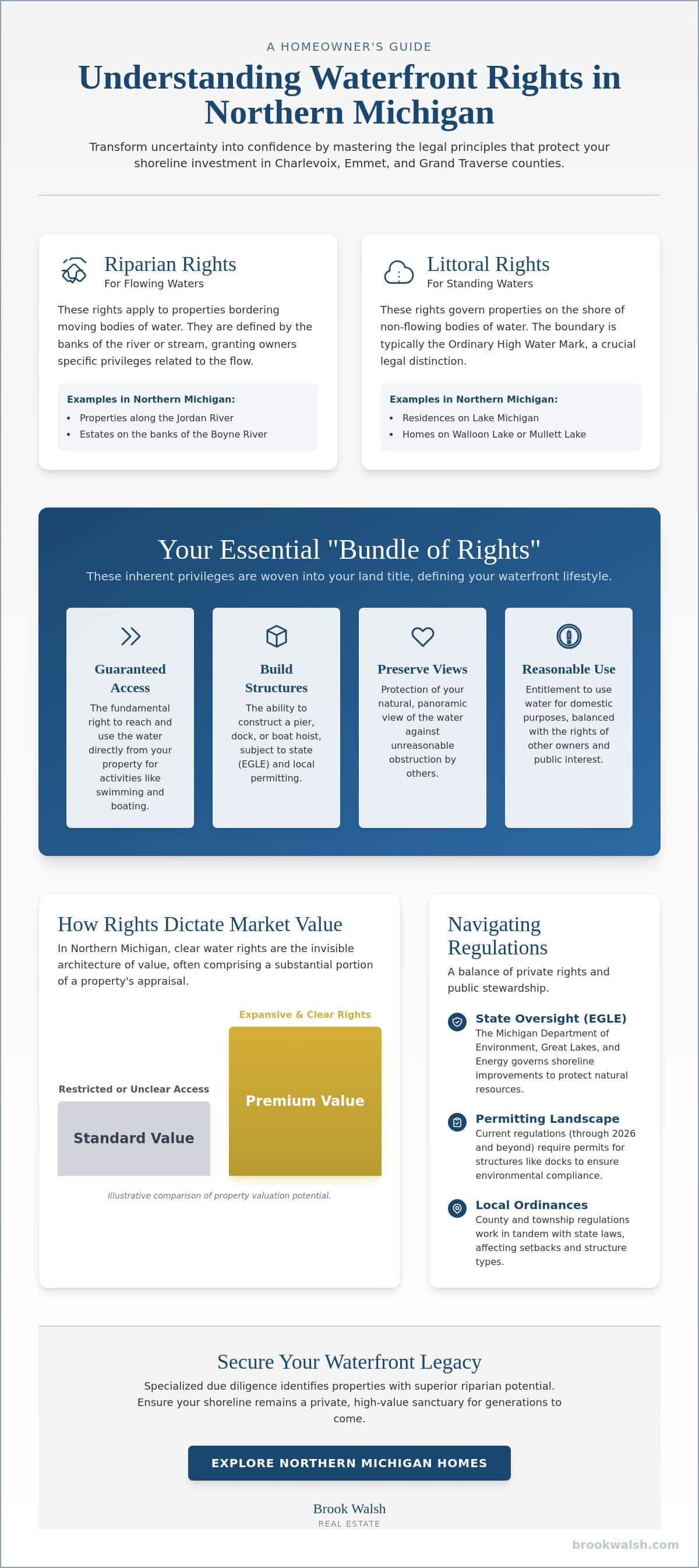
Riparian rights govern properties nestled along the banks of the Jordan or Boyne rivers in the strictest sense, as these rights specifically pertain to flowing water. In contrast, estates on inland gems like Walloon Lake or Mullett Lake fall under littoral rights, which apply to standing bodies of water such as lakes and oceans. While the terms are often used interchangeably in casual conversation, their nuances of use hinge on whether the water is considered navigable. For many luxury owners, the reasonable use of Michigan's waters remains the guiding light. This doctrine ensures that your private enjoyment of the river's current or the lake's stillness remains harmonious with the community's shared environmental heritage.
Great Lakes Littoral Rights Explained
Bordering Lake Michigan in Petoskey or Harbor Springs introduces the most complex tier of littoral ownership. In these coveted locations, the Public Trust Doctrine dictates that the State of Michigan holds the Great Lakes bottomlands in trust for the public. Your private ownership typically extends to the Ordinary High Water Mark (OHWM), a boundary that acts as the legal threshold of your estate. As of May 2025, Lake Michigan-Huron levels were approximately 6 inches below their long-term average, a fluctuation that highlights the importance of precise boundary identification.
The state currently sets the service fee for determining the Ordinary High Water Mark at $500, a rate scheduled to remain in effect until October 1, 2029. Establishing this line with professional precision protects you from municipal disputes and ensures any shoreline improvements are legally sound. If you are seeking an estate where these boundaries are already expertly vetted, exploring waterfront lifestyle homes for sale is the most direct path to securing a Northern Michigan sanctuary that is both prestigious and protected.
The Essential Bundle of Rights for Luxury Shoreline Living
Owning a shoreline estate in Charlevoix or Grand Traverse County is an exercise in curated freedom. When you invest in these coveted geographies, you aren't merely purchasing a plot of land; you're acquiring a sophisticated bundle of privileges that define your daily experience. Understanding riparian rights for waterfront property means recognizing that your ownership extends beyond the physical soil to include the right of access, the preservation of your view shed, and the exclusive use of the water for recreation. Whether you're casting a line into the morning mist or diving into the turquoise depths of the bay, these rights ensure your lifestyle remains an uninterrupted sanctuary.
One of the most dynamic aspects of this ownership is the right to accretions. As the currents of Lake Michigan or our inland waterways shift, they may naturally deposit soil along your shore, gradually expanding your footprint. Conversely, reliction occurs when water levels recede, exposing new land that becomes part of your estate. In Northern Michigan, your property line is often a living boundary that follows the water's edge, ensuring your estate stays tethered to the waves regardless of natural fluctuations. This fluid connection is a hallmark of the most prestigious shoreline investments in the region.
Dockage and Mooring Rights for Private Vessels
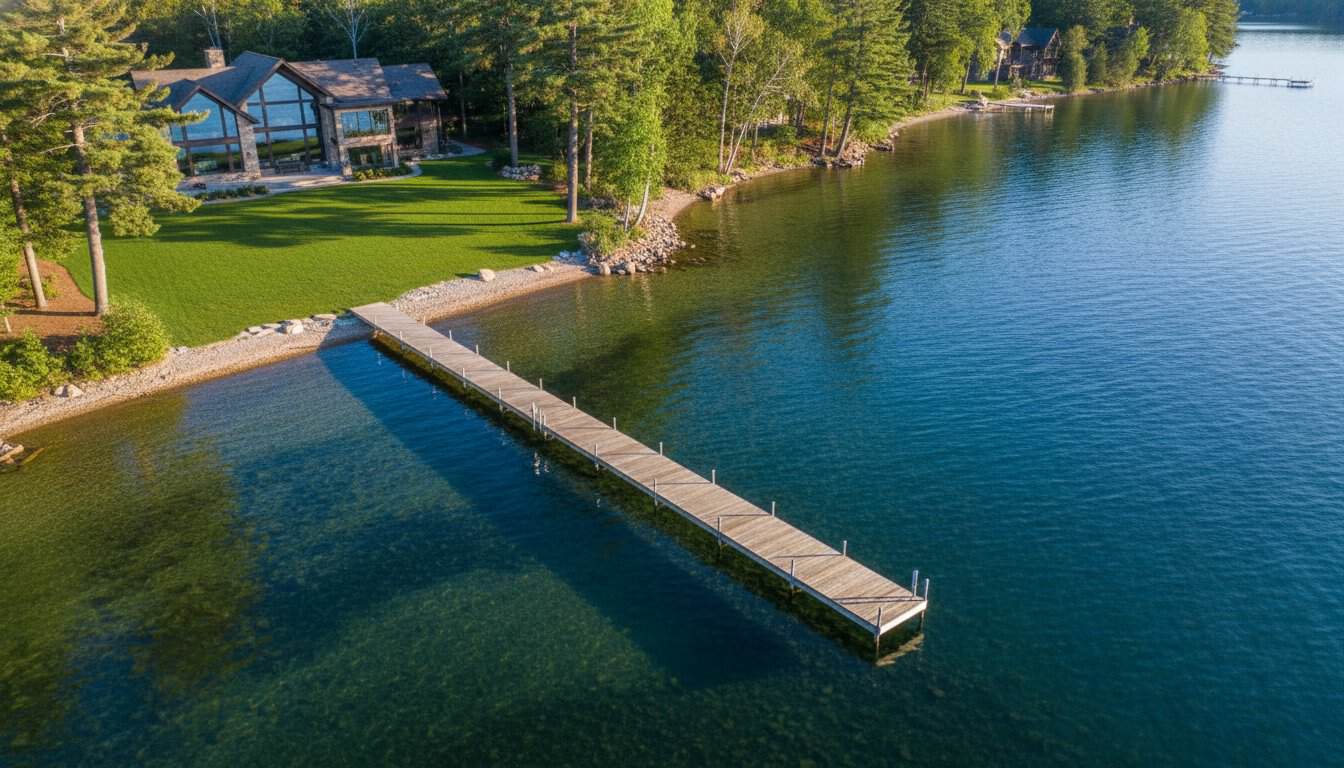
For many, the pinnacle of the regional experience is the ability to moor a private vessel just steps from the veranda. In Charlevoix and Emmet counties, the legal requirements for installing seasonal docks differ from permanent structures, often requiring specific permits from the Michigan Department of Environment, Great Lakes, and Energy (EGLE). The right to wharf out to navigable depths allows a riparian owner to construct a dock or pier to reach water deep enough for vessel navigation. This entitlement is essential for those seeking luxury lifestyle homes for sale that can accommodate large-scale yacht mooring or sophisticated boat hoists. Navigating these permits with precision ensures your maritime pursuits are both prestigious and legally secure.
Shoreline Preservation and Maintenance Rights
Maintaining the aesthetic and structural integrity of your coast is a fundamental right, yet it requires a delicate balance with environmental stewardship. You have the authority to protect your estate from erosion, a pressing concern given that engineered shoreline protection structures on Lake Michigan increased by nearly five times between 2014 and 2021. While bio-engineering and rock revetments are popular for a natural look, seawalls may be necessary in high-energy zones. However, limitations exist; beach grooming and the removal of native vegetation are strictly regulated to protect the local ecosystem. Understanding riparian rights for waterfront property allows you to maintain a pristine, manicured aesthetic while adhering to the protections that keep Northern Michigan’s waters pure and vibrant.
Local Regulations and Stewardship in Northern Michigan
While the legal foundation of your shoreline estate is built upon state common law, the practical realization of your vision often rests in the hands of local authorities. In Emmet and Charlevoix counties, the intersection of state mandates and municipal ordinances creates a sophisticated regulatory environment. Understanding riparian rights for waterfront property requires a discerning eye for these local nuances, as they dictate everything from the density of your dockage to the specific materials used in shoreline stabilization. This local oversight ensures that the very qualities that drew you to the region, such as the crystalline clarity of the water and the tranquil rhythm of the coast, are preserved for every resident.
The Michigan Department of Environment, Great Lakes, and Energy (EGLE) acts as the primary gatekeeper for any significant shoreline development. Their role is to balance your private enjoyment with the collective responsibility of water stewardship. Whether you are proposing a sophisticated permanent pier or a subtle bio-engineered erosion control system, the approval process is rigorous. Most permits for activities near inland lakes and streams carry fees ranging from $50 to $2,000, which are currently scheduled to sunset on October 1, 2029. Navigating this process with a local expert ensures that your improvements are not only beautiful but fully compliant with the evolving standards of 2026.
Navigating County-Specific Zoning and Permits
Grand Traverse County presents its own unique set of considerations for development projects. Local planning commissions here often implement specific density requirements for docks and boat hoists to prevent over-utilization of the shoreline. A common pitfall for new owners is underestimating the timeline for these approvals; overlooking a local township setback or a specific county wetland protection can delay a project by months. For those looking to maximize their shoreline's potential, conducting a thorough investment property analysis is the most effective way to identify a parcel's true development capacity before the first stone is laid.
Environmental Stewardship and Water Quality
True luxury is found in the purity of the environment. Sustainable shoreline living is a commitment to the long-term health of gems like Lake Charlevoix and Walloon Lake. For instance, if your estate requires aquatic nuisance control, the target deadline for permit applications in the MiEnviro Portal is January 31, 2026. Additionally, a copper use restriction remains in effect from May 15 through July 14 for northern region lakes to protect local ecosystems during critical cycles. Adhering to these seasonal windows is a mark of a responsible steward. By embracing these best practices, you protect the ecological integrity of the water, ensuring your estate remains a pristine, high-value sanctuary for generations to come.
Securing Your Waterfront Legacy with Expert Guidance
Acquiring a shoreline estate in Charlevoix, Emmet, or Grand Traverse County is an achievement that transcends the typical real estate transaction. It's the establishment of a legacy, a curated sanctuary where your family’s history will unfold against the backdrop of Michigan’s most pristine waters. However, the permanence of this legacy depends entirely on the precision of your acquisition strategy. Understanding riparian rights for waterfront property is the cornerstone of this process, ensuring that the exclusive lifestyle you envision is supported by an unshakeable legal foundation.
A successful purchase requires looking beyond the aesthetic appeal of a home to the legal architecture of the shore. Each parcel carries its own history, and in Northern Michigan, that history often includes complex water entitlements that can impact everything from your privacy to your property's future resale value. Positioning your purchase as a multi-generational asset requires a shift in perspective, viewing the shoreline not just as a boundary, but as a protected emotional haven that requires expert vetting.
Due Diligence During the Acquisition Process
The path to a secure waterfront investment begins long before the closing table. During the due diligence phase, a sophisticated title search and professional land survey are non-negotiable. These steps must verify the exact nature of your riparian entitlements and identify any historical easements or public access points that could compromise your privacy. Consulting with experts who specialize in Northern Michigan’s unique coastal laws allows you to confirm that your vision for the property, whether it involves a private beach or an expansive dock, is legally viable. For a deeper perspective on market strategy and asset protection, exploring the nuances of investing in northern Michigan real estate provides the clarity needed for a high-value acquisition.
The Role of a Lifestyle Real Estate Advisor
A discerning local expert does more than facilitate a sale; they bridge the gap between complex legal theory and the reality of lakeside living. At Brook Walsh Real Estate, we specialize in identifying properties with superior riparian potential, matching your specific maritime or aesthetic requirements with the right stretch of shoreline. Our deep-rooted expertise in Northern Michigan’s most exclusive communities allows us to navigate the subtle differences in county ordinances with quiet confidence. Understanding riparian rights for waterfront property is a technical necessity, but applying that knowledge to enhance your regional experience is where we provide our greatest value. We invite you to explore the curated elegance of this coveted geography with a trusted advisor who shares your appreciation for the finer details of life. Your Northern Michigan sanctuary is waiting, and we're here to ensure it remains a protected haven for generations to come.
Cultivate Your Legacy on Northern Michigan’s Shores
The serenity of a Northern Michigan morning is best enjoyed with the absolute peace of mind that your shoreline is legally secure. By distinguishing between riparian and littoral frameworks and navigating the nuanced regulatory landscape of 2026, you ensure your investment remains a private, high-value sanctuary. Mastery of understanding riparian rights for waterfront property is the final step in transforming a premier residence into an enduring family legacy across Charlevoix, Emmet, and Grand Traverse counties. It's about more than just boundaries; it's about the profound connection between your home and the crystalline waters that define this coveted region.
As a premier brokerage for lifestyle-driven property searches, we provide the specialized expertise and expert investment consulting required for high-value waterfront estates. Our deep-rooted authority in these exclusive communities bridges the gap between complex water laws and your personal escape. We invite you to discover your perfect Northern Michigan waterfront sanctuary with Brook Walsh. Your future on the water is waiting, and it has never looked more promising.
Frequently Asked Questions
Do riparian rights give me exclusive ownership of the beach in front of my home?
You typically hold exclusive ownership of the beach down to the water's edge on inland lakes, but Great Lakes ownership is more complex. On the shores of Lake Michigan, your private title extends to the Ordinary High Water Mark, while the state holds the land beyond that line in trust for the public. This means that while you enjoy private use of your upland beach, the public may have a right to traverse the area below the high water mark for specific activities like walking or fishing.
Can I build a permanent dock on any waterfront property in Northern Michigan?
No, the ability to build a permanent dock is not guaranteed and depends on obtaining a permit from the Michigan Department of Environment, Great Lakes, and Energy (EGLE). The permitting process evaluates the impact on the environment, navigation, and the rights of neighboring owners. In many high-energy areas of Lake Michigan, seasonal docks are often the only viable option due to the intense pressure of winter ice and fluctuating water levels that can damage permanent structures.
What is the difference between riparian and littoral rights for a Lake Michigan property?
Littoral rights technically govern properties bordering standing bodies of water like the Great Lakes, while riparian rights apply to flowing waters like rivers and streams. In common real estate practice, the term riparian is frequently used as a universal descriptor for all shoreline ownership. Understanding riparian rights for waterfront property in a legal sense ensures you recognize the unique Public Trust Doctrine that applies specifically to our Great Lakes coastline in Petoskey and Harbor Springs.
Can the public walk across my private shoreline in Charlevoix or Emmet County?
The public generally has the right to walk along the shoreline of the Great Lakes as long as they remain below the Ordinary High Water Mark. This right of passage is a long-standing principle of Michigan law intended to preserve public access to the Great Lakes. On inland lakes, however, your privacy is usually more absolute; the public cannot traverse your shoreline unless there is a dedicated public easement or a specific court-ordered access point on your deed.
Do I need a permit from the state to remove weeds or groom my private beach?
Yes, you must obtain a permit from EGLE before removing aquatic vegetation or performing significant beach grooming activities. The state regulates these actions to protect the delicate ecosystems of Northern Michigan's waterways and maintain water quality. For example, specific aquatic nuisance control permits for 2026 have target application deadlines as early as January 31. Attempting to manicure your shoreline without these authorizations can result in substantial fines and mandatory restoration efforts.
Are riparian rights transferred automatically when I sell my waterfront home?
Riparian rights are an inherent part of the land's title and almost always transfer automatically to the new owner upon the sale of the property. These rights are not a separate license but are woven into the very fabric of your deed. During the acquisition process, it's vital to have a professional advisor verify that no previous owner has severed these rights or granted easements that might diminish the exclusivity of your future Northern Michigan estate.
How do riparian rights affect the construction of a boathouse or shoreline cabana?
Riparian rights allow for the use of the water, but they do not grant an absolute right to build permanent structures like boathouses on the bottomlands. Modern environmental regulations in Michigan are quite restrictive regarding new constructions at the water's edge to preserve the natural aesthetic and public trust. While you may have the right to a dock, building a cabana or boathouse usually requires navigating a complex web of local zoning laws and state environmental protections.
Can my riparian rights be restricted by local township ordinances?
Local township ordinances can indeed place additional restrictions on your riparian rights, often governing the density of docks or the placement of boat hoists. While state law provides the foundational rights, municipalities in Grand Traverse or Charlevoix counties use local zoning to manage lake health and prevent overcrowding. Understanding riparian rights for waterfront property requires a dual focus on both state-level entitlements and the specific local rules that manage the character of your immediate community.
Posted by Brook Walsh onEnjoy this blog post? Click here to subscribe for updates
Leave A Comment