

What if your highly appreciated lakefront retreat in Charlevoix could be transformed into a more expansive estate without the immediate burden of a massive tax bill? You've likely watched your property value climb alongside the steady rise of the Northern Michigan market, yet the prospect of losing a significant portion of those gains to the IRS often stalls the most ambitious plans. It's a common dilemma for the discerning investor who recognizes that a 1031 exchange for vacation homes is more than a tax strategy; it's a bridge to a more refined lifestyle.
You understand that your property is more than a structure; it's a legacy held within the pristine beauty of Emmet and Charlevoix counties. This guide from Brook Walsh Real Estate shows you exactly how to navigate the 2026 safe harbor rules to achieve full tax deferral while upgrading to a premier waterfront or ski-in resort property. We will detail the essential rental requirements, the strict 45-day identification window, and the precise methods for securing a high-value replacement that reflects your standard of living.
Key Takeaways
- Discover how a 1031 exchange for vacation homes allows you to transition from seasonal ownership to a high-yield investment portfolio without immediate tax consequences.
- Master the IRS safe harbor requirements of Revenue Procedure 2008-16, ensuring your property meets the essential two-year holding and rental thresholds for full compliance.
- Learn to navigate the nuanced boundary between personal escape and investment intent to secure tax-deferred status on your next Charlevoix or Emmet County acquisition.
- Evaluate the specific performance metrics of luxury waterfront homes versus downtown condominiums to maximize your ROI in the evolving 2026 Northern Michigan market.
- Gain a strategic roadmap for identifying like-kind properties in prestigious locales like Harbor Springs and Petoskey that align with your legacy portfolio goals.
The Strategic Advantage of 1031 Exchanges for Northern Michigan Vacation Homes
The 2026 real estate landscape across Charlevoix and Emmet counties has matured into a sophisticated market where luxury is defined by privacy and high-amenity experiences. While the frantic pace of previous years has normalized, inventory remains curated and highly sought after. For owners of premium waterfront properties, this appreciation represents a significant accumulation of wealth. However, selling a cherished asset often triggers substantial tax exposure. Utilizing a 1031 exchange for vacation homes provides a strategic path to transition equity without immediate capital gains depletion. It's a method of preserving the value you've built while seeking a property that better suits your evolving aspirations.
Wealth Preservation in the 2026 Market
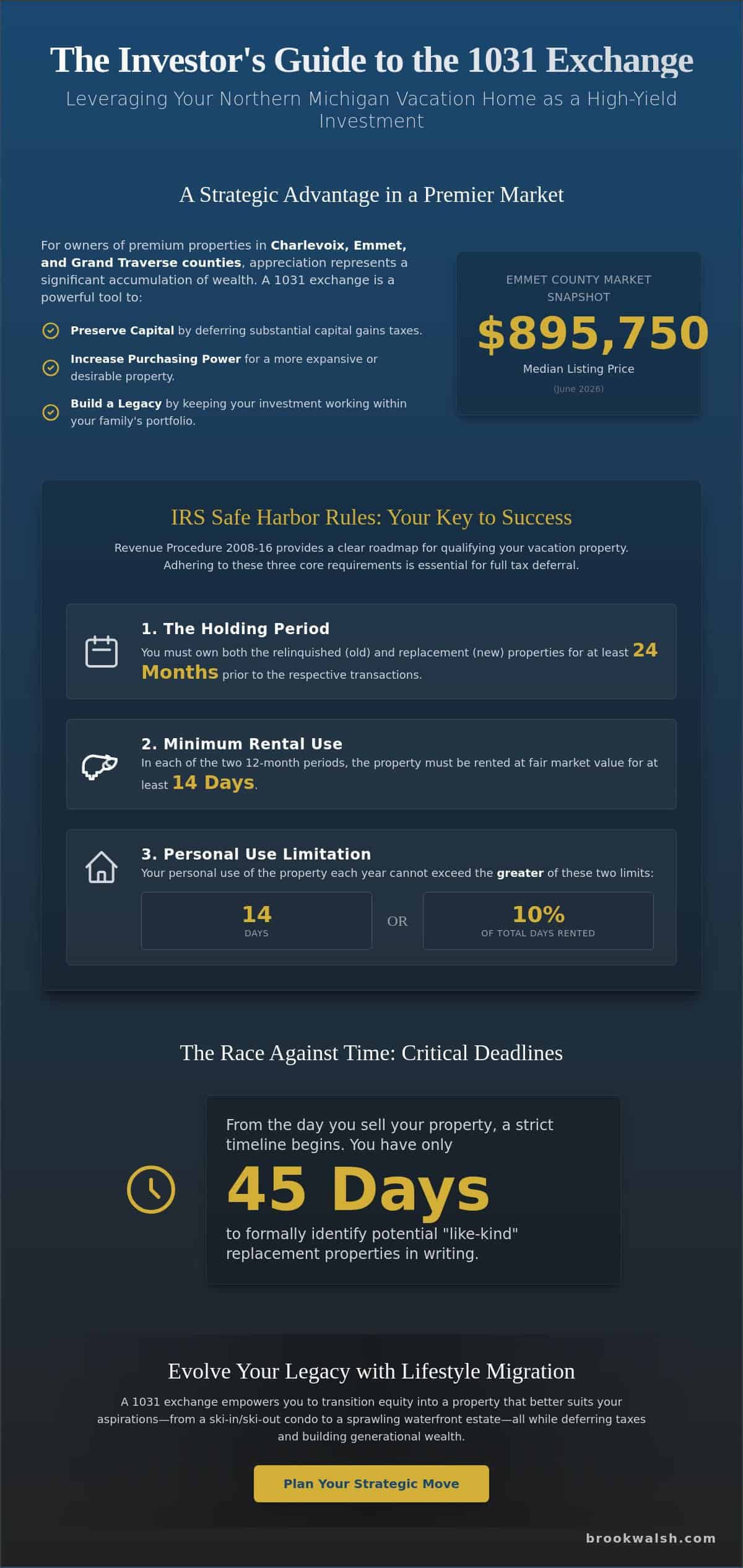
In the current fiscal climate, waiting to divest can lead to significant tax liabilities. With median listing prices in Emmet County reaching $895,750 in June 2026, the gains on long-held properties are substantial. Northern Michigan serves as a reliable haven for real estate equity, offering stability that other markets lack. By following the Internal Revenue Code Section 1031, investors can defer taxes that would otherwise erode their portfolio. This isn't just about avoiding a bill; it's about family legacy planning. It ensures that the capital remains working within your family's holdings, allowing you to maintain a dominant presence in the region's most coveted geographies.
The Lifestyle Migration Concept
Lifestyle migration is the art of moving equity to match your current stage of life. Perhaps your current Lake Charlevoix cottage no longer fits a growing family, or you find yourself drawn to the quiet prestige of a Petoskey golf estate. A 1031 exchange for vacation homes allows you to redeploy your tax-deferred dollars to increase your purchasing power significantly. You might transition from a ski-in/ski-out condominium at Boyne Mountain to a sprawling waterfront estate in Grand Traverse County. This process turns your real estate into a fluid asset. We see a consistent guest-to-owner pipeline in 2026, where those who once rented now seek to anchor their legacy in these shores. When you understand the nuances of investing in Northern Michigan real estate, you can treat your property as an emotional haven that also performs as a rigorous financial tool. Market normalization means you have more time to identify these premium listings, ensuring your next acquisition is a precise match for your lifestyle.
Navigating the IRS Safe Harbor: Revenue Procedure 2008-16 Explained
Achieving a seamless 1031 exchange for vacation homes requires more than just a desire for a lifestyle upgrade; it demands a rigorous adherence to federal guidelines. The primary concern for the IRS is whether your property is a personal residence or a legitimate investment asset. To provide clarity, the IRS Revenue Procedure 2008-16 established a safe harbor. This protocol offers a definitive path for taxpayers to qualify their seasonal properties for tax-deferred treatment, provided they meet specific ownership and usage criteria. By following these benchmarks, you can confidently transition equity from a legacy cottage to a more expansive waterfront estate without fear of an audit challenging your investment intent.
The Holding Period Requirement
The IRS looks for stability and long-term commitment when evaluating an exchange. For a vacation home to qualify, you must have owned the relinquished property for at least 24 months immediately preceding the sale. This same 24-month rule applies to the replacement property you acquire in Charlevoix or Emmet County. Specifically, the taxpayer must have owned the property for at least 24 months to satisfy the safe harbor requirements for a vacation home exchange. This duration ensures the asset is viewed as a productive part of your portfolio rather than a short-term flip.
Rental and Personal Use Limits
Within each of the two 12-month periods that make up the holding duration, the property must be rented at a fair market value for at least 14 days. In Northern Michigan, determining this value is straightforward but requires precision. For instance, with Lake Charlevoix vacation rentals seeing an average daily rate of $432 in early 2026, your rental records should reflect these local market standards. You must also account for the Michigan 6% state use tax applied to short-term stays, which serves as a secondary layer of documentation for your rental activity.
Personal use is strictly capped to ensure the property’s primary purpose remains investment-oriented. You're permitted to enjoy the home for either 14 days or 10% of the total days it was rented at fair market value, whichever is greater. If you rent your Grand Traverse waterfront home for 200 days, you could technically enjoy it for 20 days yourself. Documenting every guest stay and maintenance visit is vital for maintaining this safe harbor status. If you're uncertain how your current usage patterns align with these rules, a professional investment property analysis can provide the clarity needed to proceed with confidence. Staying within these boundaries allows you to preserve the tax-deferred status of your wealth while still experiencing the unique character of the region during the most beautiful months of the year.
Investment Intent vs. Personal Use: Overcoming the Primary 1031 Challenge
The most frequent question from property owners in Harbor Springs or Traverse City is whether a home they occasionally use for family retreats can truly qualify for tax deferral. It's a valid concern. The IRS draws a firm line between a second home held for recreation and an investment property held for the production of income. To successfully execute a 1031 exchange for vacation homes, you must demonstrate clear investment intent. This isn't a subjective feeling; it's a documented reality established through your actions leading up to the sale. A Qualified Intermediary (QI) serves as your essential partner here, ensuring the exchange funds never touch your personal accounts and that the transaction remains strictly compliant with federal standards.
Converting Personal Use to Investment Intent
If your current Charlevoix retreat has been strictly for personal enjoyment, you aren't necessarily disqualified, but you must pivot your strategy. Transitioning a property into a legitimate rental asset requires a deliberate timeline. Ideally, you should begin this process at least 24 months before you plan to sell. This transition involves listing the property at fair market rates and securing tenants. Engaging a professional firm for rental management is perhaps the strongest evidence of investment intent you can provide. It shows the IRS that you've shifted from personal occupancy to a business-minded approach. This professional oversight ensures that the IRS Revenue Procedure 2008-16 guidelines are met with precision, creating a robust audit trail of rental income and occupancy.
Common Pitfalls in Vacation Home Exchanges
One of the most dangerous mistakes is attempting to flip a vacation home shortly after acquisition. The IRS looks for a held-for-investment period, and selling too quickly can signal that your intent was profit-taking rather than long-term growth. You must also be meticulous in tracking incidental personal use. Every day you spend at your Grand Traverse waterfront home for maintenance or personal leisure must be recorded. If you exceed the 14-day or 10% limit mentioned previously, you risk the IRS reclassifying the asset as a personal residence. This primary residence trap is fatal to a 1031 exchange for vacation homes. By treating your property as a rigorous business asset, you protect your ability to migrate that equity into a more prestigious Northern Michigan estate. For those seeking to refine their portfolio, a comprehensive investment property analysis can reveal how to best position their current holdings for a future exchange.
Portfolio Diversification Strategies in Charlevoix and Emmet Counties
Portfolio diversification in Northern Michigan isn't merely about increasing the number of deeds in your safe; it's about the strategic alignment of your assets with the region's seasonal rhythms. A 1031 exchange for vacation homes offers the professional flexibility to swap properties of the same nature or character, a definition that is surprisingly broad in the eyes of the IRS. In the 2026 landscape, this means you can transition from a traditional lake house to a high-amenity resort condominium or even a strategic development lot in Grand Traverse County. This flexibility allows you to consolidate multiple smaller holdings into a single, premier estate that commands higher prestige and simplified management.
Waterfront to Resort-Lifestyle Swaps
The transition from a secluded Walloon Lake retreat to a vibrant Boyne Mountain resort property represents a sophisticated move toward year-round performance. While waterfront lifestyle homes for sale define the summer peak, resort-style assets capture the high demand of the winter ski season. This lifestyle swap ensures your equity remains productive regardless of the month. It's a calculated way to leverage your tax-deferred gains to acquire properties that offer different peak occupancy periods; this effectively smooths your portfolio's revenue stream while maintaining your presence in the most coveted areas of Emmet and Charlevoix counties.
The Luxury Condo Advantage
For the investor who values exclusivity without the burden of extensive exterior maintenance, the luxury condominium market in Bay Harbor and downtown Petoskey is a compelling target. These properties are particularly attractive as replacement assets because they offer consistent rental demand and a level of professional oversight that simplifies the ownership experience. Exploring condominium lifestyle homes for sale reveals high-yield opportunities that satisfy the like-kind requirement of a 1031 exchange for vacation homes. In a market where the median listing price in Emmet County has reached $895,750 as of June 2026, these refined urban dwellings provide a stable and prestigious entry point for redeploying your equity.
Consolidating your portfolio often means moving away from a collection of older, high-maintenance cottages and toward a singular, dominant property. This could involve selling several smaller units to fund a significant waterfront acquisition or a strategic land parcel in Grand Traverse County for future development. This process isn't just a transaction; it's a curated migration of wealth. If you're ready to see how your current holdings can be transformed into a more prestigious regional legacy, we invite you to view our curated selection of luxury lifestyle homes for sale.
Expert Guidance for Your Northern Michigan Real Estate Lifecycle
Executing a 1031 exchange for vacation homes is a complex orchestration of legal precision and local market insight. It's far more than a simple transaction; it's a commitment to a specific lifecycle of ownership that requires a steady, expert hand. At Brook Walsh Real Estate, we serve as your trusted advisor, bridging the gap between the technicalities of tax deferral and the visceral beauty of the Northern Michigan landscape. We understand that a successful exchange in 2026 relies on more than just meeting deadlines. It requires a curated strategy that anticipates market shifts, manages regulatory compliance, and honors the emotional value of your investment.
Consultative Investment Analysis
Success in the luxury market is rooted in data. When you're identifying replacement properties in Grand Traverse or Emmet counties, you need an analysis that goes beyond surface-level aesthetics. We utilize a rigorous, data-driven approach to project ROI, factoring in the 2026 average 30-year fixed mortgage rate of 6.65% and the specific rental performance of high-amenity waterfront estates. Our role is to ensure your new asset isn't just a haven, but a high-performing business tool. By integrating investing in Northern Michigan real estate with comprehensive short-term rental management, we provide the documentation necessary to satisfy the IRS and protect your tax-deferred status for the long term. This holistic view allows you to close the gap between purchase and eventual resale with absolute confidence.
Finding Your Next Northern Michigan Haven
The search for a like-kind property should be as inspiring as the region itself. We believe that an investment should align perfectly with your standard of living, whether that leads you to a quiet cove on Lake Charlevoix or a prestigious golf estate in Harbor Springs. Our local expertise is non-negotiable for 1031 success, especially as we navigate evolving short-term rental ordinances and the unique character of specific communities. We invite you to search by lifestyle to discover properties that resonate with your personal vision of excellence. Precision in selection is the hallmark of a sophisticated investor. By matching your equity with the right regional geography, we ensure your portfolio remains a source of both pride and prosperity. Your journey through the Northern Michigan market deserves a guide who appreciates the finer details of life and possesses the expert authority to secure them.
Refining Your Northern Michigan Legacy
You've explored the intricate balance between personal enjoyment and rigorous investment strategy. By mastering the safe harbor requirements and shifting your focus toward high-performing assets, you ensure your real estate holdings remain as dynamic as the landscape itself. A 1031 exchange for vacation homes is the definitive tool for those who refuse to let tax liabilities dictate their lifestyle. It allows you to move equity with precision, ensuring every property in your portfolio serves as both a financial pillar and a personal sanctuary.
Our team specializes in the unique nuances of luxury waterfront and resort properties across Charlevoix, Emmet, and Grand Traverse counties. We provide comprehensive support throughout the entire ownership lifecycle, from the initial data-driven search to professional management that maintains IRS compliance. We invite you to connect with Brook Walsh Real Estate for a professional 1031 exchange consultation and begin the next chapter of your regional portfolio. Your vision of a refined waterfront lifestyle is within reach; it simply requires the right guide to navigate the path.
Frequently Asked Questions
Can I do a 1031 exchange on a second home that I never rented out?
No, you cannot perform an exchange on a property held purely for personal use. The IRS requires the asset to be held for productive use in a trade, business, or for investment. To qualify your Charlevoix or Petoskey home, you must first establish a period of rental activity that demonstrates a clear shift in intent. This often involves listing the home at fair market rates for at least two years before the transaction occurs.
How many days a year can I personally use my 1031 replacement vacation home?
You're permitted to use the property for a period of 14 days or 10% of the days it's rented at fair market value during each 12 months. This limitation is a cornerstone of the safe harbor rules. Staying within these bounds ensures your 1031 exchange for vacation homes remains compliant and avoids reclassification as a personal residence. It's a delicate balance that allows for personal enjoyment while maintaining the asset's investment status.
What qualifies as a 'like-kind' property in a Northern Michigan exchange?
Like-kind properties include any real estate held for investment purposes within the United States. In Northern Michigan, this offers significant flexibility for your portfolio. You might exchange a luxury waterfront home on Walloon Lake for a portfolio of ski-in condominiums or a commercial space in downtown Traverse City. The nature or character of the property must be similar, but the grade or quality of the structures does not matter.
Do I need a Qualified Intermediary for a vacation home 1031 exchange?
Yes, a Qualified Intermediary is legally required to facilitate the transaction. You cannot have constructive receipt of the sale proceeds at any point during the process. The intermediary holds the funds in a secure, tax-deferred account and ensures all documentation aligns with federal requirements. This professional oversight is essential for maintaining the integrity of your exchange and provides a necessary layer of protection against potential IRS challenges.
What happens if I fail to meet the rental requirements after the exchange?
Failing to meet the rental thresholds puts your tax-deferred status at significant risk. If you don't rent the property for the required 14 days, the IRS may disqualify the exchange upon audit. You must also account for the Michigan 6% state use tax on these rentals to provide a clean audit trail. Consistent record-keeping and professional management are your best defenses against immediate capital gains taxes and potential penalties.
Can I eventually turn my 1031 replacement property into my primary residence?
You can eventually convert a replacement property into a primary residence, but you must first satisfy the investment intent requirements. Typically, this means holding and renting the property under the safe harbor rules for at least 24 months. Moving in too early can signal to the IRS that your original intent was personal use rather than investment. This could potentially void the tax deferral and trigger back taxes.
How long do I have to identify a replacement property in Michigan?
You have exactly 45 days from the date you close on your relinquished property to identify potential replacements in writing. This timeline is strict and cannot be extended for weekends or holidays. Following this, you must close on the new acquisition within 180 days. In competitive markets like Harbor Springs, having a curated list of properties ready is vital. It's a fast-paced process that requires expert guidance.
Are there specific Northern Michigan counties where 1031 exchanges are more common?
While these exchanges occur across the state, they're particularly prevalent in high-appreciation areas like Charlevoix, Emmet, and Grand Traverse counties. These regions attract sophisticated investors looking to preserve wealth within premium waterfront and resort geographies. The concentration of high-value assets makes these counties the primary focus for those executing a 1031 exchange for vacation homes in 2026. It's a strategic move for long-term wealth preservation.
Posted by Brook Walsh onEnjoy this blog post? Click here to subscribe for updates
Leave A Comment