

What if the most appealing listing isn’t the strongest fit for your business or investment goals? In Northern Michigan, commercial real estate for sale can vary widely by property type, location, and ownership considerations. A promising first impression matters, but it’s only the start of a sound decision.
It’s natural to be unsure which property type suits your plans or how to compare opportunities. Review intended use, location, property fundamentals, and due diligence consistently. Zoning, site conditions, and operating needs can all affect how a property works for you.
This guide offers a framework for comparing opportunities across Charlevoix, Emmet, and Grand Traverse counties. You’ll learn which local and property-specific details to examine, how to assess a property against your ownership goals, and where brokerage and investment guidance can help. Brook Walsh Real Estate provides commercial property sales and data-driven investment analysis, bringing local context to purchases in communities including Boyne City, Boyne Falls, Charlevoix, Petoskey, Harbor Springs, and East Jordan.

Key Takeaways
- Start with the intended business or investment use to narrow which property types merit a closer look.
- Separate what a listing shows from what documents, site review, and professional analysis can establish.
- Use the same comparison criteria to assess commercial real estate for sale across Charlevoix, Emmet, and Grand Traverse counties.
- Build due diligence into your decision by reviewing property records, site considerations, and transaction assumptions before making an offer.
- Local brokerage insight and data-driven investment analysis can help clarify property fit, location, and ownership goals.
Table of Contents
- Buying Commercial Real Estate for Sale in Northern Michigan: Define the Opportunity
- How to Evaluate Commercial Real Estate for Sale Beyond the Listing
- How to Compare Commercial Property Opportunities Across Northern Michigan
- Commercial Property Due Diligence: Questions to Resolve Before an Offer
- Find the Right Commercial Real Estate for Sale with Local Guidance
Buying Commercial Real Estate for Sale in Northern Michigan: Define the Opportunity
A compelling listing can catch your eye, but buying commercial property begins with a clear purpose. Commercial real estate is property acquired for business, investment, or another income-producing use. Broad categories include retail, office, industrial, hospitality, multifamily, and development land. The Commercial property overview offers a useful introduction to how these categories differ.
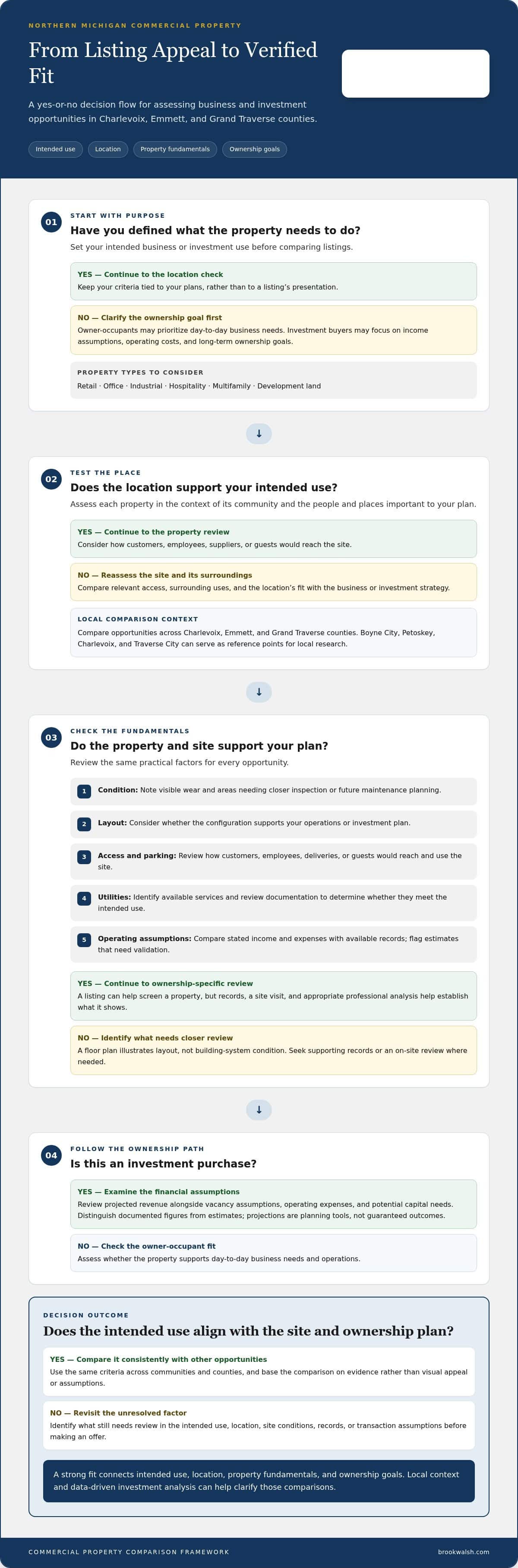
A sound commercial purchase aligns intended use with location, then tests that fit through careful due diligence. Focus on how the property could serve your plans, not just its listing photos or surface appeal.
Which commercial property types might fit your acquisition goal?
Start by defining what you want the property to do. Retail may depend on customer access and visibility; office space on how well it supports business operations; and industrial property on functional space and site access. Hospitality and multifamily properties have distinct operating considerations, while development opportunities require close attention to the land and its potential use.
Owner-occupants may prioritize a property’s fit with day-to-day business needs. Investment buyers may focus more on income assumptions, operating costs, and long-term ownership goals. Define your intended use before comparing commercial real estate for sale, so your criteria reflect your plans rather than the listing’s presentation.
Where should buyers begin in Northern Michigan?
Approach Charlevoix, Emmet, and Grand Traverse counties as distinct areas for local research, not interchangeable points on a map. Boyne City, Petoskey, Charlevoix, and Traverse City can serve as reference points as you consider where a business or investment might fit. Compare each site in the context of its community and your intended use.
Consider how customers, employees, suppliers, or guests would reach the site, and how surrounding uses may affect its day-to-day role. A location suited to a customer-facing business may differ from one that better supports office operations, hospitality, or an investment strategy. Brook Walsh Real Estate’s Northern Michigan real estate investment guidance combines local context with data-driven analysis and ownership goals to help buyers shape a purposeful search.
How to Evaluate Commercial Real Estate for Sale Beyond the Listing
A listing can show visible features, but it can’t answer every question that matters to a buyer. Use a consistent review to test whether the space and site support your plan, then identify what needs documentary, on-site, or financial review.
Which property fundamentals should buyers compare?
Assess each property against its intended use rather than relying on general impressions. A practical first-pass checklist includes:
- Condition: Note visible wear and areas that may need closer inspection or future maintenance planning.
- Layout: Consider whether the existing configuration supports your operations or investment plan.
- Access and parking: Review how customers, employees, deliveries, or guests would reach and use the site.
- Utilities: Identify available services and review documentation to determine whether they meet the property’s intended use.
- Operating assumptions: Compare stated income and expenses with available records, and flag estimates that need validation.
Photos and listing descriptions can help you screen opportunities, but they don’t replace reviewing records, visiting the site, and arranging appropriate professional analysis. A floor plan may illustrate the layout, but it doesn’t establish the condition of building systems. A stated expense can inform an initial estimate, while supporting records provide a stronger basis for evaluating it.
A property fits when its use, site, and ownership plan align. That means weighing the space’s visible appeal alongside the practical factors that may shape its operation over time.
How should an investor examine financial assumptions?
For an investment, examine projected revenue alongside vacancy assumptions, operating expenses, and potential capital needs. Consider how each assumption affects the overall picture, and distinguish documented figures from estimates. A projection is a planning tool, not a guaranteed outcome; actual results depend on the assumptions and the property’s performance.
The Commercial Real Estate Investing Guide provides broader context on investment goals and due diligence. Brook Walsh Real Estate’s real estate investment guidance connects data-driven analysis and ROI projections with ownership goals, helping buyers examine assumptions more clearly.
How to Compare Commercial Property Opportunities Across Northern Michigan
A promising listing is a candidate, not proof that a property suits your business or investment plan. To compare opportunities across Charlevoix, Emmet, and Grand Traverse counties, ask the same questions about each site. This keeps the comparison focused on evidence rather than county labels, visual appeal, or assumptions about a community.
What should buyers compare between counties and communities?
Look beyond the property line. Consider how the location relates to the people and places that matter to your intended use: customers, employers, services, and relevant transportation routes. Assess a property in Petoskey against its relationship to your target customers and operating needs, just as you would an opportunity in Charlevoix, Boyne City, or Traverse City. The place name provides context, not a verdict.
Use a consistent comparison record for each opportunity:
| Factor | What to compare |
|---|---|
| Intended use | Does the documented and practical use align with your business or investment objective? |
| Surrounding activity | What nearby businesses, services, employers, or other land uses may matter to the property’s role? |
| Access | How would customers, staff, suppliers, or guests reach and use the site? |
| Property condition | What is visible, and what needs closer site review or supporting information? |
| Available documentation | Which operating, property, or site details are supported by records, and what remains unresolved? |
This framework makes comparisons more precise without assuming that one county or community is inherently better than another. Local context can sharpen your questions, but every parcel and building still needs individual review.
How can buyers decide whether an opportunity fits?
First, match the property’s permitted and practical use to your stated objective. Then compare available operating information and known site needs using the same criteria for every candidate. If two properties appear similar, differences in access, surrounding uses, condition, or documentation may affect how well each supports your plan.
Keep a separate list of open questions. An unknown isn’t automatically evidence of poor value, but it shouldn’t be treated as a favorable assumption either. Note what needs clarification, identify the records or review that could resolve it, and consider how the answer may affect your decision. This disciplined approach helps you assess commercial real estate for sale on its merits, using local research to inform your judgment rather than replace it.
Commercial Property Due Diligence: Questions to Resolve Before an Offer
Before pursuing commercial real estate for sale, turn initial interest into a property-specific review. In Northern Michigan, due diligence should connect the proposed use with the site, building, records, and transaction plan. A clear sequence helps distinguish documented facts from assumptions and surfaces questions while there’s still time to assess their importance.
- Confirm use and zoning. Define how you intend to occupy, operate, or invest in the property. Verify current zoning and permitted uses with the relevant local jurisdiction. Don’t rely on a listing description or a property’s past use to confirm that your plans are allowed.
- Gather and organize records. Review available title, survey, lease, income, expense, and maintenance documents, as applicable. Compare seller-provided information with supporting records, and note what is missing or unclear. Keep confirmed facts separate from estimates and statements that need validation.
- Assess the building and site. Consider whether the layout, visible condition, utilities, and access support your operational needs. Record areas that call for closer inspection, including potential maintenance needs. Include environmental history and site conditions in your review, with appropriate assessment based on the property and transaction.
- Resolve property-specific questions. Create a written list tied to your acquisition objective. Identify which documents could clarify operating assumptions, which site features need further review, and which findings could affect your intended use or ownership plan. Specific questions are more likely to produce useful answers.
- Plan the transaction review. Coordinate document review and site assessment with appropriate transaction professionals. As verified information becomes available, revisit financial assumptions and investment analysis. This helps you understand how new findings affect your evaluation without treating any projection as a guaranteed outcome.
Keep the process practical. For a property in Petoskey, Charlevoix, Boyne City, or elsewhere in Emmet, Charlevoix, or Grand Traverse counties, the relevant details depend on the site and intended use. A missing document isn’t automatically a sign of poor value, but it is an unresolved question to weigh before moving forward.
For a buyer-led review that connects local brokerage perspective with data-driven investment analysis, explore Northern Michigan real estate investment guidance.
Find the Right Commercial Real Estate for Sale with Local Guidance
A thoughtful purchase brings together a clear acquisition goal, a consistent comparison of local opportunities, and careful review of each property’s assumptions. In Northern Michigan, look beyond a county or community name to see how a specific property in Charlevoix, Emmet, or Grand Traverse County aligns with your intended use and ownership plan.
What information helps shape a focused property search?
Begin with a concise acquisition brief. Identify the property type and intended use, the counties or communities you’re considering, and whether you plan to occupy the property or hold it as an investment. Add the operating assumptions and investment priorities that will shape your decision, such as the property’s role in your business or the financial factors you want to examine. A defined brief makes comparisons more purposeful and helps keep attractive but unsuitable listings in perspective.
What are the next steps toward a commercial property purchase?
With the brief in place, review potential properties against your criteria, then examine property-specific documents and site considerations. As verified details emerge, reassess operating assumptions and investment projections. This keeps the analysis grounded in evidence and lets your transaction planning reflect what is known about the property, rather than relying on a listing summary alone.
Brook Walsh Real Estate combines commercial brokerage with investment analysis, using local knowledge and data-driven review to help buyers assess opportunities in context. The analysis can clarify trade-offs and inform a decision based on your objectives, the individual property, and verified transaction information, without promising a particular result.
If you’re ready to define your next step, explore Northern Michigan real estate investment guidance as you consider commercial real estate for sale across the region.
Move Toward a Clearer Commercial Purchase
A well-considered acquisition starts with a defined purpose, not simply an appealing listing. Clarify how you intend to use or invest in a property, compare opportunities across Charlevoix, Emmet, and Grand Traverse counties using consistent criteria, and examine the records and site details behind each opportunity. These steps bring the right questions into focus before you move forward.
Local context matters, but every property deserves an individual review. Brook Walsh Real Estate provides commercial property sales and investment consulting, helping buyers assess property fit, location, ownership goals, and financial assumptions across Northern Michigan communities. Data-driven analysis can inform your decision, while property-specific documents and verified details ground the evaluation.
As you shape your next steps, explore Northern Michigan real estate investment guidance for a considered approach to commercial real estate for sale. With a clear objective and experienced local perspective, you can move ahead with greater confidence and purpose.
Frequently Asked Questions
What types of commercial real estate can I buy in Northern Michigan?
Commercial property can include retail, office, industrial, hospitality, multifamily, and development opportunities. The right category depends on your intended use, ownership plan, and the facts of each property. For a focused Northern Michigan search, define which counties and communities matter to you, from Charlevoix, Emmet, and Grand Traverse counties to Boyne City, Boyne Falls, Petoskey, Harbor Springs, and East Jordan. Compare each opportunity individually rather than assuming a property suits a use before reviewing its details.
How do I evaluate commercial real estate for sale before making an offer?
Begin with your intended use, then assess the building, site, access, utilities, available records, and operating assumptions. Apply the same criteria to each property so a polished listing doesn’t outweigh practical fit. Separate information supported by documents from seller-provided estimates or unresolved questions. Site review and appropriate professional analysis can help you understand a property and its potential needs before deciding how to proceed with commercial real estate for sale.
Is commercial real estate in Northern Michigan a good investment?
It depends on the specific property, its location, your investment objectives, and the assumptions behind projected income and expenses. A location alone can’t establish whether a property is a suitable investment. Review available records, consider ownership and operating needs, and test projections against verified information. Property-specific investment analysis can clarify the opportunity and its assumptions, but projected performance isn’t guaranteed. Careful assessment helps you make a decision that reflects your goals and the available facts.
What should I compare when looking at commercial properties in Charlevoix, Emmet, and Grand Traverse counties?
Compare intended use, surrounding activity, access, building and site condition, available documentation, and operating assumptions. Consider how each community relates to your customers, employees, or investment objectives rather than relying on county labels. Use the same criteria for every property, whether you’re considering an opportunity near Petoskey or elsewhere in the region. Verify property-specific details using current records and appropriate local sources before relying on them.
Do I need to check zoning before buying commercial real estate?
Yes. Verify current zoning and permitted uses for the specific property with the relevant local jurisdiction before relying on a proposed use. A listing description or a property’s past use doesn’t establish that your intended activity is permitted. Include zoning questions early in your review, alongside building condition, site characteristics, utilities, access, and transaction documents. This helps you evaluate whether the property’s use aligns with your business or investment objective.
What financial information should I review for a commercial property?
Review available income information, vacancy assumptions, operating expenses, leases, maintenance records, and potential capital needs, as applicable to the property. Consider how each figure was prepared and whether records support it. Separate verified information from estimates and projections, and don’t treat projected returns as promises. A useful analysis considers available property documentation alongside your ownership plan, operating expectations, and investment priorities.
How can a real estate broker help me buy commercial property in Northern Michigan?
A broker can represent you in a commercial purchase, organize your search around intended use, and provide local context as you compare properties. Brook Walsh Real Estate provides commercial property sales and investment consulting for buyers and sellers. Its investment consulting includes data-driven analysis and ROI projections. Decisions should remain grounded in your objectives and verified, property-specific information.
Posted by Brook Walsh onEnjoy this blog post? Click here to subscribe for updates
Leave A Comment