

What if the pristine parcel you envisioned as a secluded lakeside retreat is legally restricted from ever hosting the guest house or short-term rental you planned? For many, the complexity of Michigan zoning laws transforms a visionary investment into a source of quiet anxiety. It's a valid concern; the gap between a property’s aesthetic appeal and its legal potential can be wide. You seek more than just land; you're looking for a sanctuary that aligns with your specific vision of the Northern Michigan Lifestyle.
We understand that the hierarchy between the Michigan Zoning Enabling Act of 2006 and local municipal ordinances often feels like a barrier to your goals. This guide promises to demystify those regulations, showing you how they actually serve to protect your investment's long-term value and character. You'll gain a clear framework for evaluating property potential and navigating the permit process with absolute poise. We will examine the state-level authority structures and the local nuances that dictate what you can build and how you can live.
Key Takeaways
- Uncover the foundational power of the Michigan Zoning Enabling Act and how it grants local townships the authority to shape your property’s future.
- Explore how residential classifications and riparian rights dictate the boundaries of your Northern Michigan lifestyle and the serenity of your waterfront sanctuary.
- Gain the clarity needed to navigate Michigan zoning laws, ensuring you understand the critical differences between variances when planning a bespoke architectural masterpiece.
- Safeguard your long-term ROI by learning to identify non-conforming use risks and how zoning acts as a protective barrier for luxury property valuations.
- Discover the advantage of expert guidance in bridging the gap between intricate legal ordinances and the realization of your ultimate retreat.
Table of Contents
- Understanding the Michigan Zoning Enabling Act (MZEA)
- Common Zoning Classifications and Their Lifestyle Impact
- Navigating the Zoning Variance and Special Use Process
- How Zoning Laws Influence Property Value and ROI
- Expert Guidance for Your Michigan Property Journey
Understanding the Michigan Zoning Enabling Act (MZEA)
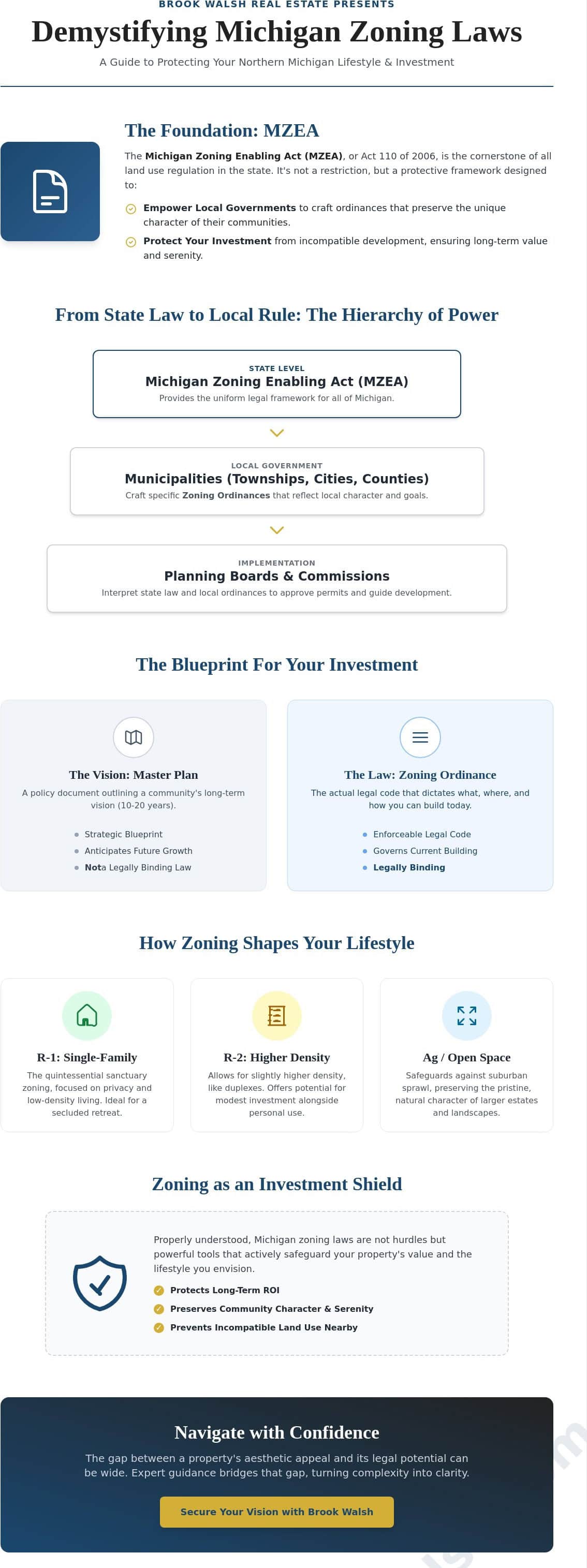
Michigan real estate is more than just a transaction; it's an investment in a specific, curated way of life. To protect that investment, you must understand the Michigan Zoning Enabling Act (MZEA), officially known as Act 110 of 2006. This legislation serves as the uniform foundation for all land use regulations across the state. By centralizing authority, it empowers local townships, cities, and counties to craft ordinances that reflect their unique character and natural beauty. Understanding Zoning through this legal lens is the first step for any discerning property owner who values the Northern Michigan Lifestyle. It ensures that the sanctuary you purchase today won't be compromised by incompatible development tomorrow.
To better understand how these regulations manifest in practical development, watch this helpful overview:
While the state provides the structural framework, the true power resides with local planning boards and commissions. These bodies interpret state law to create specific rules for their jurisdictions. This decentralized approach ensures that a lakeside retreat in Petoskey isn't governed by the same density requirements as an urban plot in Grand Rapids. It’s a delicate balance of authority where the state sets the boundaries, and the locals define the details. Mastery of Michigan zoning laws begins with recognizing this hierarchy of power.
The Legal Framework of Act 110
In the legal landscape of 2026, the Michigan Zoning Enabling Act stands as the comprehensive legislative mandate that grants local governments the authority to regulate land use to promote public health, safety, and general welfare while preserving private property rights. The legislative intent centers on balancing the rights of the individual with the collective health of the community. Within this framework, you'll encounter two primary regulatory layers:
- Zoning Districts: These define the primary use of the land, such as residential, commercial, or agricultural.
- Overlay Districts: These add extra layers of protection for specific goals, such as preserving historic architecture or protecting pristine shorelines.
Master Plan vs. Zoning Ordinance
Think of the Master Plan as the evocative vision for a community’s future. It’s a policy document, not a law. In contrast, the Zoning Ordinance is the actual legal code that dictates what you can build today. Successful investors study the Master Plan to anticipate where new infrastructure or commercial hubs will emerge over the next 10 to 20 years. Understanding the nuances of Michigan zoning laws requires looking at both the current law and the future vision. A Master Plan serves as the strategic blueprint for community evolution, making it an indispensable tool for securing the long-term ROI of your Northern Michigan investment.
Common Zoning Classifications and Their Lifestyle Impact
Zoning is the invisible architecture that defines the Northern Michigan lifestyle. It dictates whether your morning coffee is accompanied by the silent mist of a cedar forest or the rhythmic hum of a local bistro. Understanding Michigan zoning laws is essential for any investor seeking to preserve the sanctuary of their property. Most residential areas fall under R-1 or R-2 classifications. In an R-1 district, the focus is strictly on single-family dwellings, ensuring a low-density environment where privacy is paramount. R-2 districts often allow for slightly higher density, such as duplexes, which can provide unique opportunities for those looking to balance personal use with modest investment potential.
The authority for these local regulations is rooted in the Michigan Zoning Enabling Act, which grants municipalities the power to create districts that protect the health and character of their communities. For those drawn to the pristine character of larger estates, Agricultural and Open Space zoning serves as a safeguard against suburban sprawl. These classifications often require larger minimum lot sizes, sometimes five to ten acres, ensuring that the rolling hills and dense hardwoods of the region remain undisturbed. Conversely, mixed-use zoning in village centers offers a sophisticated blend of residential elegance and boutique commercial access, perfect for a lifestyle-driven investment.
Waterfront and Environmental Zoning
Michigan shoreline properties are subject to rigorous standards to protect water quality and property exclusivity. Local ordinances frequently mandate specific setbacks from the ordinary high-water mark, often ranging from 50 to 100 feet, to prevent erosion and maintain the aesthetic of the coast. The Department of Environment, Great Lakes, and Energy (EGLE) works alongside local boards to enforce vegetation buffers. These natural filters are not merely regulatory hurdles; they are essential components that maintain the crystal-clear clarity of our lakes and the long-term value of your retreat.
The Current State of Short-Term Rental (STR) Laws
The landscape of short-term rentals is shifting as we approach the 2026 legislative session. Michigan’s current stance emphasizes local control, where municipalities decide if a rental is a "By-Right" use or requires a "Special Use Permit." These permits often involve public hearings and strict occupancy limits to protect the quiet enjoyment of a neighborhood. By limiting turnover, these Michigan zoning laws help maintain the "sanctuary" feel that defines high-end residential enclaves. If you are searching for a property that aligns with these evolving standards, you might explore our curated listings to find your own Northern Michigan sanctuary that meets your specific lifestyle goals.
Navigating the Zoning Variance and Special Use Process
Sometimes your vision for a pristine retreat exceeds the rigid boundaries of local code. When a proposed sanctuary conflicts with established Michigan zoning laws, you aren't necessarily at an impasse. You'll likely find yourself before the Zoning Board of Appeals (ZBA). This body acts as a safety valve, ensuring that the law doesn't create an unintended burden on your property rights or the unique geography of your land.
You must distinguish between the two primary types of relief. A Dimensional Variance addresses physical constraints like setbacks, height limits, or lot coverage. It requires proving a "practical difficulty" unique to your land, such as an irregular shoreline or steep topography. A Use Variance is more complex; it asks to use the land for a purpose not permitted in that specific zone. This requires proving "unnecessary hardship," a high legal bar established under the Michigan Zoning Enabling Act. Understanding these nuances is vital for protecting your investment and ensuring your project proceeds without costly delays.
The 5-Step Process to Request a Variance
- Step 1: Pre-application meeting. Consult with the local zoning administrator to identify potential friction points before filing formal paperwork.
- Step 2: Proving Hardship. You must demonstrate that the property cannot be used reasonably under current restrictions due to circumstances you didn't create.
- Step 3: Public Hearing. Residents within 300 feet of your property boundary receive notification. This is the forum where community sentiment is voiced.
- Step 4: Presenting the Vision. Frame your project as a community asset. Highlight how the design preserves the Northern Michigan lifestyle and enhances neighborhood value.
- Step 5: The Final Decision. The ZBA will vote to approve, deny, or approve with specific conditions to mitigate the impact.
Winning a Special Use Permit
A Special Use Permit is required for projects that are generally compatible with a zone but require extra scrutiny. In Michigan townships, approval hinges on meeting specific standards outlined in the local ordinance. It's a discretionary process. Success depends on your ability to show that the project won't harm the health, safety, or welfare of the surrounding area.
Mitigating community concerns is the cornerstone of a successful application. If your project involves increased activity, propose robust landscape buffers to dampen noise or sophisticated lighting plans to protect the dark skies of the North. Curated architectural renderings are indispensable here. They transform abstract site plans into a visual promise of quality, showing officials and neighbors alike that your project is an exquisite addition to the local landscape. When you present a project that respects the environment and the community, you position yourself as a steward of the region's unparalleled beauty.
How Zoning Laws Influence Property Value and ROI
In the world of high-end real estate, Michigan zoning laws act as the silent architect of wealth preservation. They ensure that your multi-million dollar retreat remains a sanctuary, shielded from the encroachment of industrial noise or high-density traffic. This regulatory framework creates a predictable environment where property values don't just hold; they flourish. For the discerning buyer, a strict zoning ordinance isn't a restriction. It's a guarantee that the character of the neighborhood will endure for decades.
Protecting the Unparalleled Lifestyle
Strict zoning is a luxury homeowner's greatest ally. By preventing incompatible uses, such as a commercial facility appearing in a quiet residential enclave, these laws maintain the Northern Michigan Lifestyle our clients demand. Data from the Michigan Lake and Stream Associations suggests that properties in townships with robust shoreline protection ordinances see a 12 to 18 percent higher appreciation rate compared to those with lax oversight. This consistency ensures that the view from your terrace remains as pristine as the day you purchased it.
The correlation between consistent zoning and long-term price appreciation is undeniable. When a municipality commits to a specific vision, it removes the "uncertainty discount" that often plagues less-regulated markets. You aren't just buying a home; you're buying into a managed ecosystem of quality and exclusivity.
Zoning Due Diligence for Investors
For the savvy investor, zoning offers both a shield and a sword. Identifying "Up-Zoning" opportunities, where a parcel's designation might shift from single-family to multi-family or mixed-use, can unlock immediate equity gains. However, you must understand the risks of "Non-Conforming Use." If a structure is grandfathered in but doesn't meet current 2024 standards, a fire or major renovation could strip away those rights. This leaves you with a lot that's impossible to rebuild to its former footprint.
Before closing on a Michigan development lot, ask these essential questions:
- Does the Master Plan, which townships must review every 5 years per the Michigan Planning Enabling Act, suggest a change in density for this corridor?
- Are there "Grandfathered" rights that expire if the property remains vacant for more than 180 days?
- Does the local 2026 infrastructure budget include sewer expansions that could trigger a rezoning event?
Using zoning as a data point for ROI projections allows you to see the future of a neighborhood before it's reflected in the price. Pristine environments are maintained through strict open-space zoning, which limits supply and naturally drives up the value of existing dwellings. It's a fundamental principle of luxury real estate: scarcity, protected by law, creates value.
If you're ready to secure a property that promises both aesthetic beauty and financial security, explore our curated Northern Michigan listings today.
Expert Guidance for Your Michigan Property Journey
Understanding the nuances of Michigan zoning laws requires a partner who values your time and your vision. It's the difference between a simple transaction and the acquisition of a lifelong sanctuary. Brook Walsh Real Estate bridges the gap between rigid municipal codes and the fluid beauty of the Northern Michigan Lifestyle. Your vision deserves protection. We provide the sophisticated oversight necessary to ensure your investment remains secure, private, and aligned with your long-term goals.
Zoning regulations aren't merely hurdles; they're the framework that preserves the character of the communities we love. Whether you're eyeing a pristine waterfront lot in Bay Harbor or a secluded acreage near Charlevoix, the legal landscape dictates what's possible. We translate these complex rules into actionable insights. Our team ensures that every setback, height restriction, and land-use designation serves your interests rather than hindering them. We believe that a well-regulated community is the best place to find a lasting retreat.
The Brook Walsh Advantage
We focus on the emotional and aesthetic value of property as much as the technical data. Our brokerage acts as a professional advocate during the due diligence phase, connecting you with the region's most respected land-use consultants. We verify that your plans for a lakeside retreat or a sprawling estate are fully supported by local ordinances. This high-level consulting is essential for zoning-heavy acquisitions where environmental protections and municipal oversight are most stringent. We offer a level of expertise that transforms the search for a home into the curation of a lifestyle.
- Lifestyle-Driven Strategy: We prioritize how you intend to live, ensuring the property's legal profile matches your aspirations.
- Expert Advocacy: Our team manages the communication with local planning boards and zoning officials on your behalf.
- Strategic Networking: Access a curated list of environmental engineers and architects who specialize in Northern Michigan's unique terrain.
- Due Diligence Excellence: We conduct deep-dive research into historical zoning variances and future master plans for your chosen area.
Your Next Steps to Property Ownership
The path to owning a piece of Northern Michigan's exquisite landscape is clearer with expert guidance. We invite you to view our exclusive listings, each vetted for its unique potential and compliance with Michigan zoning laws. If you've discovered a specific parcel that captures your imagination, we can provide a custom investment analysis. This bespoke report details the developmental possibilities and any regulatory constraints specific to that lot. It's an essential tool for the discerning buyer who demands precision. Contact our office today to begin your lifestyle search and secure your place in one of Michigan's most coveted communities.
Your sanctuary is waiting. Let's ensure it's built on a foundation of expert knowledge and unparalleled local authority. Reach out to start a conversation about your future in the North.
Secure Your Northern Michigan Legacy
Navigating the intricacies of the Michigan Zoning Enabling Act of 2006 requires more than just technical knowledge; it demands a vision for how these regulations shape your daily life. By mastering Michigan zoning laws and the specific provisions within Public Act 110, you ensure that your property remains a true sanctuary while protecting your long-term return on investment. Whether you're analyzing specific classifications or seeking a variance through local boards, the details dictate the quality of your Northern Michigan lifestyle. Expert investment consulting transforms these complex legal frameworks into a clear path toward property ownership that balances prestige with practical security.
As a recognized Northern Michigan real estate authority, Brook Walsh provides a lifestyle-driven property search that aligns your aesthetic desires with the regulatory landscape. You deserve a partner who understands that a home is an emotional haven, not just a transaction. Let's find a location where the landscape and the law work in perfect harmony to support your future. Your ideal retreat is waiting to be discovered.
Begin your search for a Michigan sanctuary with Brook Walsh
Frequently Asked Questions
Can I build a guest house or ADU on my Michigan property?
You can build a guest house or accessory dwelling unit (ADU) in Michigan if your local municipality's specific zoning code permits it. While the Michigan Zoning Enabling Act of 2006 grants local governments the authority to regulate these structures, towns like Traverse City or Petoskey have individual setbacks and size requirements. In 2023, several Northern Michigan communities revised their codes to allow ADUs as a strategy to increase housing density while preserving the local character of the neighborhood.
How do I find the specific zoning ordinance for my Michigan township?
Finding the specific zoning ordinance for your Michigan township starts with a visit to the official municipal website or a digital repository like Municode. Most of the 1,240 townships in Michigan maintain digital archives where you can search for Michigan zoning laws and property maps. If the digital record is incomplete, a visit to the township hall during public hours allows you to review the physical master plan and zoning map with a planning official.
What happens if I build something that violates local zoning laws?
Building in violation of local zoning laws typically results in a formal Notice of Violation and daily fines that often range from $100 to $500 per day until the issue is corrected. In severe cases, the Michigan Zoning Enabling Act empowers municipalities to seek a court order for the physical removal of the structure. This creates a cloud on the title, making it nearly impossible to sell or refinance your Northern Michigan retreat until the property achieves full compliance.
Is short-term renting allowed by right in all Michigan residential zones?
Short-term renting isn't allowed by right in all Michigan residential zones because each of the 1,773 local units of government sets its own standards. While some resort communities embrace vacation rentals, others, such as Grand Haven or specific districts in Charlevoix, have passed ordinances since 2018 that strictly limit or ban rentals of fewer than 30 days. You must verify the specific Use Table in your local ordinance to ensure your investment aligns with the Northern Michigan Lifestyle you envision.
What is a "Non-Conforming Use" and can I expand it?
A Non-Conforming Use refers to a property use that was legal when established but no longer complies with updated Michigan zoning laws. You generally can't expand these uses; for instance, if a commercial shop exists in a residential zone, you can't increase its footprint by 10% without losing its protected status. Most ordinances dictate that if a non-conforming structure is destroyed beyond 50% of its value, it must be rebuilt according to modern standards.
How long does the zoning variance process typically take in Michigan?
The zoning variance process in Michigan typically takes between 60 and 90 days from the initial application to a final decision by the Zoning Board of Appeals (ZBA). This timeline includes a mandatory public notice period, which requires notifying all neighbors within 300 feet of the property at least 15 days before the hearing. Your success depends on proving a "practical difficulty" that prevents you from enjoying the same property rights as your neighbors in that district.
Can zoning laws change after I purchase my property?
Zoning laws can change after you purchase your property through a process called a Zoning Map Amendment or a comprehensive update to the local Master Plan. Michigan law requires municipalities to review their Master Plans every 5 years to ensure they reflect current growth trends. While your existing use might be grandfathered, new regulations could impact your ability to subdivide the land or add secondary structures to your Northern Michigan sanctuary.
What is the difference between a zoning ordinance and a deed restriction?
A zoning ordinance is a public law enacted by a municipality, while a deed restriction is a private contract recorded with the County Register of Deeds. Zoning regulates land use and density across entire districts, whereas deed restrictions, often found in luxury subdivisions, can dictate specific architectural details like roof pitches or exterior colors. In Michigan, if the two conflict, you must follow the more restrictive of the two to maintain your property's legal standing.
Posted by Brook Walsh onEnjoy this blog post? Click here to subscribe for updates
Leave A Comment