

What if a better guest communication plan meant fewer messages, not more? For vacation homeowners, managing guest communication effectively can replace repeated questions with a thoughtful rhythm that helps guests feel prepared, welcomed, and supported. That matters in Northern Michigan, where a stay in Charlevoix or Emmet County should feel like a genuine retreat, not a series of avoidable uncertainties.
It’s easy to get pulled into reactive replies when guests aren’t sure what to expect before arrival or where to turn during their stay. Clear, well-timed communication answers common questions before they arise while keeping each exchange personal and attentive. The goal isn’t to fill a guest’s inbox. It’s to offer useful guidance at the right moment.
This guide covers how to build a consistent communication plan from booking confirmation through checkout, with practical touchpoints that help guests arrive with confidence and enjoy a smoother stay. You’ll also learn how professional short-term rental management through Brook Walsh Real Estate can coordinate guest communication with the broader ownership experience, so care feels consistent across bookings, channels, and seasons.
Key Takeaways
- Map messages to each stage of the guest journey, from reservation confirmation to post-stay follow-up.
- Use templates and automation for consistent essentials, then personalize details that shape each guest’s stay.
- Build a property-specific checklist covering arrival, access, amenities, and checkout for homes in Charlevoix, Emmet, and Grand Traverse counties.
- Managing guest communication effectively means anticipating likely questions and sharing useful information at the right time.
- Compare owner-managed and professional management approaches to find a communication rhythm that fits your property and priorities.
Table of Contents
- Managing Guest Communication Effectively Starts With the Guest Journey
- Build a Step-by-Step Guest Communication Workflow
- Compare Personal Messages, Templates, and Automation
- Create a Northern Michigan Communication Plan That Fits the Property
- Make Guest Communication Sustainable With the Right Management Support
Managing Guest Communication Effectively Starts With the Guest Journey
Managing guest communication effectively means sharing clear, consistent, appropriately personal information at the moment it’s useful. For a vacation rental in Petoskey, that means more than answering messages as they arrive. Anticipate what guests need at each stage of the stay, so they can look forward to Northern Michigan with confidence instead of wondering what happens next.
Guest communication management is the planned exchange of timely, property-specific information and support from booking through post-stay follow-up. This approach reflects the broader principles of customer relationship management: building a thoughtful relationship through relevant, useful interactions, not simply sending more messages.
What guests need at each stage of a vacation rental stay
Think of the guest journey as a sequence, with each message serving a distinct purpose. The booking confirmation should acknowledge the reservation and clarify essential details already established for that guest. Closer to arrival, share practical information such as how to access the home and what to expect when they get there.
Once the stay begins, communication shifts from preparation to support. Guests may need help with property-specific features or a clear way to ask a question. Checkout reminders should arrive in time to be useful and focus on the steps for that home. A considerate follow-up can close the conversation after checkout. Keep details specific to the property and reservation; generic instructions may leave guests unsure which information applies.
How a clear communication rhythm improves the experience
Consistent timing helps guests know what to expect: confirmation after booking, practical guidance as arrival approaches, support during the visit, and a clear send-off. Not every message needs to arrive immediately. Share essential details when they’re needed, and save secondary tips for a more relevant point in the journey. This keeps communication helpful rather than crowded.
A warm welcome and concise instructions work well together. An arrival message, for example, can start with a friendly note, then lay out access details in a direct, easy-to-follow format. In a Petoskey rental, the home’s actual arrangements matter more than a generic welcome script. A calm rhythm shaped around the reservation and property gives guests a sense of care and gives owners a repeatable structure to use across bookings.
Build a Step-by-Step Guest Communication Workflow
A reliable workflow turns guest messaging into a sequence of useful touchpoints instead of a stream of last-minute replies. For a Petoskey vacation rental managed by Brook Walsh Real Estate, keep current property instructions, message templates, and reservation-specific notes together in one reference. This helps ensure the details guests receive match the home and their stay, even when messages are sent through different channels.
Make every message arrive when the guest needs it, answer the question at hand, and make the next step easy to find. A structured guest communication workflow should be simple for the owner to follow and easy for the guest to revisit.
What to send before arrival and on arrival day
Start with a confirmation that acknowledges the booking and shares essential reservation details. As arrival approaches, send planning information and property-specific guidance, including access instructions and the practical details guests need to settle in. On arrival day, make the key steps easy to locate. Put operational information in a format guests can revisit, such as a concise message or clearly organized digital guide.
Avoid putting every detail in one long welcome note. Lead with the essentials, then separate secondary information into labeled sections or a follow-up message. A guest looking for entry instructions shouldn’t have to search through local recommendations and general greetings to find them.
How to support guests during and after the stay
During the visit, make it clear how guests can ask a question or report a concern, and keep relevant property information close at hand. A specific reply can explain what to do next without overwhelming them with unrelated details. Keep the tone gracious and practical, whether the question concerns an amenity or an unexpected issue at the home.
Send a checkout reminder that distinguishes essential departure instructions from optional courtesies. After checkout, close warmly and invite feedback in a way that feels genuine, not obligatory. Managing guest communication effectively means giving guests a clear path through the reservation while leaving room for personal, thoughtful exchanges.
Compare Personal Messages, Templates, and Automation
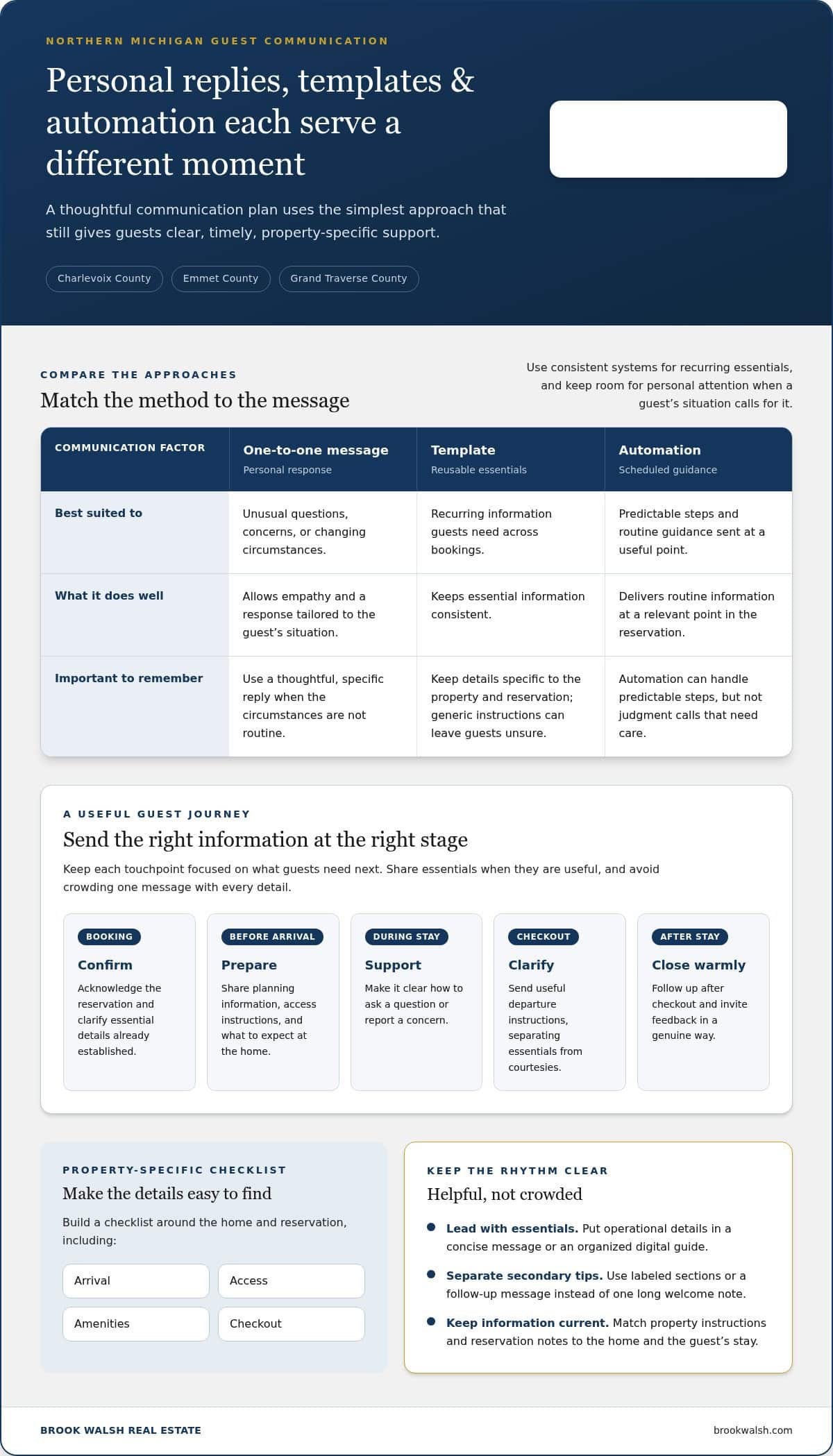
Different messages call for different approaches. A personal reply is valuable when a guest’s situation is unusual. A template keeps recurring information consistent, while scheduling can deliver routine guidance at a useful point in the reservation. Automation can handle predictable steps, but it shouldn’t make judgment calls when a concern needs care. Managing guest communication effectively means choosing the simplest method that still serves the guest well.
| Method | Best suited to | Strength | Limitation and personalization |
|---|---|---|---|
| One-to-one message | Unusual questions, concerns, or changing circumstances | Allows empathy and a response tailored to the situation | Takes individual attention; acknowledge the guest’s specific question and give clear next steps. |
| Reusable template | Recurring information, such as confirmation or checkout guidance | Creates a consistent starting point and reduces repeated drafting | Can become inaccurate; update names, dates, property details, and reservation context before sending. |
| Scheduled message | Predictable touchpoints, such as pre-arrival information | Helps deliver guidance in a planned sequence | May not fit a changed reservation; review timing and content against the booking. |
| Platform automation | Routine delivery or acknowledgment of standard information | Can reduce manual repetition for predictable tasks | Shouldn’t replace human review or judgment when a guest’s message is sensitive or unexpected. |
These methods can work together. A scheduled message may use a reviewed template, while an unexpected guest question calls for a personal response. For broader context on guest messaging and digital tools, see this guest communication resource. The right balance depends on the message, the reservation, and the care the moment calls for.
Which guest messages are best handled with templates?
Use templates when the core information stays accurate across the reservations they’re intended for, such as a welcome, arrival overview, or checkout reminder. Treat each as a draft, not a finished message. Personalize the guest’s name, dates, access details, and relevant context. Before sending, check that the instructions still match the property and that changes to the reservation haven’t made the wording misleading.
When should a host respond personally?
Give personal attention to unusual questions, concerns, and unexpected circumstances. Acknowledge what the guest has raised, respond with empathy, and make the next step clear rather than relying on a generic script. Establish an escalation process in advance so it’s clear who reviews a concern and how it’s handled. Don’t promise a response time the operation can’t reliably meet.
Create a Northern Michigan Communication Plan That Fits the Property
A guest’s questions depend on the home they’ve booked and the arrangements for their stay. A communication plan for a Petoskey vacation rental should make the property’s actual features easy to understand, without relying on generic copy that could describe any home. Across Charlevoix, Emmet, and Grand Traverse counties, share location and property details that help guests prepare, and avoid assumptions about amenities or local conditions.
Use a property-specific checklist to make essential information easy to review:
- Arrival: State the confirmed arrival details and any information guests need to plan their check-in.
- Access: Explain the property’s actual entry process and where guests can find those instructions again.
- Amenities: Describe available features accurately, with any property-specific guidance needed to use them.
- Checkout: Separate essential departure instructions from optional courtesies, and make both clear.
Adapt messages to waterfront, resort, and other property settings
The setting can shape what guests need to know, but the details should come from the home itself. For a waterfront rental, describe any included waterfront features and relevant property instructions. A resort-area home may call for clear directions to the residence within its setting, if those details are part of the guest’s arrangements. In every case, share accurate features and practical guidance. Mention Petoskey or another nearby place when it helps clarify a guest’s plans, not as a substitute for precise property information.
Keep information accurate across seasons and reservations
Separate stable instructions from details that can change. A home’s basic layout or standard access process may belong in a maintained reference, while guest names, reservation dates, and stay-specific arrangements should be reviewed for each booking. Revisit templates whenever property instructions or access details change, and before using them for a new reservation. This review helps prevent outdated guidance from reaching guests.
For owners, guest experience is part of the broader work of rental ownership, alongside caring for the property and keeping its operation consistent. Explore Northern Michigan investment guidance to consider how these pieces fit together.
Make Guest Communication Sustainable With the Right Management Support
A well-designed communication plan should work for the owner as well as the guest. Some vacation-home owners in Petoskey enjoy answering questions and guiding each stay themselves. Others prefer to entrust the ongoing coordination to professional management. The right fit depends on how much time you want to give guest care, how involved you want to remain, and what support helps the property operate smoothly.
How to decide whether to manage guest communication yourself
Consider the work behind each reservation, not just the messages guests send. You’ll need to keep property information current, prepare and review messages, respond to questions, and follow up after checkout. Ask yourself:
- Do you have the time to manage those touchpoints consistently across bookings?
- Are you comfortable responding when a question falls outside the usual script?
- Would a reliable workflow and well-maintained templates address the communication challenges you’re experiencing?
If a clear process makes the workload manageable and you value direct involvement, owner-managed communication may suit you. If guest care competes with other priorities or you want support coordinating it with the broader ownership experience, professional management may be a better fit.
How professional vacation-rental management can support owners
Professional short-term rental management brings guest communication into the larger context of caring for a vacation property. Message planning, guest questions, accurate property information, and follow-up are connected parts of the experience, not isolated tasks. For owners in Northern Michigan, including Petoskey and communities such as Boyne City, Boyne Falls, Charlevoix, Harbor Springs, and East Jordan, coordinated guest management can support a consistent approach while giving owners more time for other priorities.
Brook Walsh Real Estate provides short-term rental management for Northern Michigan vacation homeowners. Its property management service can coordinate guest communication with the broader work of vacation-home ownership.
Whichever approach you choose, keep the guest journey at the center: confirm the reservation, prepare guests for arrival, make support clear during the stay, offer straightforward checkout guidance, and close with a thoughtful follow-up. That steady sequence helps communication feel organized and personal.
Make Every Guest Touchpoint Feel Thoughtful
A considered communication plan gives guests a clear path from booking to checkout without crowding their stay with unnecessary messages. Share essential information when it’s useful, keep property instructions accurate for each reservation, and use templates or automation for predictable details. Respond personally when a question calls for judgment and care.
Managing guest communication effectively is an ongoing part of the vacation-home experience, not simply an inbox task. For owners, the right approach depends on the time and involvement they want to give guest care. A consistent workflow can support self-management, while professional vacation-rental management can coordinate communication with the broader ownership experience.
Brook Walsh Real Estate provides short-term rental management for vacation homeowners across Northern Michigan, including communities in Charlevoix, Emmet, and Grand Traverse counties. Explore vacation property guidance with Brook Walsh Real Estate to see how management support could fit your ownership priorities. With a thoughtful rhythm in place, you can help guests feel welcomed and prepared while preserving the calm, personal character of their Northern Michigan stay.
Frequently Asked Questions
What does effective guest communication mean for a vacation rental?
Effective guest communication is timely, clear, consistent, and personal enough to address each reservation. It helps guests understand what to expect, where to find property information, and how to raise a question. For owners in Petoskey and across Northern Michigan, managing guest communication effectively means planning useful touchpoints from booking through checkout, rather than relying on reactive replies or sending more messages than guests need.
How often should a vacation rental host message guests?
Message guests at meaningful points in the stay, not according to an arbitrary daily schedule. Confirm the reservation, share practical arrival guidance as the trip approaches, explain how to ask for support, and provide a checkout reminder and considerate follow-up. The right cadence depends on the property and booking. Keep each message useful, and avoid repeating details guests can easily revisit in a guide or previous message.
What should a host tell guests before arrival?
Before arrival, share the confirmed information guests need to plan and enter the property: reservation details, arrival guidance, access instructions, and essential property information. Keep key steps easy to scan and revisit rather than burying them in a long welcome note. For a vacation home in Petoskey, Boyne City, or Charlevoix, tailor directions and instructions to the actual property and the guest’s arrangements.
Can guest communication be automated without feeling impersonal?
Yes. Automation can send predictable information, such as a reservation acknowledgment or scheduled arrival guidance, while personal replies remain important for unusual questions and concerns. Use templates as a starting point, then review names, dates, property instructions, and reservation details before sending. A warm greeting and concise practical guidance can make an automated message feel considered, provided it’s accurate and doesn’t pretend to address a situation it can’t understand.
What is the best way to handle a guest complaint?
Acknowledge the concern, clarify what the guest needs, and explain the next step in plain language. Avoid a defensive or generic reply. If the issue requires review or action by someone else, follow a defined process for routing and tracking it, and keep the guest informed without promising a response time you can’t ensure. Clear, empathetic communication matters in a vacation home just as much as the eventual resolution.
Do vacation rental hosts need a unified inbox?
No single inbox is essential for every host, but a dependable way to keep conversations organized is valuable. If you use multiple booking or messaging channels, establish a routine for checking them and recording important guest questions or follow-up. A unified inbox may help bring conversations together, while a simpler setup can work if it’s managed consistently. Choose an approach that suits your booking volume, workflow, and desired level of involvement.
How can Northern Michigan vacation rental owners personalize guest messages?
Personalize messages with accurate names, reservation details, and guidance specific to the home, then add local context only when it helps guests plan. A stay in Harbor Springs, East Jordan, or Boyne Falls may call for different property directions or confirmed amenity information, not assumptions about what guests will do. Brook Walsh Real Estate provides short-term rental management for Northern Michigan vacation homeowners, including in these communities and Petoskey.
Posted by Brook Walsh onEnjoy this blog post? Click here to subscribe for updates
Leave A Comment