

What protects a Northern Michigan vacation home more effectively: a larger deposit or clear terms and reliable records? For owners in Charlevoix, Emmet, and Grand Traverse counties, knowing how to handle security deposits for vacation rentals starts with a fair, transparent process, not a copied policy that may not fit the property or booking arrangement. Guests need to understand what they’re agreeing to, and owners need a practical way to distinguish accidental damage from ordinary wear or a condition that was already there.
A thoughtful approach can protect both the home and the guest experience. This guide explains how to set out deposit terms before booking, document the property’s condition, assess potential deductions fairly, and compare a refundable deposit with a damage waiver or platform protection. It also explains why owners should verify which state requirements, local rules, and booking-platform terms apply to their specific rental. Consistent communication and property records are essential to managing vacation homes, whether you oversee each stay yourself or want support with guest care and property maintenance.

Key Takeaways
- Set deposit terms before accepting bookings, and present the same clear policy through every reservation channel.
- When deciding how to handle security deposits for vacation rentals, compare refundable deposits, damage waivers, and platform protection for guest experience, administration, and evidence requirements.
- Record your Northern Michigan property’s condition with dated photos, inventory notes, and maintenance records before and after each stay.
- Assess possible deductions against the documented condition and disclosed terms, then explain the decision and handle any refund consistently.
- Verify the requirements that apply to your property’s municipality and booking arrangement. Rules and platform terms can differ.
Table of Contents
- How vacation-rental security deposits work in Northern Michigan
- Build a clear deposit policy before accepting Northern Michigan bookings
- Compare deposits, damage waivers, and booking-platform protection
- Document condition, handle deductions, and return funds consistently
- Manage vacation-rental deposits as part of Northern Michigan property care
How vacation-rental security deposits work in Northern Michigan
A security deposit is refundable money collected from a guest and held under clearly disclosed, lawful terms. It may help address specified costs after a stay, but it is not an automatic charge or a substitute for clear communication. For a foundational overview, see How security deposits work.
A short vacation stay may raise different questions from a conventional residential tenancy, but calling a booking a “vacation rental” does not settle which rules apply. The arrangement, applicable Michigan requirements, local rules, booking-platform terms, and written rental agreement all matter. Guidance written for New York, California, or Tennessee is not a substitute for checking the requirements relevant to a Northern Michigan property.
For a broader look at how vacation-rental operators discuss alternatives to refundable deposits, watch this overview:
Which Michigan and local rules should owners verify?
Start with the property’s municipality and county. A rental in Charlevoix County, Emmet County, or Grand Traverse County may also be subject to rules set by its specific city or township, so county-level assumptions can miss important details. Review current Michigan sources and relevant local-government guidance, then compare them with the booking platform’s current terms and the rental agreement. If a legal question remains, have it reviewed by a qualified attorney.
Don’t rely on a template from another state or assume a deposit cap, account requirement, interest duty, or return deadline applies until you’ve verified it for your specific arrangement.
What should a vacation-rental deposit policy explain?
Write the policy in plain language before accepting bookings. State the deposit amount, when it will be collected, how and when a refund is handled, and which charges may be considered. Define terms with examples: a broken window or missing listed item may differ from ordinary wear, such as minor scuffs from normal use. Explain what “excessive cleaning” means for your property rather than leaving guests to guess.
Tell guests how to raise a question about a deduction and which records may support a review, such as dated photos, an inventory, maintenance notes, and relevant messages. A consistent written process lets owners and guests assess concerns against the same disclosed terms. For owners balancing guest experience with ongoing property care, clear terms are part of well-managed vacation rentals.
Build a clear deposit policy before accepting Northern Michigan bookings
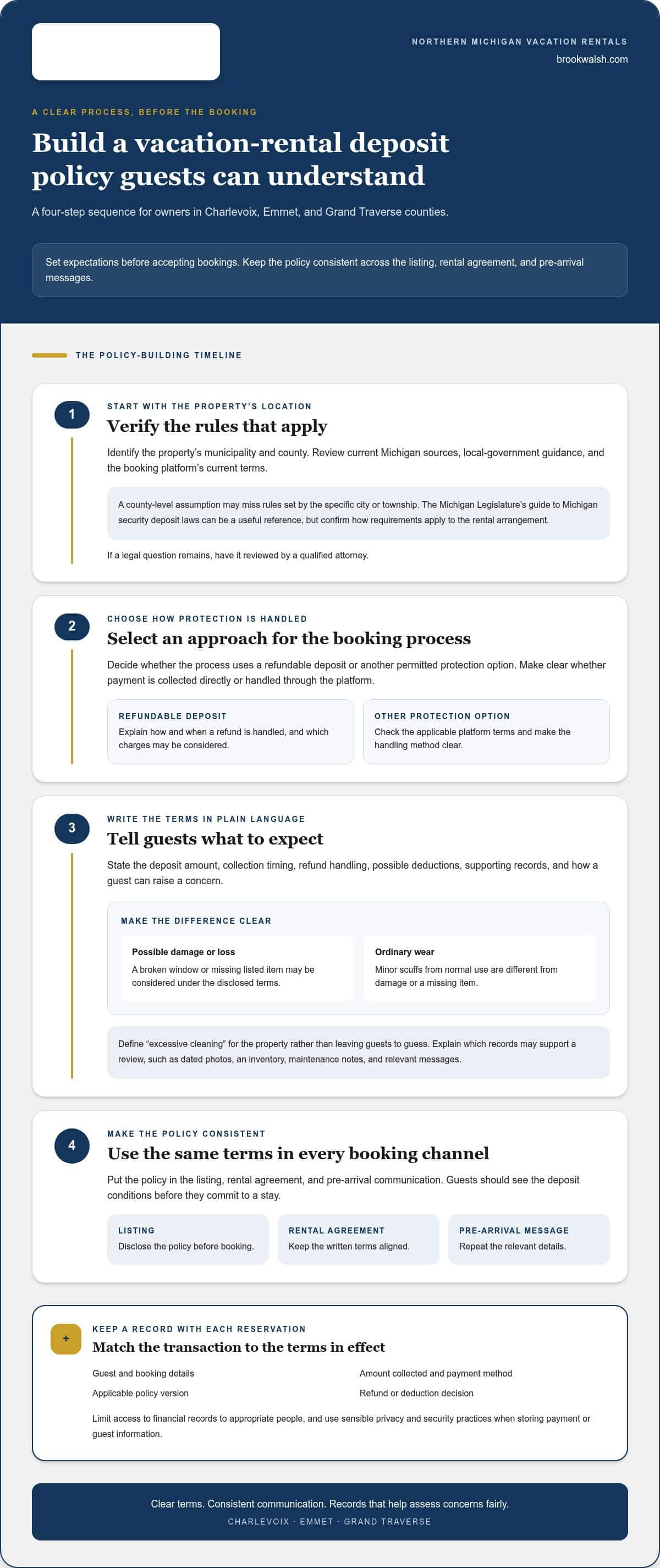
A well-written policy turns an uncomfortable post-stay conversation into a process guests can understand before they reserve. For vacation homes across Charlevoix, Emmet, and Grand Traverse counties, create the policy before publishing a listing or accepting bookings. Keep the wording consistent in the listing, rental agreement, and pre-arrival messages. Guests shouldn’t encounter new deposit conditions only after committing to a stay.
Use this sequence to establish a workable approach:
- 1. Verify the rules. Identify the property’s municipality and county, then review current Michigan sources, local-government guidance, and relevant platform terms. The Michigan Legislature’s guide to Michigan security deposit laws is a useful reference, but confirm how requirements apply to your rental arrangement.
- 2. Choose an approach. Decide whether your booking process uses a refundable deposit or another permitted protection option. Clarify whether payment is collected directly or handled through the platform.
- 3. Draft the terms. Explain the amount, collection timing, refund handling, possible deductions, supporting records, and how a guest can raise a concern.
- 4. Configure communications. Put the same policy in each booking channel and repeat the relevant details in the rental agreement and pre-arrival communication.
Write terms guests can understand before they book
Precision builds trust. Avoid broad language such as “any damage may be charged” without explaining how a concern will be assessed and documented. Describe the types of issues your policy addresses, such as damage to a listed furnishing or a missing item, and distinguish them from ordinary wear. Explain which records may be reviewed, how guests can ask questions, and how you’ll communicate a decision. Clear terms help guests understand expectations before arriving at a lakeside home or seasonal retreat.
Choose a collection and recordkeeping process
For each reservation, record the guest and booking details, amount collected, payment method, applicable policy version, and any refund or deduction decision. Limit access to financial records to appropriate people, and use sensible privacy and security practices when storing payment or guest information. A consistent record makes it easier to match each transaction to the terms in effect for that stay.
Owners weighing the operational work against a property’s investment goals can explore Northern Michigan real estate investment guidance. Vacation-rental management can also help owners coordinate guest communication, maintenance, and property care.
Compare deposits, damage waivers, and booking-platform protection
There’s no single approach for every Northern Michigan rental. The right fit depends on your booking process, the guest experience you want to create, the work you can manage consistently, and the terms that govern the property and reservation. A refundable deposit, damage waiver, and platform-administered protection are not interchangeable. Each may define responsibility, evidence, and claim handling differently. As you consider how to handle security deposits for vacation rentals, compare the actual terms rather than relying on the label alone.
| Approach | Guest experience | Owner administration | Evidence and limitations |
|---|---|---|---|
| Refundable deposit | Guests may appreciate a clear path to getting their funds returned, but an upfront hold or collection can affect how booking feels. | Requires a process to track funds, assess concerns, communicate decisions, and handle refunds. | Dated condition records and a clear basis for any deduction matter. Terms and applicable requirements govern how funds may be handled. |
| Damage waiver | May be presented as an alternative to a refundable deposit, but guests need to understand what the waiver does and doesn’t address. | Administration depends on the waiver’s terms and the process for documenting and reporting an incident. | Review covered incidents, exclusions, eligible property, limits, and claim steps. A waiver is not automatically insurance or equivalent to a deposit. |
| Booking-platform protection | May be integrated into the booking experience, though guest terms can differ by platform or reservation. | The platform may administer parts of the process, but owners still need to understand their responsibilities and follow required procedures. | Check current platform terms, evidence requirements, exclusions, and claims procedures. Don’t assume protections are identical across booking channels. |
When might a refundable deposit suit the booking model?
A refundable deposit may suit an owner who can explain the collection and refund process clearly and track each reservation consistently. That approach requires administrative work: recording the funds, reviewing the property after a stay, responding to questions, and completing the refund process. For seasonal bookings near Northern Michigan’s lakes, trails, or ski areas, explain the policy before guests reserve so expectations stay clear during busy booking periods.
What should owners check in waivers and platform protection?
Read the operative terms closely. Identify which incidents and property items are addressed, what exclusions apply, what evidence is required, and how a claim or concern must be submitted. A guest-facing waiver is not automatically insurance, and platform-administered protection is governed by the platform’s own conditions. Verify current booking terms and applicable legal requirements before choosing an approach. Michigan’s Legislature provides a reference on Michigan security deposit laws; confirm how relevant rules apply to your specific rental arrangement.
Document condition, handle deductions, and return funds consistently
Reliable records make it easier to compare a guest’s stay with the property’s documented condition instead of relying on memory after a busy turnover. For Northern Michigan rentals, use the same process between seasonal bookings, whether the home is near Charlevoix, in Emmet County, or in the Grand Traverse area. Consistent records also help keep a deposit decision fair, specific, and connected to the terms guests received.
What evidence should owners capture at arrival and departure?
Use a chronological routine for every reservation:
- Before arrival: Capture dated photos or video of each room, furnishings, appliances, and outdoor areas. Note pre-existing marks, defects, or maintenance issues, and update the property inventory when items change.
- After checkout: Inspect the same areas using the same checklist. Record new condition concerns and photograph them clearly, with enough context to identify where they are.
- Before deciding: Compare checkout evidence with the arrival record, inventory, maintenance notes, and relevant guest communications. Separate a documented change from a condition that was already present or ordinary wear from use.
- Before closing the reservation: Keep the records together with the booking details and policy version that applied to that stay.
Consistency matters during peak turnover periods, when cleaning and maintenance tasks can overlap. A room-by-room method reduces the chance that one area gets close attention while another is overlooked. These records support how to handle security deposits for vacation rentals with evidence, not assumptions.
How can owners communicate a deduction or refund clearly?
If you propose a deduction, send a concise, itemized explanation that identifies the concern, the relevant rental-agreement term, and the records supporting the decision. Keep calculations understandable and retain invoices or other relevant documentation where applicable. Don’t describe a charge vaguely as “damage” without connecting it to a specific observed condition and the policy guests received.
For a full refund, communicate the outcome and method clearly. Follow the timeline and process that apply to the specific rental arrangement, agreement, and booking platform. Don’t assume one deadline applies to every stay. If a guest questions a decision, invite a factual response and preserve the related messages and evidence. Calm, timely communication can help keep a property-care issue from undermining guest trust.
Consistent inspection, maintenance, and guest communication are part of thoughtful vacation-rental management. Explore Northern Michigan vacation-rental management as you consider how to care for your property across seasonal bookings.
Manage vacation-rental deposits as part of Northern Michigan property care
A deposit policy works best as part of a broader routine for guest communication and property care. Owners in Charlevoix, Emmet, and Grand Traverse counties can follow a repeatable process while checking requirements for the property’s specific municipality and booking arrangement. The goal is simple: guests know what to expect, and owners have a clear record of each stay.
Use this checklist to keep the process on track:
- Verify: Review current Michigan requirements, local guidance for the property’s municipality, and booking-platform terms.
- Publish: State the deposit or chosen protection approach and its terms in the listing, rental agreement, and relevant guest communications.
- Record: Document the property’s condition and inventory before arrival, noting existing wear or maintenance issues.
- Review: After checkout, compare the property with the arrival records and assess any concern against the written terms.
- Communicate: Explain the outcome clearly and retain the related records and guest correspondence.
- Refund: Follow the applicable process and timing for returning any funds owed.
When can professional vacation-rental management help?
Each reservation involves more than welcoming a guest. Communication, maintenance coordination, property-condition records, and turnover routines all contribute to caring for a Northern Michigan home. Owners can weigh the time these tasks require against how often they use the property and how involved they want to be in day-to-day operations. Brook Walsh Real Estate provides short-term rental management, including marketing, maintenance, and guest management. Owners considering how rental activity fits into a broader ownership strategy can also explore Northern Michigan real estate investment guidance.
What should owners do before the next guest arrives?
Review the written policy against current booking terms and verified Michigan and local requirements. Prepare an arrival-condition record, a checkout inspection routine, and a consistent, secure system for storing reservation details, photos, maintenance notes, and communications. These habits make how to handle security deposits for vacation rentals a repeatable part of caring for a property through changing seasons and booking cycles.
Brook Walsh Real Estate’s vacation-rental management supports owners with guest management, maintenance, and property care.
Protect Your Property With a Consistent Guest Process
A clear deposit approach supports more than a fair refund or deduction. It sets guest expectations, helps preserve trust, and creates useful records of your Northern Michigan property across changing seasons. The essentials are straightforward: verify requirements for the specific rental, explain terms before booking, document condition consistently, and communicate decisions with supporting evidence. That’s how to handle security deposits for vacation rentals with care for both the home and the guest experience.
For owners in Charlevoix, Emmet, and Grand Traverse counties, dependable guest management and property care go hand in hand. Brook Walsh Real Estate’s vacation-rental management includes marketing, maintenance, and guest management. Its investment advice can help owners consider how a rental fits into broader property goals.
Explore vacation-rental management with Brook Walsh Real Estate and consider how a thoughtful management approach can support your property and the Northern Michigan experience it offers. With clear processes in place, you can welcome guests with greater confidence.
Frequently Asked Questions
Are security deposits legal for Michigan vacation rentals?
A refundable deposit may be used, but whether Michigan’s statutory security-deposit requirements govern a particular vacation stay depends on the arrangement and applicable law. Don’t decide based only on the stay’s short length. Before collecting funds, review current Michigan requirements, local rules, the rental agreement, and booking-platform terms. For a home in Charlevoix, Emmet, or Grand Traverse County, identify its specific municipality too, since local short-term-rental requirements can vary.
How much security deposit should I collect for a vacation rental?
Choose an amount only after checking which requirements apply to your rental arrangement. Michigan law sets a limit of 1.5 times monthly rent for covered residential rental units, but applying that rule to a short-term booking and its payment structure requires careful review. Don’t assume a nightly rate translates directly into a monthly-rent calculation or adopt another state’s formula. Explain the amount and terms clearly before guests book.
When should I return a vacation-rental security deposit in Michigan?
If Michigan’s security-deposit requirements apply, the deposit or remaining balance is generally due within 30 days after the tenant vacates, with an itemized list of intended deductions within that period. A short-term guest arrangement may require a closer applicability review, so don’t assume this deadline fits every booking. Check current rules, the written agreement, and the applicable platform process, then communicate the refund timing and method clearly to the guest.
Can I deduct cleaning costs or damage from a vacation-rental deposit?
Potential deductions depend on applicable law, disclosed agreement terms, and supporting records. Documented damage beyond ordinary wear may be treated differently from routine turnover cleaning or pre-existing conditions. Don’t automatically charge the deposit for standard cleaning or describe a deduction only as “damage.” State the basis clearly, keep relevant evidence and calculations, and verify whether the proposed charge is permitted for your specific rental arrangement.
Is a damage waiver the same as a vacation-rental security deposit?
No. A refundable deposit is money collected and potentially returned under disclosed terms. A damage waiver is a separate arrangement whose scope depends on its specific conditions; it isn’t automatically equivalent to a deposit or insurance. Before choosing one, review which incidents and property items it addresses, its exclusions, and how concerns or claims are handled. Explain the option to guests plainly, and check the legal and booking terms that apply.
What evidence should I keep if a vacation-rental guest disputes a deduction?
Keep dated arrival and checkout photos, an inventory, maintenance notes, reservation and policy records, relevant guest messages, and a clear calculation of any proposed deduction. Compare the checkout condition with the arrival documentation so pre-existing issues and ordinary wear aren’t mistaken for new damage. For a home in Boyne City, Petoskey, or elsewhere in Northern Michigan, organized records help make the decision easier to explain and review.
Do booking platforms handle security deposits for vacation rentals?
Some booking processes may involve platform-handled deposits or damage-protection options, but features and procedures can differ by platform and reservation. Don’t assume the platform collects funds, administers a claim, or provides the same protection across every booking channel. Review current terms, including what evidence is required and how an issue must be reported. Make sure your listing and rental agreement accurately describe the process guests will encounter.
Do local rules differ for vacation rentals in Charlevoix, Emmet, and Grand Traverse counties?
Yes, local short-term-rental requirements can differ by city or township, even within the same county. Check the rules for the property’s exact municipality rather than relying on a countywide assumption. This matters for homes in Charlevoix, Boyne Falls, Harbor Springs, East Jordan, or communities near Traverse City. Local licensing or zoning requirements are separate from deposit terms, so review both the operational rules and the requirements relevant to your deposit arrangement.
Posted by Brook Walsh onEnjoy this blog post? Click here to subscribe for updates
Leave A Comment