

What makes a contractor a good fit for a lakeside rental may differ from what a condominium near the ski slopes needs. In Northern Michigan, how to find a reliable contractor for rental properties starts with the work itself: define the scope, timing, access arrangements, and how the work fits the property’s rental use.
Vague expectations can lead to delays, unfinished maintenance, or confusion about what was included. Those problems are harder to manage when you’re coordinating from a distance. A home in Charlevoix County may have different operating needs from a rental in Emmet or Grand Traverse County. Reliability is not just about completing a repair. It also means agreeing on the work in advance, communicating clearly, and recording what was done.
This guide explains how to define a work request, compare proposals against consistent criteria, and plan for access, updates, and follow-up. It also shows how rental operations and investment goals can help you set maintenance priorities for a Northern Michigan property.
Key Takeaways
- Learn how to find a reliable contractor for rental properties by matching the proposed work to the property’s needs and rental use.
- Separate urgent repairs, recurring upkeep, and optional improvements before authorizing work.
- Compare contractors using consistent criteria, including scope, communication, scheduling, documentation, and follow-up.
- Use a step-by-step process to organize work and record completion for rentals in Charlevoix, Emmet, and Grand Traverse counties.
- Consider how maintenance decisions affect property condition, rental operations, and longer-term ownership goals.
Table of Contents
- Why reliable contractors matter for Northern Michigan rental properties
- Define the rental property's maintenance needs before comparing contractors
- Compare contractor fit using scope, communication, and accountability
- Use a step-by-step process to organize rental-property contractor work
- Connect contractor decisions to a Northern Michigan rental-property plan
Why reliable contractors matter for Northern Michigan rental properties
A rental is both a place to stay and an operating asset. An incomplete repair can affect a guest’s stay, inconvenience a tenant, or complicate the next scheduled arrival. If you manage the property from elsewhere, unclear work details and access plans can make even a modest maintenance issue harder to resolve.
For this guide, reliability means the agreed scope is specific, communication is clear, and completion can be compared with what you authorized. Those are practical ways to assess a project, rather than relying on a polished promise. Rental use adds another consideration: the work should support the property’s operation as well as its condition.
The same fundamentals apply across Charlevoix, Emmet, and Grand Traverse counties, whether the property is a waterfront home, resort-area retreat, condominium, or another rental. Local conditions and property features may shape the work, but the process stays consistent: define the job, agree on how updates will be shared, and keep a record of what was completed.
What makes rental-property work different from ordinary home repairs?
With an owner-occupied home, the person approving a repair may be there to explain the issue, provide access, and review the result. A rental may have scheduled occupancy, and its owner may be managing it from a distance. That makes coordination part of the assignment. The scope should identify the affected area and intended outcome, while the communication plan should cover access, progress, and any proposed changes.
For example, a repair may need to be coordinated between guest stays, or a recurring issue may need to be tracked over time. Keeping records connects the reported problem with the work completed and any follow-up. An overview of general contractor responsibilities and risks can also help distinguish project coordination from the particular repair or improvement authorized for a property.
Contractor, property manager, or investment adviser: who does what?
A contractor performs agreed repair or improvement work. A property manager focuses on rental operations and owner needs, including maintenance coordination as part of running a rental. Investment analysis considers how a property fits an owner’s broader financial and lifestyle objectives. These roles can inform one another, but they are not interchangeable: managing a rental is not the same as doing construction, and investment analysis is not a repair service.
Brook Walsh Real Estate provides vacation-rental management and investment-property analysis for Northern Michigan owners. This perspective can help owners consider maintenance in relation to rental operations and longer-term ownership goals. The Northern Michigan real estate investment analysis page connects property considerations with investment planning.
Define the rental property's maintenance needs before comparing contractors
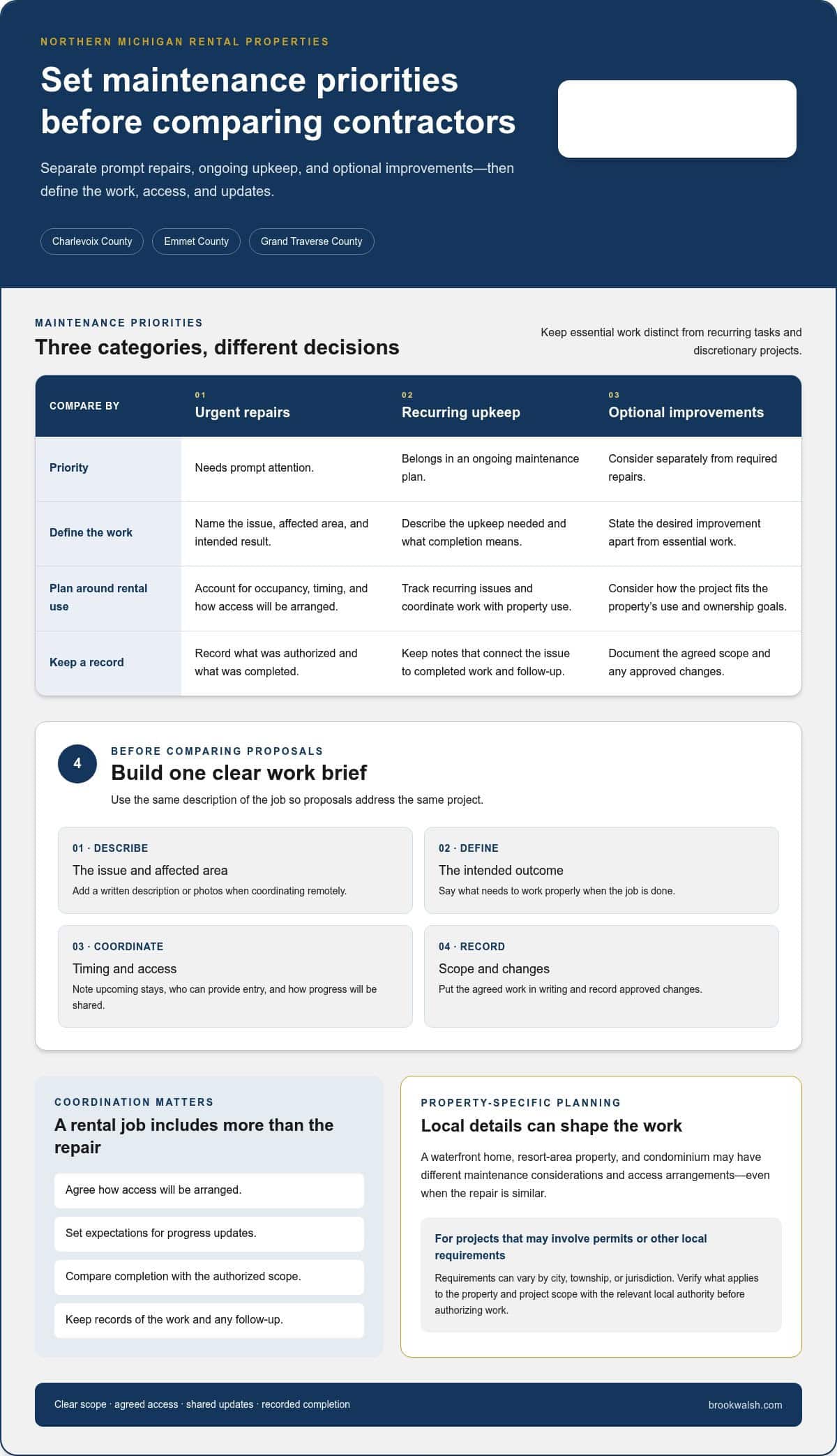
Start by deciding what the property needs, how the work relates to rental operations, and what outcome will count as complete. Without a defined scope, one proposal might cover a repair while another includes an upgrade. Comparing them would mean comparing different projects, not contractor fit.
Sort maintenance into three categories: urgent repairs that need prompt attention, recurring upkeep for an ongoing plan, and optional improvements to consider separately. This keeps essential work from getting mixed up with discretionary projects. It also helps you prioritize the property’s condition and rental use without treating every possible improvement as equally pressing.
Turn a maintenance concern into a clear work scope
Describe the issue and the affected area, then state the result you want. Include rental-use constraints, such as an upcoming stay or access that needs to be arranged while you’re away. Separate required repairs from optional upgrades, and put the agreed scope in writing. If the plan changes, record the approved change so everyone has the same understanding of the work.
For example, “refresh the bathroom” could mean very different things to an owner and a contractor. A stronger brief identifies the specific concern, where it appears, and what needs to work properly when the job is done. Photos or a written description can help explain the issue when you’re coordinating remotely. List unrelated repairs separately so each item can be discussed and tracked.
Account for property type, access, and rental operations
A waterfront home, resort property, and condominium can have different maintenance considerations. Even when the repair is similar, access arrangements may differ. Note who can provide entry, whether occupancy affects scheduling, and how you want progress and completion details shared. Treat these as planning details, not assumptions about local rules or building requirements.
Location matters, too. A rental in Charlevoix, Emmet, or Grand Traverse County may be within a city, township, or other local jurisdiction. Requirements can vary, so do not assume the same rules apply across the region. If a project may involve permits or other local requirements, verify what applies to that property and scope with the relevant local authority before authorizing work. Keep that question separate from the repair description so the work brief stays clear.
Consider how maintenance priorities support the home’s use and your longer-term ownership objectives. Brook Walsh Real Estate’s Northern Michigan investment-property analysis offers a related perspective on evaluating lifestyle-property opportunities. A property-specific plan gives you a sound basis for comparing proposals.
Compare contractor fit using scope, communication, and accountability
Once the work brief is ready, compare how each proposed approach addresses the property’s needs. Do not rely on a polished presentation alone. To make a fair comparison, record the same information for each option. The right fit depends on the work, the property, and its operating priorities, whether the rental is in Charlevoix, Emmet, or Grand Traverse County.
What evidence helps evaluate a contractor’s fit?
Look for examples of comparable work and a clear explanation of what the proposal covers. Keep written records of decisions, approved changes, and completion details instead of relying on verbal summaries. References, credentials, and insurance details are also items to review for the specific work. Focus on information that relates to your project, not broad claims that are difficult to connect to its needs.
| Criterion | Evidence to record | Relevance to rental operations |
|---|---|---|
| Scope clarity | Work described, areas affected, intended result, and stated exclusions | Helps separate essential repairs from unrelated additions and makes completion easier to assess. |
| Relevant experience | Examples of comparable repair or improvement work | Shows whether the work resembles this property’s needs, such as those of a condominium or waterfront rental. |
| Communication | How updates, questions, and decisions will be shared | Gives a remote owner a record of progress and decisions affecting the rental. |
| Documentation | Written proposal, approved changes, and completion notes | Connects the original request with the work performed and any follow-up. |
| Scheduling and access | Proposed timing, access assumptions, and coordination needs | Helps account for occupancy and entry arrangements without guesswork. |
| Follow-up | How outstanding items or concerns will be recorded after the work | Makes it easier to track unresolved details that could affect ongoing operations. |
How to compare proposals without focusing only on price
Read each proposal for what it includes, what it excludes, and what it assumes about access or materials. A lower figure may reflect a narrower scope; a higher one may include work another proposal leaves out. If the proposals do not cover the same work, the figures alone do not tell you which is the better fit. Compare scope, schedule, communication, and documentation together. Do not treat a few proposals as a regional benchmark.
Use the table to note differences and identify what each proposal actually addresses. If an important assumption is unclear, record it as an open question rather than treating it as included. Comparing the same details helps you make a considered decision based on the rental’s operating needs and keep expectations clear from authorization through follow-up.
Use a step-by-step process to organize rental-property contractor work
A consistent workflow turns a maintenance concern into a clear assignment and a useful property record. It is particularly helpful when you’re coordinating from a distance or managing rentals across Charlevoix, Emmet, and Grand Traverse counties. The process does not replace the contractor’s responsibility for agreed work. It gives the owner and property manager a shared way to organize the request, decisions, and follow-up.
- Record the concern. Note what happened, where it occurred, when it was observed, and what may be affected. Add relevant photos or observations, and distinguish what you have seen from what you suspect. This gives everyone a factual starting point.
- Set the operating context. Record occupancy or turnover considerations, access limits, and who can provide entry. Include the desired outcome and any timing considerations tied to rental operations. Keep sensitive access details in the appropriate property records.
- Review the proposed work. Compare the proposal with the written scope and the property’s priorities. Identify what is included, what is excluded, and any assumptions about materials, access, or sequencing. Do not treat a proposal as approval for work beyond the agreed request.
- Document decisions and changes. Keep a written record of the authorized scope, communication plan, and approved changes. If a new issue changes the proposed work, record the decision before treating the revised scope as agreed.
- Record completion and follow-up. Note what was reported as complete, any unresolved items, and recommended follow-up. Keep this information with the property’s operating records so it can inform future planning.
From maintenance request to agreed scope
A useful request gives the contractor enough information to discuss the work without pretending to diagnose the problem. Identify the affected room or feature, include a clear observation, and explain any rental-use constraint. Then compare the proposed work with that record. A shared reference helps align the owner’s priorities, the contractor’s assignment, and the communication plan.
Property-management coordination can help connect a maintenance request with occupancy information and owner communication. It does not replace the contractor’s repair or improvement work. Keep responsibilities clear: the manager helps organize rental operations, while the contractor completes the agreed work.
Track completion and preserve useful property records
Close the loop with a concise record of when the work was reported complete, which items were addressed, any remaining concerns, and recommended follow-up. Keep proposals, approved changes, related communications, and completion notes together with the property’s operating records. Over time, this history can help you recognize recurring needs and plan thoughtfully, without assuming a past repair guarantees a particular future result.
For a broader perspective on owning and operating a Northern Michigan rental, explore Brook Walsh’s Northern Michigan property guidance. With a clear process, how to find a reliable contractor for rental properties becomes less about guesswork and more about documented expectations, coordinated work, and informed decisions.
Connect contractor decisions to a Northern Michigan rental-property plan
Consider a repair alongside the property’s role: how it is used as a rental, what condition it needs to remain in, and what you hope to achieve as an owner. A maintenance history can help distinguish a recurring operational need from a one-time improvement while keeping the guest or tenant experience in view. This approach is useful across Charlevoix, Emmet, and Grand Traverse counties, without assuming every home or jurisdiction has the same needs.
When property-management context can help owners plan
Rental operations add practical considerations to maintenance planning, including how an issue affects use of the home, owner communication, and coordination around occupancy. Vacation-rental management focuses on these ongoing operating needs. It complements, but does not replace, the contractor’s responsibility for agreed repair or improvement work.
Brook Walsh Real Estate provides vacation-rental management and investment-property analysis for Northern Michigan owners. This perspective can help frame maintenance decisions around the property’s rental use and longer-term ownership objectives. A waterfront home, condominium, or resort property may each need a plan shaped by its own features and operating priorities rather than a one-size-fits-all checklist.
Investment planning adds another perspective. Consider whether a proposed improvement supports the property’s intended use and your ownership goals, or whether the immediate priority is keeping essential operations on track. Brook Walsh’s Northern Michigan real-estate investment analysis connects lifestyle-property considerations with broader investment decisions.
Make the next decision with the property's goals in view
Before authorizing work, bring the key pieces together: a clear scope, relevant evidence, a communication plan, and records of decisions and completion. This makes it easier to assess whether the proposal addresses the actual need and fits the property’s operating priorities. It also creates a useful reference for future planning, particularly when you manage ownership or day-to-day coordination from a distance.
The best decision is not necessarily the broadest project or the most elaborate proposal. It is the one that addresses the property’s needs and fits its rental model, condition, and longer-term goals. That is the practical core of how to find a reliable contractor for rental properties: evaluate the work in context and make expectations and accountability clear from the start.
To consider how rental operations and property goals fit together across Northern Michigan, explore Northern Michigan real-estate and rental-property guidance.
Let your ownership goals guide the next step
A rental property’s needs can change as your plans evolve. Set aside time to consider whether the way you operate the home supports the experience you want to offer and the role the property plays in your ownership plans. For a home in Charlevoix, Emmet, or Grand Traverse County, that reflection can connect practical decisions with what makes the property meaningful to you.
Knowing how to find a reliable contractor for rental properties is one part of thoughtful ownership. The next is setting a clear direction for the property, so future maintenance decisions reflect its purpose rather than being handled as isolated tasks. You do not need to map out every future project. A considered plan gives you a steadier starting point.
Brook Walsh Real Estate brings a Northern Michigan perspective to rental-property ownership through vacation-rental management and investment-property analysis. Explore Brook Walsh’s Northern Michigan property guidance as you plan the next chapter for your property.
Frequently Asked Questions
How do I find a reliable contractor for a rental property?
Match the contractor’s experience and proposed work to the specific repair. The right fit for a recurring plumbing issue may differ from the right fit for a larger improvement involving several parts of the property. Compare relevant examples, written proposals, and communication plans. These concrete details offer a more grounded way to judge how to find a reliable contractor for rental properties than broad assurances alone.
What should a rental-property contractor proposal include?
A useful proposal identifies the work, the areas affected, what is excluded, and any assumptions about access, materials, or coordination. It should give you enough detail to distinguish the planned repair from optional work and understand how changes will be handled. Note occupancy or entry constraints that may affect scheduling. Then compare proposals against the same scope so their differences are clear.
Should I use one contractor for every rental-property repair?
Not necessarily. A good fit for routine upkeep may not be the right fit for a specialized repair or broader improvement. Consider the work involved and whether the contractor’s relevant experience matches it. Continuity can make records easier to follow for recurring tasks, but convenience alone should not determine fit. Choose based on the type of work rather than expecting one solution to cover every maintenance need.
How can an out-of-town owner manage contractor work?
Choose one clear communication path and identify who can coordinate property entry and relay decisions. Before work begins, agree on how updates, questions, and approvals will be recorded. If a property manager is involved, clarify that person’s coordination role and which decisions remain with the owner. This structure helps reduce confusion when you are not nearby and avoids relying on informal messages or assumptions.
Is a property manager the same as a rental-property contractor?
No. A contractor completes the repair or improvement work they have agreed to do. A property manager coordinates rental operations and owner needs. For example, a manager may organize a maintenance request around occupancy, while the contractor performs the authorized repair. The roles can work together, but they are not interchangeable. Clear responsibilities show who is coordinating the rental and who is accountable for the specified work.
What records should I keep after rental-property maintenance?
Keep a property-specific history linking the original concern to the work and any later action. Useful records include the proposal, written approvals, relevant correspondence, completion details, and notes about unresolved items. Organizing records by room, feature, or system can make recurring patterns easier to spot. For a rental near Boyne City, Petoskey, or elsewhere in the region, an orderly file also helps maintain continuity if ownership coordination changes.
Do contractor requirements vary across Northern Michigan counties?
Requirements may depend on the work and the property’s precise jurisdiction, so a county name alone may not answer every question. Across Charlevoix, Emmet, and Grand Traverse counties, identify whether the property is within a city or township and verify applicable requirements with the relevant local authority before work proceeds. This applies to homes around Boyne City, Boyne Falls, Charlevoix, Petoskey, Harbor Springs, and East Jordan, where the property address determines the jurisdiction.
Posted by Brook Walsh onEnjoy this blog post? Click here to subscribe for updates
Leave A Comment