

A beautiful waterfront setting doesn’t make a vacation rental a sound investment. Learning how to analyze a vacation rental property means looking beyond its summer appeal to test demand across seasons, account for the full cost of ownership, and understand what the numbers say before you buy. A Northern Michigan getaway may look promising, but a careful assessment helps reveal whether that promise holds through quieter months and unexpected expenses.
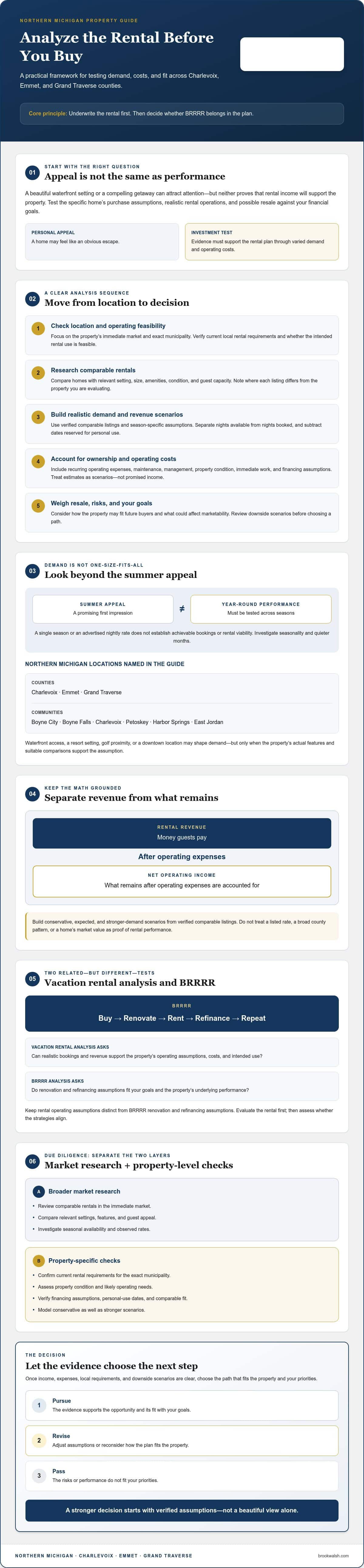
This guide offers a repeatable way to evaluate a potential rental in Charlevoix, Emmet, and Grand Traverse counties, including communities such as Boyne City, Boyne Falls, Charlevoix, Petoskey, Harbor Springs, and East Jordan. You’ll consider location and seasonal demand, estimate operating costs such as maintenance and management, and identify local requirements to verify for the property’s exact municipality. Then you can weigh whether BRRRR, buying, renovating, renting, refinancing, and repeating- fits your goals and the property’s underlying performance. The principle is simple: underwrite the rental first, then decide whether BRRRR belongs in the plan. With a clearer view of income, expenses, and risk, you can pursue the opportunity, revise your assumptions, or walk away with confidence.

Key Takeaways
- Learn how to analyze a vacation rental property by testing its investment potential, not just its market value or personal appeal.
- Build grounded revenue assumptions for Charlevoix, Emmet, and Grand Traverse counties by accounting for seasonal demand, personal-use dates, and verified comparable listings.
- Separate vacation-rental operating assumptions from BRRRR’s renovation and refinancing assumptions to see whether the strategies align with your goals.
- Use an ordered due-diligence process to distinguish broader market research from property-specific checks and operating considerations.
- Weigh the evidence, downside scenarios, and your priorities to decide whether to pursue, revise, or pass on a property.
Table of Contents
- How to Analyze a Vacation Rental Property Before You Buy
- Assess Northern Michigan Demand, Revenue, and Property-Level Costs
- BRRRR Method vs. Vacation Rental Analysis: What Each Can Tell You
- A Practical Due-Diligence Checklist for a Northern Michigan Rental
- Turn Your Analysis into a Confident Northern Michigan Property Decision
How to Analyze a Vacation Rental Property Before You Buy
A compelling Northern Michigan home may feel like an obvious escape, but personal appeal and investment performance are different questions. To understand how to analyze a vacation rental property, test whether the purchase, realistic rental operations, and eventual resale align with your financial goals. Don’t rely on the home’s beauty or estimated market value alone.
Start with the property’s location and operating feasibility, then examine demand, potential revenue, expenses, and risks before making a decision. Treat each estimate as a scenario, not promised income. Before relying on your model, verify comparable rentals, achievable nightly rates, seasonality, property condition, financing assumptions, and applicable local requirements.
For another perspective on evaluating vacation-rental markets, watch this overview:
What does vacation rental property analysis include?
Assess three distinct parts of the investment. Acquisition assumptions cover the purchase and any immediate work needed to make the home suitable for your intended use. Operating assumptions estimate rental activity alongside recurring expenses, maintenance, and management. Resale assumptions consider how the property might fit future buyers and what could affect its marketability. For foundational valuation concepts, see this overview of real estate appraisal. Keep in mind that market value alone doesn’t establish rental viability.
An attractive home can still have weak investment fundamentals if achievable bookings don’t support operating costs, if improvements exceed your plan, or if local requirements limit the intended rental use. Keep the distinction clear: Rental revenue is the money guests pay; net operating income is what remains after operating expenses are accounted for. Your final model should reflect the specific property, not a lifestyle wish list.
Why does Northern Michigan location matter?
Compare evidence for the property’s immediate market across Charlevoix, Emmet, and Grand Traverse counties. Don’t assume countywide patterns describe a particular community, or that demand in one season predicts another. Look for comparable listings with a similar setting and guest appeal, then investigate their seasonal availability and observed rates. Whether you’re considering Boyne City, Boyne Falls, Charlevoix, Petoskey, Harbor Springs, or East Jordan, compare properties with relevant features. Waterfront access, a resort setting, golf proximity, or a downtown location may shape demand, but only if the home’s actual features and suitable comparisons support that assumption.
Separate broad market research from property-level checks. Confirm the exact municipality’s current rental requirements, assess the home’s condition and likely operating needs, and model conservative as well as stronger scenarios. Brook Walsh Real Estate offers investment property analysis in Northern Michigan to help test assumptions against a specific property and market.
Assess Northern Michigan Demand, Revenue, and Property-Level Costs
A credible forecast starts with evidence from comparable rentals, not the most appealing listing or a single optimistic estimate. For a property in Charlevoix, Emmet, or Grand Traverse County, identify nearby rentals that resemble it in setting, size, amenities, condition, and guest capacity. A waterfront home, a downtown condominium, and a property near a golf course may attract different guests and booking patterns. Record where each comparison differs, and don’t treat an advertised nightly rate as proof of what your property can earn.
How can you estimate vacation rental income responsibly?
Build conservative, expected, and stronger-demand scenarios using verified comparable listings and season-specific assumptions. For each scenario, distinguish nights available to guests from nights actually booked, then subtract any dates you plan to reserve for personal use. Dates blocked for an owner’s summer stay can’t also count as bookable inventory. Test whether the projection still fits your investment goals if bookings or rates fall short of expectations.
Gross booking revenue is what guests pay, not what an investor keeps. Cleaning, management, utilities, maintenance, taxes, and other operating costs reduce the amount available to support ownership. This distinction is central to how to analyze a vacation rental property without mistaking a polished revenue forecast for a complete financial picture.
Which costs and operational demands belong in the analysis?
Map expenses to the way the specific property will operate. Include management and cleaning, utilities, insurance, taxes, routine maintenance, and furnishing or replacement needs where applicable. Separate recurring costs from expenses that change with guest turnover or property use. Allow for repairs and slower booking periods in your scenarios rather than assuming every available date generates revenue.
- Recurring: insurance, property taxes, utilities, management, and any ongoing services or subscriptions.
- Variable: cleaning, guest supplies, utilities that vary with use, and turnover-related wear.
- Irregular: repairs, replacements, and larger maintenance needs identified through property review.
Verify tax treatment with a qualified tax professional, confirm insurance terms with an insurance provider, and check current requirements and costs with the relevant municipality. Local rules and property conditions can change the operating picture, so don’t rely on assumptions drawn from a different community or home.
For broader context as you refine the model, explore Northern Michigan investment guidance. Local investment property analysis can also help you test assumptions against a specific property. Neither analysis nor management guarantees rental results.
BRRRR Method vs. Vacation Rental Analysis: What Each Can Tell You
BRRRR and vacation-rental analysis can inform the same purchase, but they answer different questions. BRRRR stands for Buy, Rehab, Rent, Refinance, Repeat. It’s a sequence for evaluating an acquisition, improvements, rental plan, and potential refinance. A vacation-rental analysis tests whether a specific property’s seasonal income and operating costs support your goals. Neither approach guarantees a particular result.
How does the BRRRR method work?
Each stage calls for a separate decision. Buy: does the purchase make sense before relying on future proceeds? Rehab: what work is needed, what might it cost, and when could the property be ready? Rent: does the intended rental strategy fit the property and local requirements? Refinance: will a lender consider the property, your circumstances, its valuation, and current terms? Repeat: if the earlier assumptions hold, does the next purchase still fit your broader plan?
Keep renovation scope and rental performance distinct from refinance proceeds. A completed project or strong booking forecast doesn’t establish how a lender will underwrite a refinance. Verify financing terms with a lender, valuation assumptions with a qualified real estate professional, and tax implications with a tax professional.
When might BRRRR assumptions conflict with vacation rental plans?
Short-term rental projections may be based on seasonal bookings, nightly rates, and operating expenses. A lender may assess a refinance using its own criteria and documentation. Don’t assume projected guest revenue will be accepted as qualifying income or support a particular valuation. Renovation timing matters, too: delays or unfinished work can shift the expected opening and change which demand periods are available.
Use the comparison below to identify what evidence each approach needs. This is one practical part of how to analyze a vacation rental property without treating a promising forecast as proof that a BRRRR plan works.
| Approach | Core assumptions | Uncertainties to test | Evidence to gather |
|---|---|---|---|
| BRRRR | Purchase, rehabilitation, rental plan, and potential refinance fit together. | Renovation scope, property valuation, lender criteria, borrower circumstances, and current terms. | Property assessment, documented improvement plan, lender guidance, and valuation support. |
| Vacation rental | Seasonal demand and achievable rates can support operating costs. | Available nights, personal-use dates, local requirements, expenses, and booking variability. | Relevant comparable listings, property-specific costs, and current municipal information. |
If either strategy depends on an assumption you can’t verify, revisit the model before proceeding. For a property-specific perspective, Brook Walsh Real Estate offers investment property analysis in Northern Michigan, grounded in the local market rather than a guaranteed income or refinancing outcome.
A Practical Due-Diligence Checklist for a Northern Michigan Rental
Move from broad market research to evidence about the exact property. In Charlevoix, Emmet, and Grand Traverse counties, conditions and requirements can vary by municipality, so a promising county-level outlook isn’t enough to establish that a particular home can operate as planned. Whether you’re reviewing a property in Boyne City, Boyne Falls, Charlevoix, Petoskey, Harbor Springs, or East Jordan, work through each step before making an offer. Record what’s confirmed, what remains uncertain, and what would change your decision.
What should investors verify before making an offer?
- Define your investment goals. Decide how the property should serve you financially and personally, including how much owner use you expect.
- Research the local market. Gather comparable rental evidence for the property’s specific area and setting. Note differences in location, amenities, condition, and guest appeal rather than treating listings as interchangeable.
- Confirm intended use. Ask the relevant city, township, or other local authority about current requirements for the property’s exact address. Verify that the intended rental use is allowed before relying on income projections.
- Assess the property. Have its condition reviewed by appropriate qualified professionals. Confirm practical access and investigate whether the services needed to operate and maintain the home are available.
- Validate the operating model. Reconcile your revenue assumptions with likely availability, personal-use dates, expenses, and management needs. Seek current guidance from qualified tax, insurance, and financing professionals where relevant.
Keep the findings in one review sheet. For every assumption, note its evidence source, verification date, open questions, and any contingency needed before proceeding. This makes it easier to distinguish a documented fact from an estimate or unresolved concern.
How should you stress-test the investment case?
Test how the plan responds when conditions are less favorable than expected. Model weaker demand, unexpected repairs, a change in management arrangements, or a delay before the property is ready to host guests. Then rerun the numbers with fewer rentable nights if personal-use plans take priority during attractive booking periods.
Set your own decision threshold before reviewing the final scenarios. It might reflect your tolerance for operating shortfalls, the cash you’re prepared to commit, or the balance you want between personal enjoyment and investment performance. There is no universal return target that fits every property or investor. If the downside case falls outside your limits, revise your assumptions, investigate further, or pass.
A tailored local review can help test the model against a specific opportunity. Explore Northern Michigan property investment analysis as you refine your criteria for a rental in the region.
Turn Your Analysis into a Confident Northern Michigan Property Decision
A sound decision doesn’t depend on a single attractive projection. It comes from matching verified evidence with your financial priorities, intended use, and comfort with uncertainty. In Charlevoix, Emmet, and Grand Traverse counties, a property’s appeal as a personal retreat may be undeniable while its rental performance remains uncertain. Keep those two judgments separate.
What findings support moving forward or walking away?
Consider proceeding when you can support the intended use, demand assumptions, operating model, and understanding of the property’s condition with reliable evidence. If key information is incomplete, revise the model and investigate before committing. If unresolved risks exceed your own limits, passing is a sound outcome, even when the setting is exceptional.
- Go: The evidence supports your rental plan, downside scenarios remain within your tolerance, and the property fits your defined financial objective.
- Revise: Important assumptions need stronger comparable data, updated expense details, or confirmation from the relevant local authority or qualified professional.
- Pass: Intended use, property condition, or financial exposure can’t be reconciled with your priorities.
These are decision principles, not universal return thresholds. A compelling lifestyle purchase may still be worthwhile to you, but be clear whether you’re choosing it for personal enjoyment, investment performance, or a considered blend of both. That distinction keeps a vacation-home preference from quietly substituting for an investment case.
How can a local real estate advisor support the next step?
Local expertise can add context to property selection and help test whether your assumptions fit a particular community and home. Brokerage, investment property analysis, and short-term rental management each address different parts of the ownership journey. Management can inform your operating plan, but it can’t guarantee bookings, income, or investment results.
Once your criteria are clear, explore Northern Michigan lifestyle-based property searches to consider locations and property types that suit your plans. Use what you’ve learned about the numbers to guide the search, not the other way around.
Learning how to analyze a vacation rental property gives you a disciplined way to weigh opportunity against uncertainty. If you’re considering a property in Northern Michigan, Brook Walsh Real Estate can help you discuss its investment fit and local context. Use the analysis to clarify your next questions, whether you decide to proceed, refine your plan, or wait for a better match.
Make Your Next Northern Michigan Investment Decision with Clarity
Knowing how to analyze a vacation rental property means looking beyond its appeal as a getaway. Test seasonal demand against comparable properties, account for the full operating picture, and verify that the home’s intended use fits its location. Treat revenue forecasts as scenarios, not promises.
Keep the BRRRR strategy in its proper place, too. A property’s rental performance and a lender’s refinance decision rely on different assumptions, so evaluate each on its own evidence. Then decide whether the opportunity meets your priorities: move forward, refine the model, or pass.
Brook Walsh Real Estate focuses on Northern Michigan, including Charlevoix, Emmet, and Grand Traverse counties, with investment property analysis and vacation rental management among its listed services. If you’re weighing a specific opportunity, discuss a Northern Michigan investment property with Brook Walsh Real Estate. A thoughtful review can help you take the next step with greater confidence, wherever your analysis leads.
Frequently Asked Questions
How do you analyze a vacation rental property before buying?
To learn how to analyze a vacation rental property, test whether the specific home can meet your investment goals, not simply whether its asking price seems fair. Review acquisition and improvement needs, compare relevant rentals nearby, model seasonal revenue and operating expenses, then assess property condition, intended use, and resale considerations. Evidence for a home near Petoskey may not transfer to one in East Jordan. Base your decision on property-level assumptions you can verify.
What is a good return on a vacation rental property?
There’s no single return that makes every vacation rental a good investment. Set your own threshold based on your financial goals, available capital, personal-use plans, and tolerance for uncertain bookings or unexpected expenses. Compare projected income after operating costs with the full investment required, and test less favorable scenarios. A property in Harbor Springs or Boyne City may be an appealing retreat, but lifestyle value and investment performance are separate measures.
How do you estimate vacation rental income?
Estimate income using verified comparable rentals that resemble the property in location, condition, amenities, and guest appeal. Build seasonal scenarios from achievable nightly rates and likely booked nights, not advertised rates alone. Separate nights available to guests from owner-use dates and unbooked nights. For example, if you reserve part of a peak season for personal use, those dates shouldn’t also count as potential bookings. Treat every projection as an estimate, not promised income.
Can the BRRRR method work for a vacation rental?
It can, if the purchase, renovation, rental plan, and potential refinance assumptions all hold up independently. BRRRR means Buy, Rehab, Rent, Refinance, Repeat. A vacation rental’s seasonal revenue forecast doesn’t establish what a lender will approve or how the property will be valued. Confirm renovation scope and timing, rental feasibility, refinance criteria, current financing terms, and tax considerations with the appropriate qualified professionals before relying on a BRRRR plan.
What costs should you include when analyzing a vacation rental?
Include acquisition and improvement costs in your overall investment assessment, then account for operating expenses such as management, cleaning, utilities, insurance, property taxes, maintenance, and furnishing where applicable. Consider variable turnover expenses and leave room in your model for repairs and lower-demand periods. Actual costs depend on the home and its location. Verify current tax details with a tax professional, insurance terms with an insurer, and local requirements with the relevant authority.
What should I check before buying a vacation rental in Northern Michigan?
Research the exact property and municipality, not just the county. In Charlevoix, Emmet, and Grand Traverse counties, verify intended rental use and current local requirements with the relevant authority before relying on rental income. Review comparable listings, property condition, access, needed services, operating expenses, and seasonal assumptions. Whether you’re considering Boyne Falls, Charlevoix, or another Northern Michigan community, confirm that the evidence applies to that address and property.
How do seasonality and personal use affect vacation rental analysis?
Seasonality changes when guests are likely to book, so model demand and achievable rates across stronger and quieter periods rather than applying one average to the year. Personal stays reduce the nights available to rent, especially if they overlap with dates your revenue scenario assumes are bookable. Compare the investment case with and without those stays. A home in Boyne City or near Grand Traverse County should be assessed using relevant local evidence, not a general regional assumption.
Posted by Brook Walsh onEnjoy this blog post? Click here to subscribe for updates
Leave A Comment