

What if the right Northern Michigan investment isn’t simply the home with the most appealing asking price, but the one whose financing and intended use align? Buying an investment property in northern michigan calls for a plan that accounts for more than the purchase itself, from how you’ll use the home to the costs and responsibilities of ownership.
Financing an investment property may involve a different approach than buying a primary residence. And a property suited to a personal retreat may not fit the same rental strategy. In a region where waterfront settings, resort communities, and quiet escapes shape the experience, local details matter alongside the numbers.
This guide covers how to prepare for financing conversations, compare possible approaches without relying on assumed rates or qualification thresholds, and assess whether your plans fit your finances. It also looks at how to evaluate properties across Charlevoix, Emmet, and Grand Traverse counties, including how intended rental use and ongoing ownership responsibilities can shape a purchase decision. The goal is a clear, locally grounded plan before you commit.

Key Takeaways
- Buying an investment property in northern michigan starts with matching financing preparation to how you plan to use the home.
- Organize your financial picture and define your intended use before discussing financing options.
- Compare properties in Charlevoix, Emmet, and Grand Traverse counties by location, property type, and ownership demands.
- Evaluate property condition, management needs, and recurring obligations alongside the purchase price.
- Treat potential rental income as an assumption to examine, not a guaranteed source of repayment.
Table of Contents
- Why buying an investment property in Northern Michigan starts with a financing plan
- How to prepare for a mortgage on a Northern Michigan investment property
- How to assess an investment property across Charlevoix, Emmet, and Grand Traverse counties
- Evaluating an investment property mortgage
- Turn mortgage preparation into a considered Northern Michigan purchase
Why buying an investment property in Northern Michigan starts with a financing plan
A home can be captivating and still be a poor fit for an investment plan. A waterfront retreat in Charlevoix County, a condominium near a ski area in Emmet County, and a property in Grand Traverse County each offer a different way to experience Northern Michigan. But a home’s appeal alone doesn’t determine whether the purchase suits your finances or intended use. Buying an investment property in Northern Michigan starts with connecting those elements before you focus on a particular home.
Investment-property financing is the way a buyer arranges funds to purchase a property intended to generate rental income, serve as a personal retreat, or do both. The assessment can differ from a purchase made solely for everyday personal use, so consider your plans and financial picture when reviewing financing terms. There isn’t one universal qualification formula to assume.
A closer look at Northern Michigan waterfront property can help bring the setting and property characteristics into focus:
What makes an investment-property purchase different?
A primary home is generally chosen around the buyer’s day-to-day needs. An investment property adds questions about how the home will be used, what responsibilities come with ownership, and whether the full plan fits the buyer’s finances. Rental use may bring management needs and income assumptions into the decision; personal stays can affect when the home is available for guests. A blended plan means considering both.
Real estate investing includes choices about property type, valuation, financing, and potential returns. The Real Estate Investing Overview offers broader context. Local evaluation brings those ideas back to the specific property and its intended role.
Define the property’s intended role before comparing financing
Start with a clear priority: rental use, personal use, or a deliberate mix. Then consider what that choice means for location, property type, and the time and attention you can give ongoing ownership. A home chosen as a personal sanctuary may call for different features than one selected with guest stays in mind. Neither purpose is automatically the better investment; fit depends on your plan.
Make a simple working brief before reviewing financing approaches:
- Describe when and how you expect to use the property.
- Outline the ownership tasks you’re prepared to manage or arrange.
- List the property characteristics that matter to your plan.
- Identify what you still need to learn about a specific location or property.
Use that brief to guide research across Charlevoix, Emmet, and Grand Traverse counties. Compare communities and property types based on your intended experience and practical ownership needs, not on assumptions that one county guarantees stronger returns. Brook Walsh Real Estate offers Northern Michigan real estate investment advisory, helping buyers connect a property’s lifestyle and local characteristics with their investment plans. Brook Walsh Real Estate’s Northern Michigan investment-property guidance can complement your financing preparation.
How to prepare for a mortgage on a Northern Michigan investment property
A well-organized application begins before you settle on a home. First, get a clear view of your finances and intended use. Then organize information about the borrower and property for the lender’s assessment. When buying an investment property in northern Michigan, preparation can help you compare possibilities with a steadier sense of what fits, whether you’re considering a waterfront home in Charlevoix County, a condominium in Emmet County, or another property in Grand Traverse County.
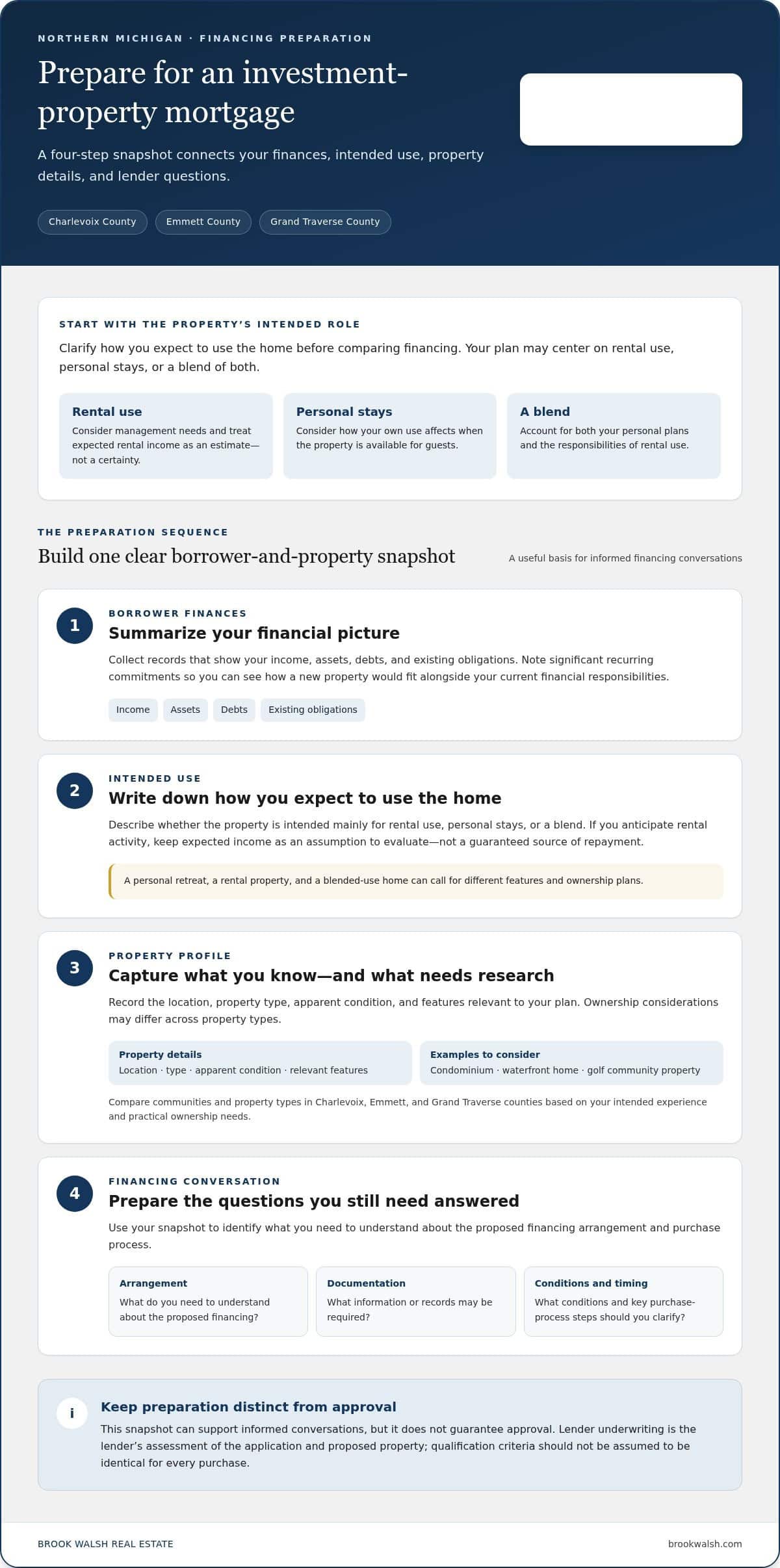
Build a clear borrower and property snapshot
Gather a personal financial overview, then assemble a concise profile of the kind of property you’re considering. These materials support informed conversations but don’t guarantee approval. Keep buyer research distinct from lender underwriting, the lender’s assessment of the application and proposed property.
Organize your information in a sequence:
- Summarize your finances. Collect records that show income, assets, debts, and existing obligations. Note significant recurring commitments so you can see how a new property would sit alongside your current financial responsibilities.
- Write down your use plan. Describe whether the property is intended mainly for rental use, personal stays, or a blend. If you anticipate rental activity, treat expected income as an estimate to evaluate, not a certainty.
- Assemble a property profile. Record the location, property type, apparent condition, and features relevant to your plan. A condominium, waterfront home, or golf community property may involve different ownership considerations, so capture what you know and what remains to be researched.
- Prepare financing questions. Note what you need to understand about the proposed arrangement, required documentation, applicable conditions, and the timing of key steps in your purchase process.
This snapshot brings the borrower’s circumstances and the property’s characteristics into one view without assuming the same criteria apply to every purchase.
Compare financing approaches without assuming identical terms
Financing structures and underwriting approaches can vary with the buyer, property, and arrangement. Compare proposals as complete commitments, not by focusing on one appealing feature. Review the overall obligations, required conditions, timing of key steps, and fit with your intended ownership plan. Pay attention to how the property’s use is treated and what assumptions, if any, are part of the assessment.
For broader context on evaluating possible investment strategies and their trade-offs, the Forbes Guide to Real Estate Investment can complement your property-specific research. Keep your notes consistent as you review opportunities across Northern Michigan, and revisit the full plan whenever the location or property type changes.
Brook Walsh’s Northern Michigan investment property guidance can help connect that financial preparation to the character and practical demands of a specific home.
How to assess an investment property across Charlevoix, Emmet, and Grand Traverse counties
A useful comparison begins with the property’s role, not a county ranking. Across Charlevoix and Emmet counties, as well as the broader Northern Michigan region, a home’s setting, condition, access, and ownership demands all affect how well it fits your plans. A waterfront property may offer the retreat you envision, while a condominium, golf community home, ski-area property, resort setting, or downtown location in places like Boyne City, Charlevoix, or Petoskey may better suit another mix of personal use and rental plans. None guarantees a particular financial outcome.
Use lifestyle preferences as search filters, then assess each property on its own merits. Brook Walsh Real Estate guidance can help connect local property characteristics with the purpose you’ve defined for the purchase when buying an investment property in northern Michigan.
Match property type and lifestyle to the investment plan
Think about what you want your time in Northern Michigan to feel like, then weigh that experience alongside ownership responsibilities. Waterfront, Ski, Golf, Resort, and Downtown searches across our local communities can help narrow the field, but a category label won’t tell you whether a property suits your finances, personal schedule, or rental plans. A condominium may have shared ownership considerations; a standalone home may place more property upkeep on you. Review the actual details rather than assuming every property in a category works the same way.
Compare local fit without assuming returns
Use the table as a starting framework for comparing specific properties. The county is a research area, not a forecast of future demand or income. Fill in the details using property materials, direct observation, and relevant local research, keeping verified facts separate from expectations.
| Location | Property type | Intended use | Ownership demands | Research still needed |
|---|---|---|---|---|
| Charlevoix County (Boyne City, East Jordan, Charlevoix) | Compare waterfront homes, condominiums, and other options that match your search. | Note personal stays, rental plans, or a blend. | Assess condition, upkeep, and management needs for the specific property. | Review property records, access, condition, and any use-related requirements that apply to the location. |
| Emmet County (Petoskey, Harbor Springs, Boyne Falls area) | Consider ski, resort, waterfront, or other lifestyle preferences. | Define how often you expect to use the home and when it might be rented. | Identify maintenance and coordination needs tied to the property type. | Gather parcel-specific details and distinguish confirmed information from assumptions about future demand. |
| Northern Michigan Region | Compare downtown, golf, waterfront, condominium, and other suitable property types. | Clarify whether personal access or rental use takes priority. | Consider condition, ongoing care, and any management arrangements. | Research the individual property and its setting before estimating potential income or use. |
For each candidate, record observable facts separately from projections. Access, layout, condition, and ownership responsibilities can be investigated; future rental demand and income remain assumptions to test. Comparing properties this way keeps the focus on fit across Northern Michigan, rather than treating one county or lifestyle as an automatic path to stronger returns.
Evaluating an investment property mortgage
A financing proposal is only one part of deciding whether a particular home fits your plans. Review the property and the way you expect to own it together: personal stays, potential rental use, maintenance, management, and recurring obligations all shape the full picture. For a home in Charlevoix, Emmet, or Grand Traverse County, a careful review can show which parts of your plan rely on confirmed details and which depend on assumptions.
Stress-test the ownership plan
Consider how you’d manage the property if rental use pauses, changes, or doesn’t match your expectations. Could you still use and care for the home in a way that feels worthwhile? Separate the personal value of a Northern Michigan retreat from financial assumptions, and plan conservatively rather than relying on a particular rental outcome.
Use this checklist to review the fit between the property and your financing plan:
- Personal use: Note when you expect to stay, what features matter to you, and how personal use might affect your rental plans.
- Property condition: Review the home’s condition and identify maintenance needs or features that could affect ongoing care.
- Management: Decide how day-to-day responsibilities would be handled, including how you’d respond if your intended rental use changes.
- Recurring obligations: List the regular costs and commitments associated with ownership, using property-specific information rather than broad assumptions.
- Income assumptions: Treat possible rental income as an estimate to examine, not guaranteed repayment capacity. Consider how your plan would work if that income were lower or interrupted.
A property’s lifestyle appeal should strengthen your decision, not obscure its practical demands. Searches for Waterfront, Ski, Golf, Resort, or Downtown homes can help focus your options. Brook Walsh’s homes searchable by lifestyle offer a way to align your search with the experience you want.
Review property and local-use questions before proceeding
Before committing, assess access, condition, maintenance responsibilities, and property-specific ownership details. For a condominium or community property, include any relevant shared arrangements in your review. If rental use is part of the plan, research rules that may apply to the specific municipality and property, along with any relevant community or association requirements. Don’t assume nearby properties share the same terms.
Keep a short record of what you’ve verified and what remains uncertain. Local requirements, insurance considerations, tax treatment, and financing conditions can depend on the property and circumstances. Avoid treating general information as a definitive answer for your purchase, and resolve open questions with property-specific research before using them in your financial assumptions.
Brook Walsh’s local investment guidance can help connect property characteristics and intended use as you assess a Northern Michigan purchase. Explore Northern Michigan investment property guidance as you refine your evaluation.
Turn mortgage preparation into a considered Northern Michigan purchase
A thoughtful purchase takes shape when financing preparation and property research inform each other. Buying an investment property in Northern Michigan means weighing what you can responsibly take on alongside the home and ownership experience you want. A concise plan keeps those considerations connected as you explore Charlevoix, Emmet, and Grand Traverse counties.
Create a brief that connects financing and property goals
Before comparing specific listings, bring your priorities into one working brief. It can be simple, but it should help you evaluate each home against the same intentions rather than being swept along by a striking view or appealing feature.
- Intended use: State whether the property is primarily for rental use, personal stays, or a blend.
- Target county: Note whether you’re focusing on Charlevoix, Emmet, or Grand Traverse County, and what draws you to that area.
- Property type: Identify the kinds of homes you want to consider, such as waterfront homes, condominiums, or golf community properties.
- Personal priorities: Record the setting, access, and features that matter to your own experience of the home.
- Open questions: List details about condition, ownership responsibilities, local use, and financing that need further research.
Keep the brief beside your financial overview and update it as you learn more. If a property’s anticipated use changes, revisit the assumptions connected to it. This makes it easier to notice when a beautiful home no longer aligns with your budget, plans, or ownership capacity. It also gives property analysis a clear purpose: assessing whether a particular home fits your goals, not predicting a guaranteed return.
Explore properties through a lifestyle-informed lens
Lifestyle preferences can make a broad search more focused. Brook Walsh’s search tools let you look for Northern Michigan homes by lifestyle, including Condominium, Downtown, Golf, Land Lover, Luxury, Resort, Ski, and Waterfront. Filters for bedrooms, bathrooms, and price range can help refine results, and listings can be sorted by price from high to low. These tools can narrow your search, but they aren’t investment verdicts. Each property still deserves a close look at condition, intended use, and ownership obligations.
As you compare homes, use Northern Michigan homes by lifestyle to explore properties that reflect your priorities. Then return to your brief and consider whether each setting works for personal stays, rental plans, or the balance you have in mind.
Once you own a property, ongoing care and management become part of the ownership plan. Northern Michigan Escapes is Brook Walsh’s family-owned vacation-rental and property-management agency. Its services are relevant to buyers considering vacation-rental management as part of their ownership plans.
Before moving forward, organize your finances, refine your brief, and compare properties with a clear sense of fit. Brook Walsh’s investment guidance can help you assess Northern Michigan properties in light of your lifestyle and investment plans.
Make your Northern Michigan property search intentional
Turn your priorities into a focused property brief, then use it to assess opportunities with care. As you consider buying an investment property in northern michigan, keep the home’s appeal and its practical fit in the same decision. Your preferred setting should support the experience you want, while the property itself should fit your ownership plans.
Local insight can add context to that evaluation. Brook Walsh offers real estate investment advisory that combines real estate experience with investment knowledge, helping buyers consider how a home’s characteristics align with their plans. Mortgage decisions remain a separate part of your preparation.
Whether you’re exploring a personal retreat, a rental property, or a thoughtful blend of both, explore Northern Michigan investment guidance and shape your property search around the life and ownership experience you want.
Frequently Asked Questions
Can I use projected rental income to qualify for an investment-property mortgage?
Possibly, but projected rent shouldn’t be treated as assured qualifying income. A lender decides whether and how to consider it under the specific underwriting approach, and may request information about the property and proposed rental use. For example, if you plan to reserve time for personal stays in Petoskey or Charlevoix, the rental projection should reflect that plan rather than assume constant availability. The lender’s assessment determines how an income estimate is treated.
What documents should I prepare before applying for an investment-property mortgage?
Organize records that give a clear picture of your finances and the property you’re considering. Useful starting points include income documentation, account statements showing assets, a summary of debts and recurring obligations, and information about other properties you own. Gather the listing details, property condition information, and a short description of your intended use, too. Document requirements vary, so treat this as a preparation file rather than a complete application checklist.
Is a mortgage for an investment property different from one for a primary home?
It can be, because the property’s intended use and ownership arrangement may affect how a lender evaluates the application. A home in Boyne City that you plan to rent, for instance, may be assessed differently from a residence you’ll occupy as your everyday home. Financing terms and criteria aren’t universal, so compare the actual conditions presented for your circumstances rather than assuming a primary-home mortgage applies unchanged.
Can I buy a Northern Michigan property for both personal use and rental activity?
A property can be planned for both personal stays and rental use, but the arrangement needs to fit the financing terms and applicable local requirements. Be clear about when you expect to use the home yourself, since those dates affect its availability for guests. For a property near Harbor Springs or East Jordan, research rules for the specific municipality and any relevant association before relying on a rental plan.
Does the county where an investment property is located affect mortgage approval?
A county name alone doesn’t determine approval. The lender considers the borrower and specific property under the financing arrangement, so location is one part of a broader review. As you compare opportunities around Boyne Falls, Charlevoix, or other Northern Michigan communities, keep verified property details separate from expectations about future demand or income. The exact home and its proposed use matter more than a county-level assumption.
Should I compare mortgage offers before choosing an investment property?
Yes. Comparing proposals can help you understand how their conditions fit your purchase and ownership plans. Look beyond a headline figure: review the full payment obligations, conditions, timing, and how each proposal treats the property’s intended use or projected rent. If a home in Grand Traverse County becomes your leading choice, revisit the comparison using that property’s details rather than relying on terms discussed for a different home.
What happens if my investment-property plan changes after purchase?
Your plans may evolve, but the mortgage documents and applicable local requirements still matter. If rental activity pauses or you decide to use the home more often, review your loan terms and research rules that apply to the property’s location before changing how you use it. Reassess ongoing costs and management needs, too. In Northern Michigan, a flexible ownership plan can help you respond thoughtfully without assuming rental income will continue.
Posted by Brook Walsh onEnjoy this blog post? Click here to subscribe for updates
Leave A Comment