
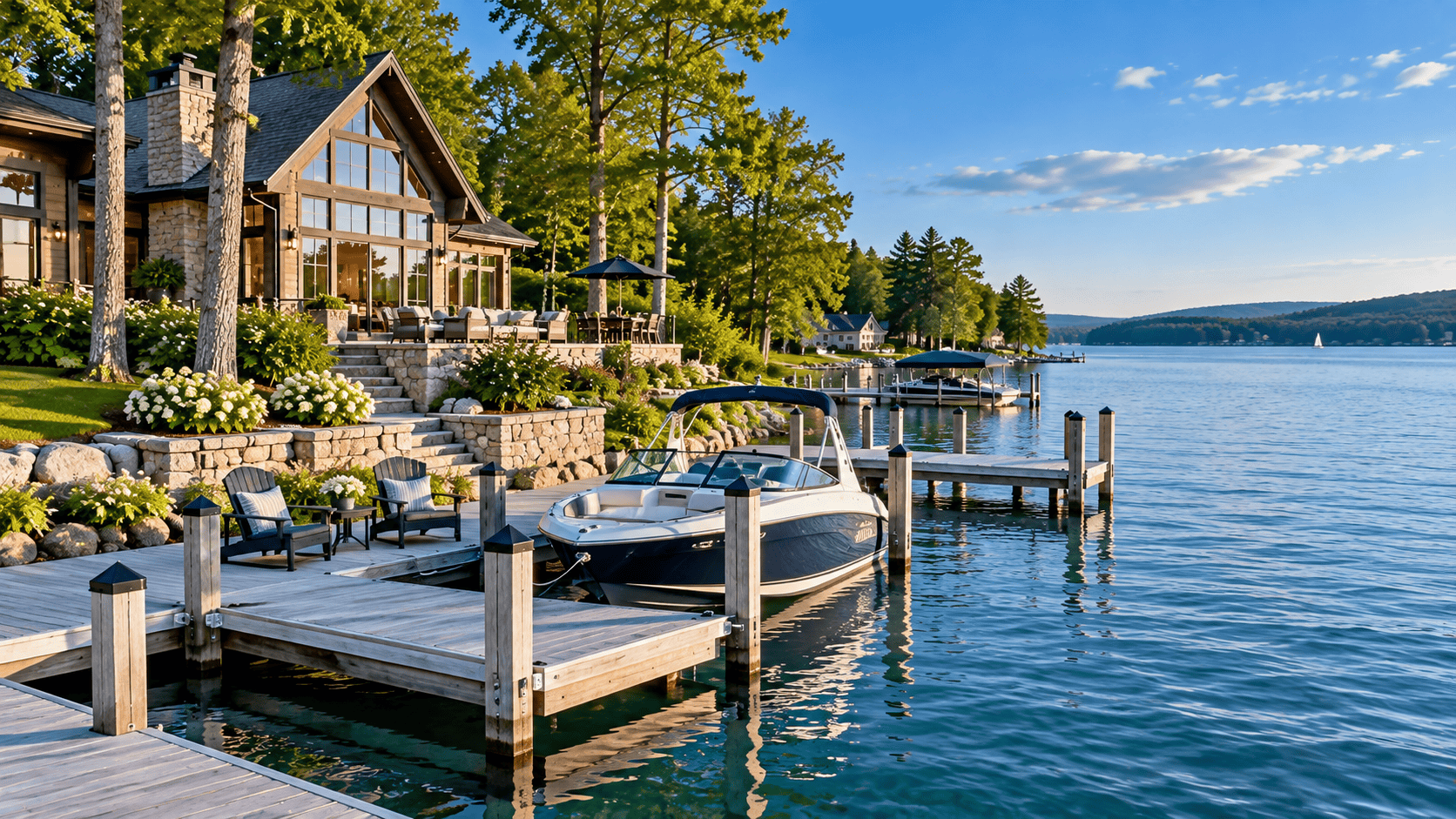
A private dock isn't merely an extension of your patio; it's an intricate legal and hydrological asset that defines your entire waterfront experience. When buying a home with a boat slip across Charlevoix, Emmet, or Grand Traverse counties, you likely picture unhurried mornings and effortless departures onto Lake Charlevoix or Grand Traverse Bay. Yet, beneath that idyllic lifestyle lies justifiable caution. Discerning buyers frequently wrestle with ambiguous riparian rights, strict EGLE shoreline restrictions, and the fear of purchasing a slip that can't accommodate their vessel during low-water cycles.
You shouldn't have to second-guess the ground beneath your keel. In this guide, you'll discover how to evaluate slip ownership, vessel compatibility, and waterfront regulations to secure your premier lakeside home. We explore the critical distinctions between deeded docks, licenses, and dockominiums while breaking down regional depth realities and seasonal ice safeguards. Consider this your clear roadmap to securing an extraordinary Northern Michigan property with complete confidence.
Key Takeaways
- Discover how dedicated private dockage provides effortless water access while bypassing congested municipal launches and multi-year marina waitlists.
- Master the critical legal distinctions when buying a home with a boat slip, ensuring clear title whether navigating deeded riparian frontage, dockominiums, or assigned rights.
- Accurately assess your vessel's draft, beam, and length overall against cyclical Great Lakes water level shifts to prevent costly navigational errors.
- Uncover hidden association restrictions and implement essential winter de-icing protocols to safeguard your shoreline investment from seasonal damage.
- Pinpoint premier boating enclaves across Charlevoix, Emmet, and Grand Traverse counties that offer seamless deep-water access and enduring lifestyle value.
Table of Contents
- Understanding the True Lifestyle and Asset Value of a Private Boat Slip
- Navigating Legal Ownership: Deeded Slips, Dockominiums, and Assigned Rights
- Evaluating Technical Specifications: Matching Slip Dimensions to Your Vessel
- Essential Due Diligence Checklist for Prospective Slip Homeowners
- Locating Premier Waterfront Communities Across Northern Michigan
Understanding the True Lifestyle and Asset Value of a Private Boat Slip
Securing private mooring transforms how you experience Northern Michigan's premier waterways. When buying a home with a boat slip, you acquire far more than waterfront real estate; you secure immediate access to Lake Charlevoix, Walloon Lake, or Grand Traverse Bay. Instead of negotiating congested public launches or languishing on multi-year municipal marina waitlists, your vessel rests steps from your living room, poised for instant departure whenever the open water calls.
To better understand how slip ownership integrates with residential property acquisitions, watch this practical overview:
The Daily Convenience of Direct Water Mooring
Owning a dedicated slip eliminates the logistical friction that so often dampens a day on the lake. You bypass trailer hitching, steep launch ramps, and highway hauling altogether. Stocking the galley becomes as straightforward as carrying a cooler from your kitchen to the deck, allowing morning coffee to drift effortlessly into an offshore cruise. Beyond daily comfort, understanding dock types and shoreline configurations ensures your craft remains protected against seasonal chop, creating a safe, stable platform for effortless guest embarkation at sunset.
Investment Resale Value and Waterfront Market Premiums
From an equity standpoint, verified dock privileges serve as a powerful asset protector in the regional luxury market. Shoreline structure approvals face strict environmental scrutiny across Charlevoix, Emmet, and Grand Traverse counties, creating enduring physical scarcity that insulates property values. Discerning purchasers consistently filter their search for waterfront lifestyle homes for sale by dock availability. By buying a home with a boat slip already permitted and established, you bypass extensive regulatory delays while securing a property asset that commands lasting appreciation.
Navigating Legal Ownership: Deeded Slips, Dockominiums, and Assigned Rights
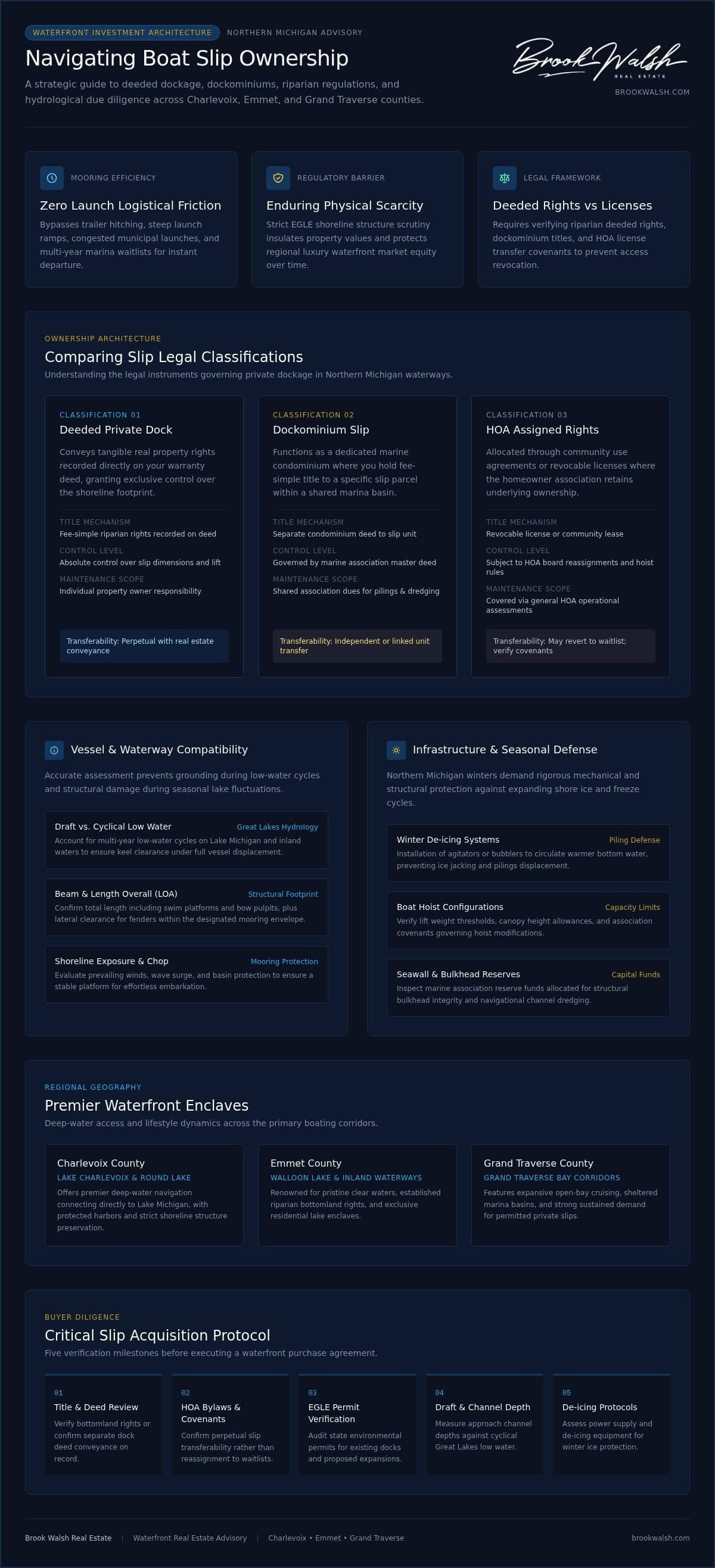
Slip rights in Northern Michigan are not created equal. When buying a home with a boat slip, assuming the physical structure automatically transfers with the real estate deed is a precarious mistake. Boating privileges exist across a spectrum of legal instruments, ranging from fee-simple riparian shoreline to revocable community licenses and condominium sub-regimes. Unraveling these distinct classifications protects your lifestyle investment before you reach the closing table.
Deeded Private Docks vs. Community HOA Assigned Slips
A deeded private dock conveys tangible real property rights recorded directly on your warranty deed, granting absolute, exclusive control over your mooring footprint. In contrast, many residential enclaves across Charlevoix and Emmet counties allocate docks through assigned use agreements or revocable licenses. Under a license, the association retains underlying ownership; the board can alter slip dimensions, reassign dock positions based on seniority, or prohibit specific boat hoist configurations. Always inspect the transferability covenants in the association bylaws to confirm that slip privileges convey perpetually rather than reverting to a community waiting list.
Understanding the Dockominium Structure
A dockominium functions as a dedicated marine condominium, where you hold fee-simple title to a specific slip parcel within a protected basin while sharing ownership of common elements. Owners pay routine dues that support collective reserve funds for channel dredging, structural piling maintenance, and harbor utility systems. When considering this arrangement alongside condominium lifestyle homes for sale, thoroughly review the entity's financial reserves to avoid unexpected capital assessments for bulkheads or seawall repairs.
Riparian Rights and Michigan Waterway Regulations
Riparian doctrine in Michigan governs private bottomland rights for waterfront parcels. On inland waters like Walloon Lake or Lake Charlevoix, riparian owners typically hold title out to the thread of the lake, subject to public navigation rights. Along the Great Lakes shorelines of Grand Traverse Bay, private ownership stops at the Ordinary High Water Mark, with bottomlands held in public trust. Placing permanent docks, boat hoists, or rock revetments requires strict compliance with Michigan's Great Lakes construction permits under state environmental statutes. Partnering with a dedicated regional advisor ensures your dock configuration aligns with both local township zoning and state natural resource laws.
Evaluating Technical Specifications: Matching Slip Dimensions to Your Vessel
Precision is essential when aligning a property's marine infrastructure with your watercraft. While a dock may look generous during a gentle summer walkthrough, operational compatibility hinges on strict hydrographic and structural data. When buying a home with a boat slip, you must evaluate three core vessel metrics against the dock footprint: length overall (including swim platforms and bow pulpits), total beam width with adequate fender clearance, and deep-keel or propeller draft under variable regional water baselines.
Water Depth Dynamics, Beam Width, and Channel Clearance
Freshwater depths across Northern Michigan do not remain static. Lake Michigan-Huron water levels cycle over multi-year environmental periods, with the forecasted mean water level settling near 176.54 meters (579.20 feet IGLD 1985). A slip showing four feet of depth today might leave a twin-engine cruiser grounded during a low-water cycle. In bays and connecting inland channels throughout Grand Traverse and Emmet counties, you must measure approach channel depth at low-water datum points. Verify bridge clearances, turning basins, and shallow shoals before finalizing purchase terms.
Dock Construction Quality, Shore Power, and Mechanical Lifts
Structural integrity determines how securely your dock holds your vessel through relentless wave action. Inspect piling stability, timber cribbing, framing resilience, and adherence to established federal marine construction standards to gauge overall craftsmanship. Modern vessels require clean, dedicated electrical service. Check that shore power pedestals deliver sufficient amperage, whether 30-amp or 50-amp, to maintain battery systems and onboard climate controls without tripping breakers.
If the slip features a mechanical boat lift, match the manufacturer capacity against your fully fueled vessel displacement, factoring in full water tanks and gear. Buying a home with a boat slip equipped with an undersized hoist leads to mechanical failure, leaving your craft vulnerable to surging waves.
Essential Due Diligence Checklist for Prospective Slip Homeowners
Rigorous due diligence separates a rewarding shoreline lifestyle from a costly navigational headache. A physical dock structure represents only the surface of your obligations. When buying a home with a boat slip, prospective owners must inspect community governance, plan for harsh winter freezing cycles, and confirm environmental compliance before committing capital.
Association Covenants, Subleasing, and Usage Restrictions
Homeowners association bylaws frequently harbor stringent limitations that catch uninformed purchasers off guard. Never assume your slip accommodates any recreational vessel in your fleet. Review governing documents specifically for:
- Vessel type bans, such as outright prohibitions against personal watercraft, wake-surf boats, or commercial charters
- Restrictions on visiting guest watercraft and overnight mooring limits
- Strict bans against subleasing your slip to non-residents or linking slip usage to short-term rental guests
Aligning your boating goals with these regulations ensures seamless enjoyment when evaluating luxury lifestyle homes for sale across Emmet and Charlevoix counties.
Winterization Protocols, Ice Expansion, and Bubbler Systems
Northern Michigan winters bring deep freezes that transform calm bays into thick sheets of moving pack ice. Without preventative mechanics, horizontal ice expansion and vertical lake heaving can lift untreated wooden pilings straight out of the lakebed. Permanent dock systems require automated circulators or diffused-air de-icers (often termed bubblers) to keep water moving and ice-free around critical structural pilings. Removable pipe docks, by comparison, require seasonal removal each autumn and reinstallation every spring, requiring a coordinated schedule with local marine contractors.
Environmental Permitting, Seawall Conditions, and Dredging Constraints
Examine existing shoreline structures closely. Steel sheet piling and rock revetments show signs of distress through soil loss, tieback corrosion, or inward bowing. If the boat basin has accumulated silt, never assume you can simply dredge the approach channel; dredging requires rigorous permits from both local authorities and state environmental regulators. Verify historical permits with municipal offices to confirm all existing structures were legally authorized.
To evaluate potential docking properties with an experienced advisor by your side, contact Brook Walsh Real Estate for dedicated buyer representation across Northern Michigan.
Locating Premier Waterfront Communities Across Northern Michigan
Every bay and inland lake across Northern Michigan presents its own distinctive maritime personality. Finding the right setting means matching your personal boating habits with the unique hydrographic characteristics of local harbors. When buying a home with a boat slip, choosing between open big-water cruising and tranquil, inland lake recreation shapes your daily time on the water.
Charlevoix, Emmet, and Grand Traverse County Opportunities
Each county provides distinct navigational advantages for luxury property owners:
- Charlevoix County: Renowned for Round Lake and Lake Charlevoix, this corridor provides one of the finest natural harbors in the Great Lakes. A protected slip here offers calm inland cruising with direct channel transit beneath the historic bascule bridge into Lake Michigan.
- Emmet County: Harbor Springs and Petoskey anchor the deep waters of Little Traverse Bay. Known for steep drop-offs and celebrated sailing traditions, properties in these harbors easily accommodate large-displacement sailing yachts and high-performance cruisers.
- Grand Traverse County: Spanning East and West Grand Traverse Bays into Traverse City, this region offers dramatic shoreline views and clear, open-water routes. Local municipal docks maintain active slip waitlists with non-refundable application and renewal fees, underscoring the enduring value of securing private residential dock rights.
Partnering with an Experienced Northern Michigan Waterfront Advisor
Acquiring waterfront property demands a nuanced understanding of municipal setbacks, bottomland permissions, and local zoning codes. For instance, Peninsula Township in Grand Traverse County enforces strict limits on the number of boat hoists permitted for specific dock designs. An established local specialist guides you past these regulatory hurdles, pinpointing private enclaves and pocket listings before they reach public platforms.
Your vessel represents an investment in relaxation and personal escape. Brook Walsh provides the regional command and specialized market analysis necessary to secure properties that perfectly match your marine requirements. Explore refined properties with verified dock access by reviewing our curated lifestyle property searches, and find a private sanctuary designed for effortless northern living.
Chart Your Course to Exceptional Waterfront Living
Acquiring shoreline property isn't merely about finding luxury architecture; it's about claiming an effortless gateway to Northern Michigan's most treasured waters. When buying a home with a boat slip, aligning clear deeded title, verified channel depths, and proactive winterization safeguards ensures that your private dock serves as an enduring sanctuary rather than an unforeseen complication. With the proper due diligence, morning departures and spontaneous sunset cruises become the effortless rhythm of your daily life.
Every harbor across Lake Charlevoix, Walloon Lake, and Little Traverse Bay possesses its own distinct hydrographic character and municipal zoning standards. Pairing deep regional authority with proven expertise matching luxury vessel requirements to exceptional waterfront properties, we guide you past the technical complexities of shoreline acquisitions. Contact Brook Walsh Real Estate today to discover exclusive waterfront homes with private boat slips tailored to your boating lifestyle, and begin your next chapter on the water with absolute confidence.
Frequently Asked Questions
What is the main legal difference between a deeded boat slip and an assigned slip?
A deeded boat slip conveys fee-simple real property rights recorded directly on your warranty deed, giving you perpetual, exclusive ownership that transfers automatically upon sale. An assigned slip grants a revocable license governed by community or marina association bylaws. When buying a home with a boat slip under an association, assigned rights might revert to a waitlist or require board re-approval upon title transfer, whereas deeded rights remain securely attached to the property.
Can I moor any size boat in a residential slip that comes with a home?
No, slip dimensions and environmental constraints impose strict vessel boundaries. You must account for your watercraft's beam, total length overall (including swim platforms and outboards), and low-water draft. In communities around Lake Charlevoix, Petoskey, or Harbor Springs, local zoning or HOA covenants often cap overall vessel length or forbid specific watercraft like commercial charters. Always confirm channel depth and turning radius clearances before bringing your vessel home.
How do winter freeze conditions impact boat slips and docks in Northern Michigan?
Subzero winter temperatures form thick shelf ice that expands horizontally and shifts with changing winds. This ice heaving exerts tremendous pressure against permanent pilings, potentially jacking crib docks out of the lakebed. Waterfront homeowners protect permanent structures by deploying automated diffused-air de-icing systems to maintain open water around pilings. Alternatively, seasonal pipe docks in bays around East Jordan or Boyne City must be dismantled and pulled ashore each autumn.
Are there restrictions against renting out my private boat slip to a third party?
Yes, significant restrictions frequently apply depending on municipal zoning and neighborhood covenants. While riparian owners on private inland parcels may have greater flexibility, many associations in Charlevoix and Emmet counties explicitly prohibit leasing slips to non-residents. Local township ordinances also regulate commercial marina activity on residential shorelines. If rental income is part of your investment strategy, review municipal zoning and association declarations carefully to ensure third-party slip rentals are permitted.
What maintenance responsibilities come with owning a home with a private dock?
Owning a private dock involves continuous structural upkeep and seasonal preservation. Homeowners must inspect timber framing, hardware corrosion, and electrical shore power pedestals regularly. In places like Boyne City and Harbor Springs, maintenance includes deploying winter de-icers, removing temporary ramps before freezes, and servicing mechanical boat lifts. You should also monitor shoreline seawalls and riprap revetments for erosion or settling, ensuring the approach basin remains safe, functional, and fully operational year after year.
Can I add a mechanical boat lift or expand an existing dock after purchasing?
Adding a mechanical lift or expanding dock square footage is not guaranteed and requires regulatory approvals. In Northern Michigan, modifications below the Ordinary High Water Mark must comply with Michigan Department of Environment, Great Lakes, and Energy (EGLE) guidelines. Local township zoning in places like Charlevoix or Peninsula Township also limits hoist quantities and dock extensions. Always verify bottomland permissions and permit histories before buying a home with a boat slip if modifications are planned.
How do fluctuating lake levels affect home values with boat slips?
Lake levels across Lake Michigan and interconnected inland waterways shift naturally over multi-year cycles. Properties with deep-water access that maintain navigable drafts during low-water eras command exceptional market premiums and retain strong investment equity. Conversely, shallow bays that turn unusable during cyclical lows face dampened buyer interest. Slips engineered with adaptable floating systems or established dredged channels provide superior asset protection against cyclical Great Lakes hydrological swings.
Posted by Brook Walsh onEnjoy this blog post? Click here to subscribe for updates
Leave A Comment